
 A
A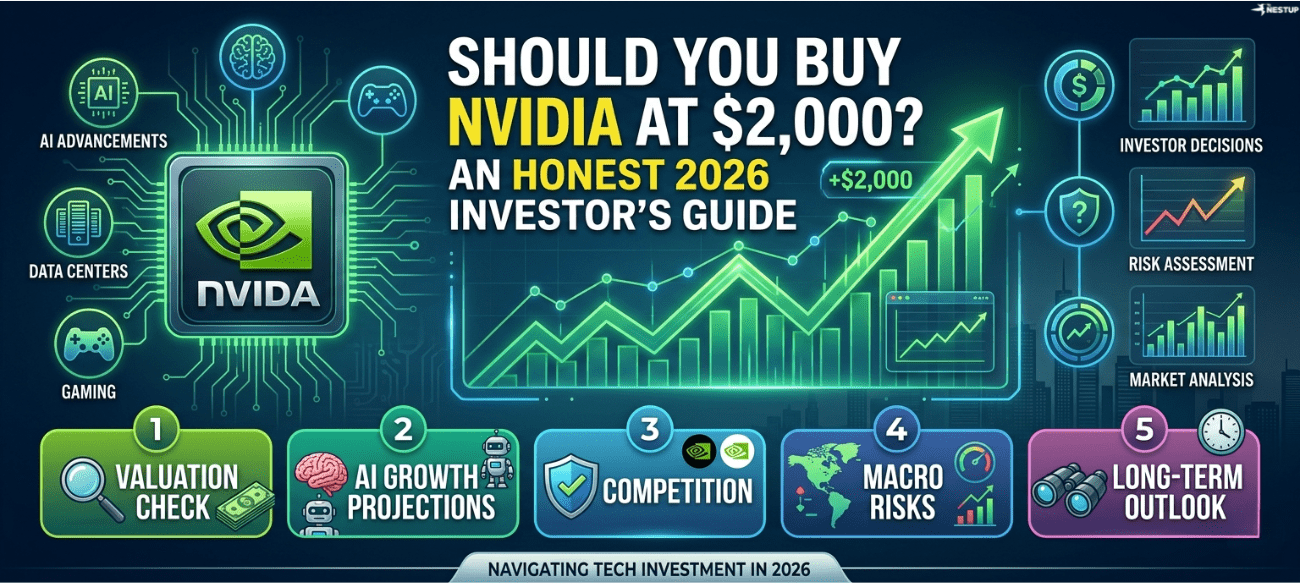
Nvidia has become one of the defining companies of the artificial intelligence era. Its GPUs power the majority of large-scale AI training and inference workloads used by cloud providers, enterprises, research institutions, and governments. As AI investment continues to accelerate, Nvidia sits at the center of a rapidly expanding ecosystem.
Yet success alone does not automatically make a stock a compelling investment.
For investors evaluating Nvidia around a hypothetical $2,000 share price (or its equivalent market capitalization after stock splits), the real question is whether the company's future earnings can justify increasingly ambitious market expectations. This analysis examines Nvidia's financial performance, competitive position, valuation, and long-term risks using publicly available financial data, company disclosures, and industry research.
Nvidia is no longer simply a graphics chip manufacturer. Over the past decade, the company has evolved into a full-stack accelerated computing and artificial intelligence platform that supplies the hardware, networking, software, and development tools powering modern AI infrastructure.
Its business now extends far beyond gaming GPUs. Nvidia designs high-performance graphics processing units (GPUs), AI accelerators, networking technologies, enterprise software, and complete AI systems used by hyperscale cloud providers, governments, research institutions, and enterprises worldwide. The company's platforms support a broad range of workloads, including generative AI, large language models (LLMs), scientific computing, robotics, autonomous vehicles, healthcare, and digital twins.
Rather than selling individual chips alone, Nvidia increasingly delivers integrated AI infrastructure. Its latest Blackwell architecture combines GPUs, high-speed NVLink interconnects, networking hardware acquired through Mellanox, CUDA software, AI libraries, and enterprise support into complete computing platforms designed for large-scale AI deployment. This integrated approach has transformed Nvidia from a semiconductor vendor into one of the foundational technology providers of the AI economy.
By 2026, the transformation of NVIDIA is complete. The company that once lived and died by the refresh cycles of teenage gamers has effectively. Nvidia has become one of the most important suppliers of AI infrastructure worldwide, providing hardware, networking, and software platforms that underpin many large-scale AI deployments. It is no longer just a chipmaker, it is a comprehensive AI infrastructure platform an inescapable architecture of networking, proprietary libraries, and Blackwell systems that power the modern world.
Yet, for the investor staring at a $2,000 share price, a profound dilemma has emerged. We are no longer debating whether NVIDIA is a "good company" its $100 billion-plus in annual data center revenue has settled debate. The real question is whether any organization, regardless of its dominance, can ever grow fast enough to satisfy the market’s extreme expectations. At this altitude, are you buying the next decade of innovation, or are you simply paying a premium for a success story that has already been told?
The Ghost in the Machine: Why CUDA is the Real Monopoly
Silicon Valley is littered with the corpses of "NVIDIA killers" hardware startups that claimed to offer more teraflops per watt. But these competitors often miss the point. NVIDIA’s true hegemony isn’t etched in silicon; it is written in code.
As of 2026, NVIDIA still commands a staggering 75–85% of the AI accelerator market. This dominance is protected by an invisible moat: the CUDA software tools. For over a decade, CUDA has been the default language of AI research and enterprise deployment. This has created a level of technical inertia that makes switching hardware feel less like a simple upgrade and more like a heart transplant. As the industry reality dictates:
"Switching away from NVIDIA hardware often requires rewriting workflows, retraining teams, and adapting software stacks."
This friction means that even when a competitor offers a cheaper or faster chip, the "total cost of ownership" for an enterprise remains lower with NVIDIA. The ecosystem is calcified; the developers are trained, the libraries are optimized, and the risk of moving away is simply too high for most CTOs to stomach.
The Customer-Competitor Paradox: The Rise of Custom Silicon
However, even the strongest moat can be flanked. NVIDIA faces a unique existential threat: its most profitable customers are also its most motivated rivals. The "hyperscalers" the very companies driving NVIDIA’s historic revenue are desperately trying to break their dependency on the "NVIDIA tax."
While NVIDIA’s Blackwell systems are ramping globally to meet insatiable demand, companies like Alphabet, Amazon, and Microsoft are funneling billions into internal hardware programs. They aren't looking to sell these chips to the public; they are looking to run their own massive inference workloads at a fraction of the cost. The primary weapons in this silent revolt include:
- Google TPUs (Tensor Processing Units)
- Amazon Trainium
- Microsoft Maia
Furthermore, the traditional competitive landscape is finally catching up. Advanced Micro Devices (AMD) has seen its data center revenue surge as its EPYC CPUs and Instinct accelerators gain traction. Perhaps most tellingly, industry titans like Meta and OpenAI have begun actively testing AMD hardware to diversify their supply chains. NVIDIA isn't being dethroned overnight, but its pricing power is finally facing a ceiling.
Revenue Side of NVIDIA
Nvidia's financial profile has changed dramatically as AI infrastructure spending has accelerated.
For fiscal year 2026, Nvidia reported record revenue of approximately $215.9 billion, representing 65% year-over-year growth. The overwhelming majority of that growth came from the Data Center segment, which generated approximately $193.7 billion in revenue around 90% of total company sales. This business includes AI GPUs, networking products, DGX systems, and complete AI infrastructure deployed by cloud providers and enterprise customers.
The remaining revenue is generated from several smaller but strategically important segments:
| Business Segment | Primary Products | Strategic Importance |
|---|---|---|
| Data Center | Blackwell & Hopper GPUs, NVLink, InfiniBand networking, DGX systems | Core growth engine driven by AI infrastructure demand |
| Gaming | GeForce RTX GPUs | Mature business that continues to generate significant cash flow while maintaining Nvidia's leadership in PC graphics |
| Professional Visualization | RTX workstation GPUs and enterprise visualization platforms | Supports engineering, simulation, media production, and digital twins |
| Automotive & Robotics | DRIVE autonomous driving platform, Jetson edge AI modules | Long-term growth opportunity in autonomous vehicles and industrial AI |
| OEM & Other | Embedded products and legacy solutions | Small but diversified revenue contribution |
This shift illustrates how Nvidia has evolved from a consumer graphics company into an enterprise infrastructure business. While gaming established the company's GPU leadership, AI data centers now account for the vast majority of its revenue and earnings
Nvidia's AI Ecosystem
One of Nvidia's greatest competitive strengths is that it does not compete solely on hardware performance. Instead, it has built a tightly integrated ecosystem that combines silicon, networking, software, and developer tools into a unified AI platform.
The ecosystem consists of several interconnected layers:
- AI Compute: Blackwell and Hopper GPUs optimized for AI training and inference.
- Networking: NVLink, NVSwitch, Spectrum Ethernet, and Quantum InfiniBand technologies that enable thousands of GPUs to operate as a single AI supercomputer.
- Software Platform: CUDA, TensorRT, cuDNN, NCCL, and hundreds of optimized AI libraries that accelerate application development.
- Enterprise Software: Nvidia AI Enterprise provides commercially supported software, security updates, and optimized AI frameworks for corporate deployments.
- Reference Systems: DGX servers and DGX Cloud offer integrated AI infrastructure that reduces deployment complexity for enterprises.
- Developer Community: Millions of developers, researchers, universities, startups, and software vendors build applications using Nvidia's programming model, creating strong ecosystem network effects.
Because these components are designed to work together, customers benefit from optimized performance, easier deployment, and lower operational risk compared with assembling infrastructure from multiple vendors. This ecosystem approach has become a key differentiator as organizations increasingly deploy AI at enterprise scale.
The Geopolitical Blind Spot: A Zero-Sum Game in China
One of the most significant risks to the $2,000 valuation is the "China Wild Card." While the AI boom feels global, NVIDIA has effectively been excised from one of its largest potential markets. US export restrictions have not just hindered growth; they have caused a market share collapse that would be fatal to any other company.
The severity of this shift cannot be overstated. Even the company’s leadership has had to face this reality head-on:
"Jensen Huang himself acknowledged NVIDIA’s China AI market share effectively fell to zero in some segments because of export controls."
While NVIDIA has managed to backfill this lost revenue with Western demand, the loss of China is a permanent structural headwind. As China aggressively localizes its semiconductor infrastructure to support domestic alternatives, NVIDIA loses a massive long-term growth lever. At a $2,000 share price, there is no longer a margin for such geopolitical errors.
The Sovereign Mandate: AI as National Defense
If there is a reason to believe the party isn't over, it lies in the shift from "corporate spending" to "strategic national infrastructure." In 2026, AI capability is no longer viewed as an optional R&D expense. It has become a matter of national security and survival.
Cloud providers fear falling behind, governments fear losing geopolitical leadership, and enterprises fear obsolescence. This "geopolitical fear" creates a sustained spending pressure that defies traditional economic cycles. When AI is viewed as the new electricity, the provider of the "transformers" and "grids" in this case, NVIDIA enjoys a level of demand that is essentially mandated by the state of the world. This is what fuels the $100 billion data center revenue: a collective, global panic to ensure one isn't left behind in the intelligence age.
Competitive Moat
Nvidia's competitive advantage extends well beyond its leadership in GPU design. Its moat is built on multiple reinforcing advantages that make it difficult for competitors to replicate the company's position.
CUDA Software Platform.
CUDA remains the industry's most widely adopted GPU computing platform for AI development. Thousands of AI frameworks, research projects, and enterprise applications have been optimized for CUDA over more than a decade. Migrating away often requires rewriting software, validating new workflows, retraining engineering teams, and re-optimizing applications creating significant switching costs for customers.
Integrated Hardware and Software.
Unlike competitors that primarily sell chips, Nvidia offers a vertically integrated platform that includes GPUs, networking, software libraries, AI frameworks, enterprise support, and complete AI systems. This integration simplifies deployment while improving performance and reliability.
Scale and Ecosystem Effects.
Nvidia works closely with nearly every major cloud provider, leading AI model developer, enterprise software company, and systems integrator. The widespread adoption of its platform encourages software developers to optimize first for Nvidia hardware, reinforcing a powerful ecosystem advantage.
Engineering and Execution.
The company has consistently delivered new GPU architectures including Hopper and Blackwell while expanding into networking, enterprise AI software, and large-scale AI infrastructure. Its ability to execute across multiple technology layers has allowed it to capture a larger share of AI spending than companies focused on chips alone.
However, these advantages are not unassailable. Large cloud providers including Google, Amazon, and Microsoft continue investing in proprietary AI accelerators, while competitors such as AMD are expanding their AI hardware portfolios. As a result, Nvidia's long-term leadership will depend not only on maintaining superior hardware performance but also on preserving the strength of its software ecosystem and developer community.
Priced for Perfection: The Four-Question Litmus Test
NVIDIA is no longer priced like a semiconductor stock; it is priced like the high-margin utility of the entire AI economy. For the reasonable investor, the decision to hold or buy at these levels comes down to a four-part framework:
- Will Infrastructure Spending Continue Rising? Long-term value requires AI capital expenditure to explode for another decade without a material "air pocket" or slowdown.
- Can NVIDIA Maintain These Margins? The current hardware margins are historically anomalous. Can they survive the combined pressure of AMD, custom hyperscaler ASICs, and the loss of the China market?
- Is CUDA’s Moat Still Durable? The investment thesis holds only as long as developers remain locked into the NVIDIA software ecosystem. If open-source alternatives provide an "easy button" for migration, the moat evaporates.
- Are You Buying Growth or Momentum? You must distinguish between a deep conviction in the business model and the psychological urge to buy a stock because the line has gone up.
Should I buy Nvidia at $2,000?
Nvidia is a dominant AI infrastructure company, but at $2,000 the stock is priced for near-perfect execution. The key issue is not whether the business is strong it is but whether it can keep growing fast enough to meet extreme expectations. For many investors, that makes the decision more about valuation risk than company quality.
Why is CUDA such a big deal for Nvidia?
CUDA is Nvidia’s software ecosystem and the main reason its moat is so strong. It has become the default language for AI research and enterprise deployment, which makes switching to another chip provider costly and disruptive. Companies often face rewriting workflows, retraining teams, and adapting software stacks if they move away.
What risks do hyperscalers like Google and Amazon pose to Nvidia?
Hyperscalers are major Nvidia customers, but they are also building their own chips to reduce dependence on Nvidia. Google TPUs, Amazon Trainium, and Microsoft Maia are designed to handle massive workloads at lower cost. This creates pressure on Nvidia’s pricing power, even if it remains the market leader.
How does China affect the case for buying Nvidia?
China is a major structural risk because US export restrictions have sharply reduced Nvidia’s access to that market. The article says Nvidia’s China AI market share fell to zero in some segments, and that lost growth is hard to replace long term. At a very high share price, that geopolitical headwind matters more.
What is the main bull case for Nvidia in 2026?
The bull case is that AI spending has become strategic infrastructure, not just normal corporate investment. Governments, cloud providers, and enterprises fear falling behind, which keeps demand for Nvidia systems strong. That sustained pressure supports its huge data center revenue and reinforces the idea that AI is becoming as essential as electricity.
How should a reasonable investor approach Nvidia now?
A reasonable investor should treat Nvidia as a core but not all-in position. The article recommends strict position sizing, pairing it with semiconductor ETFs to reduce single-stock risk, and trimming after major parabolic rallies. The idea is to benefit from Nvidia’s strength without assuming it can stay perfectly dominant forever.
The Rational Investor’s Playbook for 2026
As we navigate the remainder of 2026, the most sophisticated players are moving away from an "all-in" mentality. Instead, "reasonable" investors are practicing strict position-sizing discipline. This involves holding NVIDIA as a core part of a broader AI portfolio, often pairing it with semiconductor ETFs to mitigate single-stock risk, and crucially trimming positions after major parabolic rallies to lock in gains.
NVIDIA is a rare beast: a company generating genuine, massive earnings that also happens to be the center of a speculative mania. In the short term, the stock is a slave to sentiment and the narrative of the AI frontier. In the long term, it will be strictly earnings-driven.
The bull case is supported by undeniable fundamentals and a software moat that remains the envy of the tech world. But at $2,000, the market isn't just asking NVIDIA to succeed it is asking it to remain the most important company in the world, perfectly, for the foreseeable future. The higher the expectations, the smaller the margin for disappointment becomes.
Disclaimer: This article is for informational purposes only and is not financial advice.