
 N
N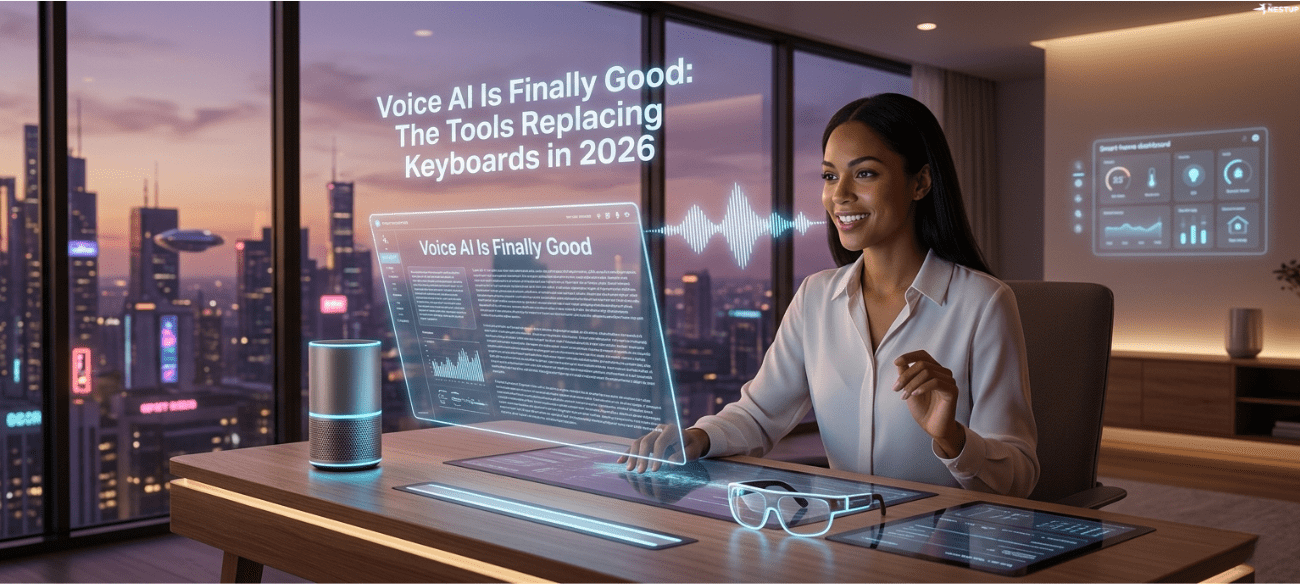
For decades, we’ve endured a love-hate relationship with our keyboards. We typed because we had to—not because it was natural. Voice-to-text was a perpetual "technology demo" that promised liberation but delivered gibberish, bizarre punctuation, and the crushing friction of constant correction.
By 2026, we have crossed the Rubicon. Voice AI has transitioned from a shaky gimmick into a workflow-changing powerhouse. We are witnessing a wholesale migration toward "thinking out loud," a cognitive shift where the laptop lid stays open, but the hands stay off the home row. The keyboard is losing its status as the default interface for creation.
1. The 2026 Tipping Point: Utility Over Gimmicks
The catalyst for this revolution was the arrival of transformer-based speech recognition, specifically the Whisper-style architectures. Unlike the rigid, rule-based systems of the past, these models were trained on massive, messy, real-world datasets.
We’ve reached a point where accuracy is so high that editing a transcript is objectively faster than typing from scratch. These systems don't just "hear"; they understand context, handling:
- Over 100 languages and complex multilingual "code-switching" mid-sentence.
- Heavy regional accents and varied speaking speeds.
- Dense technical vocabulary and industry-specific jargon.
- Chaotic background noise that would have paralyzed 2022-era tech.
"The important thing is this: voice AI no longer feels futuristic. It feels practical."
This reliability allows founders to draft complex strategy memos while walking and developers to dictate code comments without breaking their flow. When you can "think out loud" and see your ideas structured perfectly on screen, the mechanical act of typing begins to feel like a bottleneck.
2. Privacy at the Edge: The Rise of Local-First AI
A visionary strategist looks at more than just accuracy; they look at the infrastructure of trust. We are seeing a massive shift toward "local-first" AI through tools like MacWhisper and Superwhisper. This is the democratization of high-end processing, moving the heavy lifting from the cloud directly to the user’s device.
This shift solves the three traditional "deal-breakers" of voice adoption:
- Privacy: For medical, legal, and journalistic workflows, data never leaves the machine, eliminating the security risks of cloud dictation.
- Latency: Local processing removes the "upload-and-wait" delay, making the interface feel like an extension of the mind.
- Reliability: Work continues in the field or in the air, independent of an internet connection.
There is a strategic trade-off, of course: running these powerful models requires robust hardware and can lead to higher battery consumption. But for the modern professional, the cost of a charge is a small price to pay for total data sovereignty.
3. The Productivity Powerhouse: AI Formatting Layers
The true "killer app" in this space isn't just transcription—it's the intelligence layer applied afterward. Tools like Superwhisper have revolutionized the workflow by moving beyond raw text. They utilize custom AI formatting modes that bridge the gap between spoken word and professional output:
- Coding Mode: Automatically formats technical terms and syntax correctly.
- Documentation Mode: Structures spoken thoughts into hierarchical paragraphs and bullet points.
- Email Mode: Instinctively rewrites rough, spoken drafts into polished, professional prose.
This is where voice AI finally replaces the keyboard. We are no longer just dictating; we are "prompting" our documents into existence. The AI handles the filler words and the "umms," leaving the creator to focus solely on the high-level architecture of their ideas.
4. Breaking the 200ms Barrier: From Tools to Agents
In the realm of human-AI interaction, responsiveness is the prerequisite for agency. Technical leaders like Deepgram have pushed the limits of streaming transcription to under 200 milliseconds.
This isn't just about speed; it’s about the psychological shift from using a "transcription tool" to interacting with a "live agent." When latency exceeds 500ms, the conversation feels mechanical and forced. At sub-200ms, the delay vanishes, allowing AI to behave like a real conversational partner.
"The entire pipeline increasingly behaves like a real conversational system instead of a simple transcription tool."
This near-instant recognition is the foundational layer for the next generation of AI assistants—agents that can listen, reason, and respond in the flow of a natural human conversation.
5. Emotional Inflection and the Social "Final Boss"
The sterile nature of the keyboard is most apparent when compared to the emotional nuance of modern speech synthesis. Thanks to innovators like ElevenLabs, AI no longer sounds like a robot. It incorporates human pacing, natural breathing, and emotional inflection.
An AI can now deliver bad news with empathy or a project update with enthusiasm. This nuance makes voice a far more expressive medium for communication across dozens of languages.
However, we must address the "Final Boss": social friction. Typing is private; speaking is public. The awkwardness of dictating in a quiet café or a crowded train remains the last hurdle. The solution is already arriving in the form of:
- Wearable input devices that allow for subtle, low-volume interaction.
- Noise-isolating microphones that strip away ambient chatter.
Just as we once looked askance at people wearing wireless earbuds in public, we are fast approaching a world where "thinking out loud" to a digital companion is a normalized, daily behavior.
Conclusion: The Hybrid Future.
The keyboard is not headed for extinction, but its reign as the "default" is over. We are entering a hybrid era of productivity. Your voice will handle the heavy lifting—the creation, the brainstorming, and the rapid drafting. Your keyboard will remain the tool of choice for the "last mile": precision editing, complex coding syntax, and quiet refinement in shared spaces.
The friction is vanishing. The interface is becoming invisible. As you look at your schedule for tomorrow, ask yourself: Which task will you "speak" into existence instead of typing?