
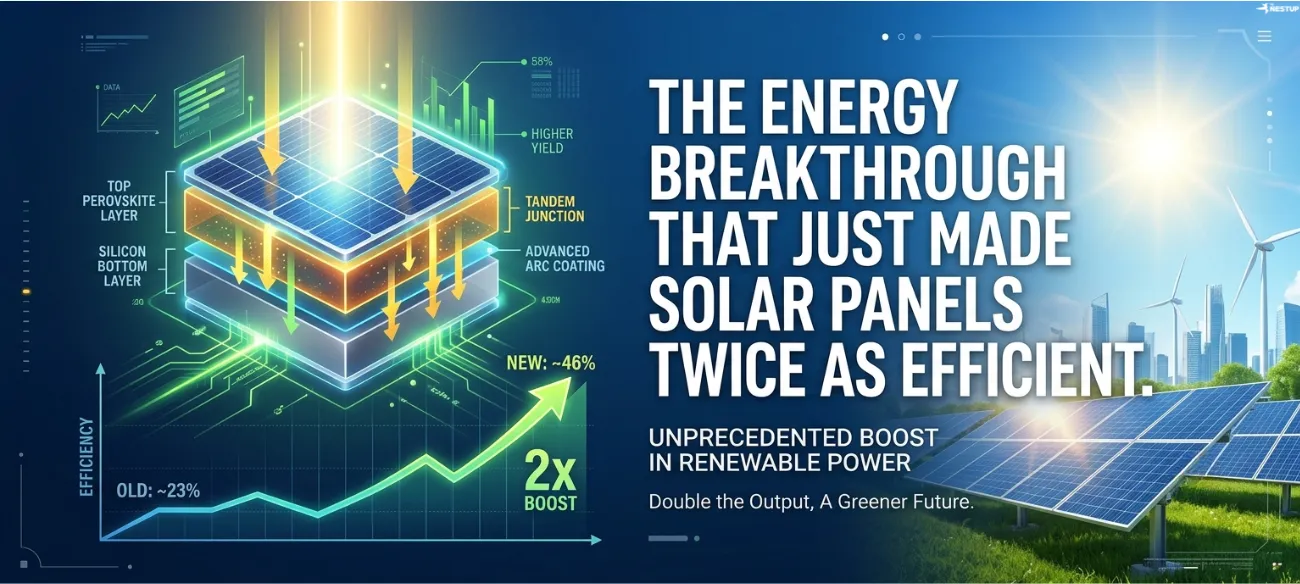
The Hook: Breaking the 29% Barrier
For decades, the solar industry has been remarkably stagnant, tethered to a single material that has finally met its match. While silicon has been the reliable workhorse of the green energy movement, it has hit a physical wall. Most residential panels currently installed on rooftops convert a mere 20% to 22% of sunlight into usable electricity. Even under perfect laboratory conditions, silicon faces a hard theoretical limit—known to physicists as the Shockley-Queisser limit—of approximately 29%.
We are no longer looking at incremental gains. The emergence of "tandem cells" represents a structural leap that is finally smashing through this decades-old ceiling. By integrating a "miracle material" called perovskite with traditional silicon, the industry is moving from a period of calculated stagnation into a new era where efficiency benchmarks of 30% to 35% are becoming the new baseline.
Stacking the Rainbow for Maximum Power
To understand why this technology is a game-changer, we must look at the nature of sunlight through the lens of an energy analyst. Sunlight is composed of various wavelengths, and traditional silicon is effectively "colorblind." It is highly efficient at capturing red and infrared light, but it essentially ignores the high-energy blue light at the other end of the spectrum.
Tandem cells solve this by layering materials. Perovskite, a synthetic material, can be custom-tuned to catch the blue light that silicon reflects or wastes. By stacking a thin film of perovskite on top of a silicon base, we create a multi-layered trap for photons.
"The top layer grabs the blue light, the bottom layer catches the red light, and together they squeeze significantly more electricity out of the exact same footprint."
From an engineering perspective, "stacking" is a much more elegant solution than continuing to refine silicon. We have reached a point of diminishing returns with silicon R&D, where squeezing out an extra 0.1% of efficiency costs millions. Perovskite offers a "leapfrog" opportunity, utilizing the strengths of two distinct materials to capture the full solar rainbow.
The Perovskite Revolution
Perovskite is being hailed as a miracle material because of its "tunability." Unlike silicon, which is a fixed mineral, perovskites are synthetic structures that can be chemically adjusted in a lab. This allows researchers to create "tandem-ready" manufacturing lines where the perovskite layer is optimized to perfectly complement the silicon layer beneath it.
In high-end laboratory settings, this flexibility has already pushed conversion efficiencies into the 30% to 35% range. For the energy market, the implication is profound: we can now produce significantly more power without increasing the physical size of the installation. This is a critical factor for urban environments and residential properties where roof space is the primary constraint on energy independence.
A High-Stakes Global Arms Race
The transition from academic breakthrough to industrial standard has sparked an international race between established manufacturers and nimble startups. The current landscape is defined by three major leaders:
- Oxford PV: A spinout from the University of Oxford with a factory in Germany. They were the first to ship commercial tandem modules to utility customers, currently operating at 25% efficiency with a roadmap to reach 30% by 2030.
- LONGi Solar: A Chinese industry giant that holds the current record-breaking lab efficiency of 35% for a tandem cell.
- Trina Solar: Another major Chinese player that has successfully certified an industrial-sized, mass-production-ready module at 29.2% efficiency.
The 40-Year Durability Challenge
There is, however, a significant hurdle to mainstream adoption: the "stability gap." Silicon is a remarkably tough material, often carrying warranties for 30 to 40 years of outdoor exposure. Perovskite, by contrast, is notoriously sensitive to moisture, oxygen, heat, and ultraviolet (UV) light. In its raw form, it can degrade in days.
Because of this, the industry is rolling out the technology in careful, calculated stages to build market confidence:
| Era | What's Happening | Where It's Going |
| Current State (2026) | Early Commercialization | 10-year warranties; limited strictly to large-scale industrial/utility projects. |
| The Next Push (2027–2028) | Lifespan Upgrades | Advanced coatings and chemical engineering target a 20–25 year lifespan. |
| The Vision (2030) | Mainstream Rooftops | Tandem panels become the standard, high-efficiency choice for residential homes. |
It’s Not the Panel, It’s the "Balance of System"
One of the most important insights for any energy analyst is that the solar panel itself is rarely the most expensive part of a project. The real costs lie in the "Balance of System" (BOS)—the land, the mounting racks, the copper wiring, the concrete foundations, and the manual labor required for installation.
Tandem cells revolutionize the economics of solar because they produce 30% to 40% more power in the same space. This density allows a developer to generate the same amount of electricity with one-third fewer panels, which directly reduces the amount of land, wiring, and concrete needed.
The results are transformative for the energy market:
- 10% Reduction in LCOE: This reduction in the Levelized Cost of Electricity is the "holy grail" for the industry, finally allowing solar to achieve decisive cost-competitiveness with natural gas in nearly every market.
- 12% Higher ROI: The increased energy density leads to a much faster return on investment.
- Expanded Viability: Higher efficiency makes solar viable in northern geographies or on sub-optimal roof types that were previously deemed too small to be profitable.
The Future of the Rooftop
The shift from traditional silicon to tandem perovskite cells marks the end of the era of incremental gains. We are moving toward a future where "high-efficiency" is no longer a premium niche, but the mainstream standard. As chemical engineering continues to bridge the durability gap, the 29% efficiency ceiling will soon be viewed as a historical relic.
When solar power becomes 40% more efficient and the total cost of installation drops by double digits, the math of energy changes. How will your own household’s energy consumption—and your relationship with the grid—change when your roof becomes a high-performance power plant?