
Introduction: The "10 Years Away" Myth is Dead
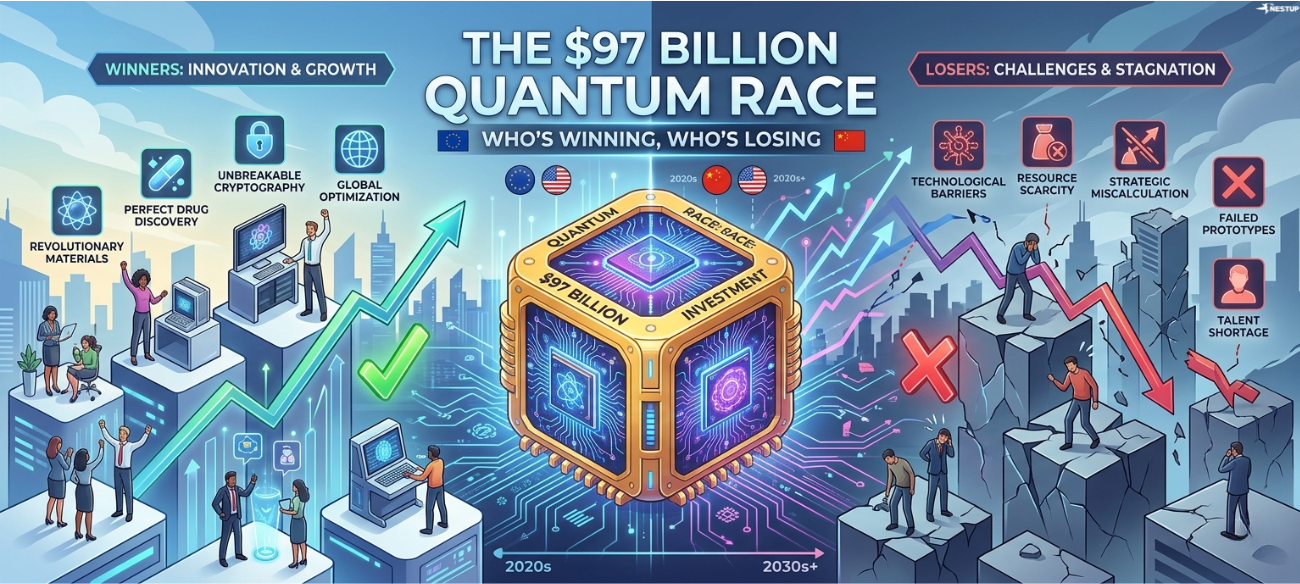
For the better part of two decades, the "quantum computer" was the tech industry’s favorite punchline—a revolutionary breakthrough that was perpetually a decade away. But as we close out the first half of 2026, the laughter has stopped. The speculative bubble of 2025 has settled into a cold, hard industrial reality. We have moved decisively past the era of "quantum supremacy" press releases and into a $97 billion global infrastructure war.
The primary question driving the current fiscal cycle isn’t whether these machines will work—it's who will own the first fault-tolerant stack and how "victory" will redefine global security. This isn't just about physics anymore; it's about who controls the next century of computational power.
Takeaway 1: The $97 Billion Infrastructure Shift
The transition from scientific curiosity to industrial cornerstone is best quantified by the capital flight into the sector. Total spending across government national programs, corporate R&D, and the public markets is now tracking toward $97 billion. This capital isn't just chasing qubits; it's building the specialized foundries, cryogenic cooling systems, and photonic interconnects required to sustain them.
The shift from "science" to "infrastructure" is the most significant marker of the industry’s maturity in 2026. We are seeing a move away from bespoke laboratory setups toward modular, repeatable systems. However, a "B-side" to this massive investment has emerged: while the money is real, the industry is increasingly realizing that useful, fault-tolerant systems remain extraordinarily difficult to scale. In 2026, we are witnessing a race where the capital is accelerating faster than the physics, creating a high-stakes "utility gap" that only the strongest players will bridge.
Takeaway 2: The Battle of Philosophies—IBM’s Ecosystem vs. Google’s Research
The 2026 landscape is dominated by two heavyweights with fundamentally different DNA. IBM remains the "Enterprise Heavyweight," leveraging its superconducting architecture—prized for its fast gate speeds—to build a systematic, modular roadmap. Their lead isn't just in hardware, but in "consistency." By providing a transparent roadmap and a deep cloud-integrated developer ecosystem, IBM has positioned itself as the safe bet for the Fortune 500.
"IBM has successfully pivoted from being a computer manufacturer to a long-term quantum infrastructure provider, prioritizing hybrid workflows and developer access over flashy, one-off experiments."
Contrast this with Google, the "Research Powerhouse." While IBM builds the pipes, Google is focused on the water. Their "Willow" architecture has become the catalyst for the current obsession with logical qubits and error correction. Google excels at pushing the theoretical boundaries of the field, focusing on foundational breakthroughs that aim to solve the high error rates inherent in superconducting systems. While their commercialization efforts feel less "industrial" than IBM's, their research prestige remains the gold standard for the field’s long-term viability.
Takeaway 3: The Public Stars and the Million-Qubit Dream
The "middle ground" of the market has become the most volatile and exciting sector in 2026. IonQ has emerged as the "Public Market Quantum Star," providing a critical alternative to superconducting qubits with its Trapped Ion architecture. While trapped-ion operations are slower, they offer significantly higher fidelity and better coherence times—a trade-off many researchers now prefer. With Q1 revenue guidance hitting the 260M–270M range and a string of aggressive acquisitions including Oxford Ionics and SkyWater Technology, IonQ is proving that there is a massive market for full-stack quantum networking.
Meanwhile, the "Billion-Dollar Dark Horse," PsiQuantum, continues its high-stakes gamble on a photonic approach. By using light instead of matter and leveraging existing silicon photonics manufacturing, they aim to bypass the cooling and scaling bottlenecks of their rivals. The appointment of industry titans like Lip-Bu Tan to their board has signaled to the street that their secretive goal of a million-qubit, error-corrected machine isn't just hype—it’s a manufacturing challenge they believe they’ve solved.
Takeaway 4: The Geopolitical Cold War in the Cloud
Quantum has officially moved from the R&D budget to the National Security budget. In 2026, the race is as much about sovereignty as it is about profit. China, led by entities like Origin Quantum, has focused its massive state funding not just on building a computer, but on a "National Secure Network" centered on quantum communications and cryptography.
Governments now treat quantum as "strategic infrastructure," comparable to the semiconductor push of the early 2020s. This "Cold War in the Cloud" is the primary reason funding has remained resilient even as the industry struggles through the "NISQ" (Noisy Intermediate-Scale Quantum) era. The fear of an adversary reaching a "cryptographic break" before a "quantum defense" is established has turned 2026 into a year of frantic state-sponsored scaling.
Takeaway 5: The Great Misconception—Quantum Won’t Replace Your Laptop
One of the most persistent myths of the early 2020s has finally been debunked: quantum computers are not general-purpose machines. You will not be running a web browser or gaming on a quantum processor. Instead, these systems are "specialized accelerators" designed to solve specific, "unsolvable" mathematical problems that classical silicon—regardless of its power—simply cannot handle.
The global economy is being reshaped by quantum’s specialization in four key domains:
- Optimization: Solving logistics and global supply chain bottlenecks that are too complex for classical clusters.
- Simulation: Modeling molecular interactions at the atomic level for drug discovery and battery chemistry.
- Cryptography: Engineering post-quantum encryption protocols to secure the world's data.
- Material Science: Developing superconducting materials and new catalysts for carbon capture.
Takeaway 6: The AI Synergy—Machines Building Machines
The most critical trend of 2026 is the total convergence of AI and Quantum. We have moved past using AI as a "use case" for quantum; today, AI is a dependency. The complexity of modern quantum processors—especially in chip calibration and real-time error correction—has far exceeded human capability.
The convergence of AI and Quantum is the primary "accelerator" for the field; we are now using classical AI models to manage the "noise" of quantum systems, effectively allowing machines to build the machines that will eventually surpass them.
AI is currently performing the "heavy lifting" of identifying and fixing qubit decoherence in microseconds, a feat that is single-handedly shortening the timeline to true fault tolerance.
Conclusion: The Race to the Error-Correction Finish Line
As we survey the $97 billion landscape of 2026, the leaderboards are clear but the final winner is not. IBM leads in ecosystem maturity; Google leads in research prestige; IonQ leads in public-market momentum; and PsiQuantum holds the most ambitious long-term architecture.
However, the "real winner" will not be the company with the most qubits, but the one that first solves the dual riddle of error correction and scalability. Until a player can run a fault-tolerant system that doesn't collapse under its own environmental "noise," the race remains wide open. The first nation or corporation to reach that finish line will hold the keys to the world’s chemistry, its financial markets, and its most guarded secrets. In 2026, the "10-year myth" is dead—and the era of quantum consequence has begun.