
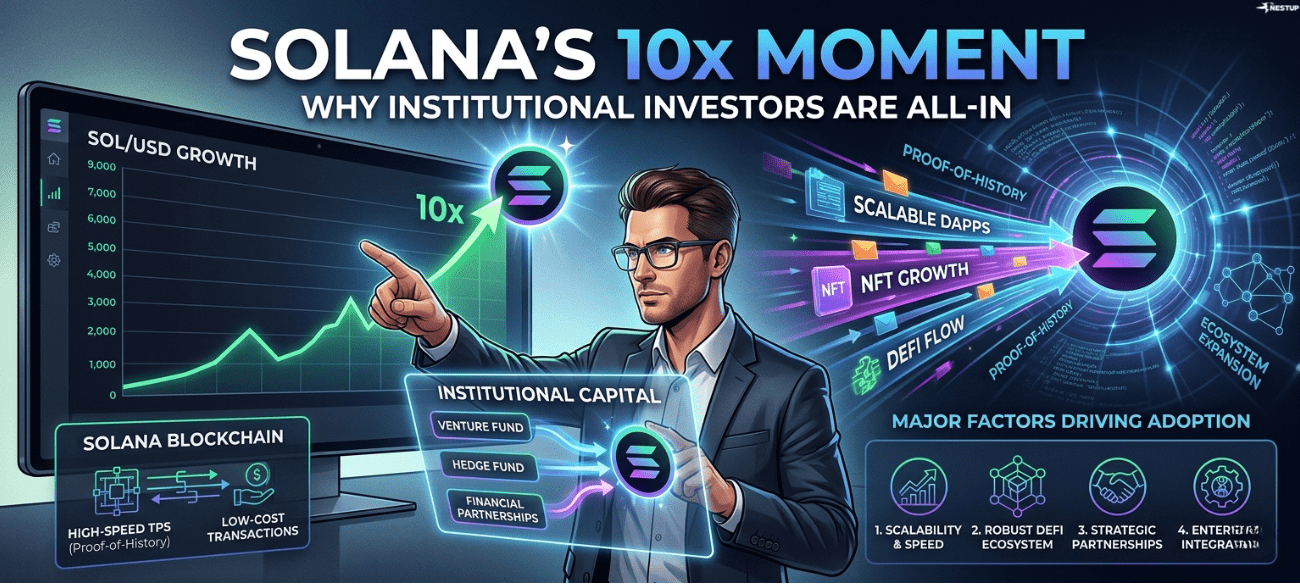
The Hook: The Evolution of a Contender In the early 2020s, Solana was often dismissed as the "Solyndra of crypto"—a venture-backed experiment prone to embarrassing outages and speculative meme coin frenzies. By 2026, the narrative has undergone a total inversion as the network matures into the "Nasdaq of decentralized rails." The world’s largest financial institutions have pivoted away from ideological debates over decentralization purity, choosing instead to prioritize transaction throughput, capital efficiency, and battle-tested reliability.
The End of the "Unreliable" Narrative (Alpenglow) For enterprise-scale applications, uptime is the only metric that truly matters; a settlement system that "goes down" is a non-starter for global finance. Institutions demand determinism—the guarantee that a transaction will execute exactly as intended without network-level delays or coordination failures.
The Alpenglow upgrade has been the catalyst for this shift, fundamentally re-engineering consensus efficiency and network responsiveness. By optimizing validator coordination and fault tolerance, Alpenglow provides the predictable infrastructure required for sophisticated on-chain treasury management and high-volume institutional settlement.
"The goal of Alpenglow is to dramatically improve Solana’s consensus efficiency and network responsiveness, strengthening the argument that the network can support enterprise-scale applications."
Stablecoins are the New Settlement Rails While retail participants chase volatility, the sophisticated institutional story is built on the back of stablecoin settlement. Solana has emerged as the preferred layer for global payment rails because its architecture handles high-frequency transfers and micro-transactions with a cost-basis that legacy systems simply cannot match.
This transition from speculation to utility is most evident in cross-border settlement and corporate treasury movement. Rather than viewing the chain as a digital casino, global banks are increasingly utilizing Solana as a high-performance settlement layer to move real-world value with near-instant finality.
The DePIN Advantage (Real-World Utility) Decentralized Physical Infrastructure Networks (DePIN) have become Solana’s "killer app" for real-world integration. These protocols leverage the blockchain to coordinate physical hardware—from wireless nodes to mapping sensors—requiring thousands of cheap micro-interactions that would be economically impossible on fragmented Layer 2 (L2) ecosystems.
Specific infrastructure types currently scaling on Solana include:
- Wireless infrastructure and 5G nodes
- Distributed compute and GPU clusters
- Global mapping and geospatial networks
- Environmental and industrial sensor networks
Monolithic Simplicity vs. Modular Fragmentation The industry remains split between Ethereum’s modular rollup strategy and Solana’s monolithic, single-chain model. However, for a Senior Strategist, the choice often comes down to operational clarity; managing assets across dozens of fragmented L2s introduces significant "bridge risk," which many institutions now view as an unacceptable security liability.
Solana’s unified liquidity and single-state machine offer a "frictionless" environment that simplifies onboarding and execution. By avoiding the user confusion and security vulnerabilities inherent in multi-chain bridges, Solana provides a cleaner, more robust architecture for institutional-grade financial products.
"Solana argues that one high-performance chain can provide better UX than many fragmented layers, providing a model that can feel operationally cleaner to large financial players."
The Move Toward Regulatory Normalization (The ETF Factor) The emergence of Solana as a candidate for a spot ETF marks a turning point in regulatory normalization. This institutional interest is sustained by a rare combination of deep market liquidity, a massive ecosystem footprint, high institutional demand, and a resilient developer base.
Crucially, the technical stability introduced by the Alpenglow upgrade has provided the necessary "safety signal" for regulators and fund managers alike. An ETF approval does more than provide a price catalyst; it validates the network as a legitimate component of the global financial system, accessible through traditional retirement and investment accounts.
Crypto is Going Mobile-First Solana’s aggressive pursuit of mobile-native experiences—through dedicated hardware and integrated wallets—is designed to capture the next billion users in emerging markets. This mobile-first strategy positions the network as the primary gateway for global remittance economies where the smartphone, not the desktop, is the center of the financial world.
Despite this momentum, the network must still navigate legitimate critiques regarding centralization. Concerns over high validator hardware requirements, network concentration, and governance influence remain a focal point for critics. Maintaining the delicate balance between high-performance utility and meaningful decentralization will be the defining challenge of the next era.
Conclusion: From Speculation to Infrastructure We have officially exited the "speculation phase" of crypto and entered the "infrastructure phase," where value is derived from utility rather than hype. Solana’s ascent reflects this shift, as the network optimizes for the extreme speed and cost efficiency required to host the next generation of internet-scale financial networks.
The Bottom Line: The winners of this cycle are no longer the most ideological, but the most functional. Success is defined by the ability to scale reliably, support real-world movement of capital, and simplify the transition for institutional finance.
Final Thought: As the global financial landscape is rewritten on-chain, will the market ultimately value the purity of decentralization, or the raw, high-performance utility of a unified digital rail?