
In the rearview mirror of 2026, the frenetic noise of the early 2020s—the neon-soaked speculation of "memecoins" and the erratic boom-bust cycles of NFTs—feels like a distant, chaotic adolescence for the digital asset industry. While the headlines were busy chasing volatility, a far more profound transformation was occurring in the shadows. Stablecoins, once dismissed as mere "crypto cash" for day traders, have quietly evolved into a $300 billion parallel digital-dollar system.
This is no longer a niche crypto experiment; it is a fundamental reconfiguration of how value moves across the globe. We have entered an era where the dollar has been unbundled from traditional ledger systems and re-coded as a high-velocity, internet-native asset.
From "Crypto Cash" to the Global Infrastructure Layer
The most significant shift in the last few years has been the transition of stablecoins from speculative side-effects into the invisible plumbing of the global economy. If the internet of the 1990s was about the movement of information, the "2026 reality" is about the movement of value at the same speed.
Stablecoins now provide the essential infrastructure layer for a dizzying array of sectors. They have become the primary settlement rails for machine-to-machine AI payments, where autonomous agents negotiate and pay for compute power in real-time. They have replaced the clunky, predatory systems of global remittances, offering instant liquidity to families across borders. From the tokenization of real-world assets like commercial real estate to the real-time settlement of international commerce, stablecoins have become the unseen wiring of the 21st century.
"Stablecoins quietly became the most important part of crypto."
This isn't just about efficiency; it's about a structural upgrade to the global economy. We are no longer waiting three days for a bank transfer to clear; we are transacting on 24/7, always-on financial rails that ignore weekends and national holidays.
The "Two-Headed Giant" and the Religion of Liquidity
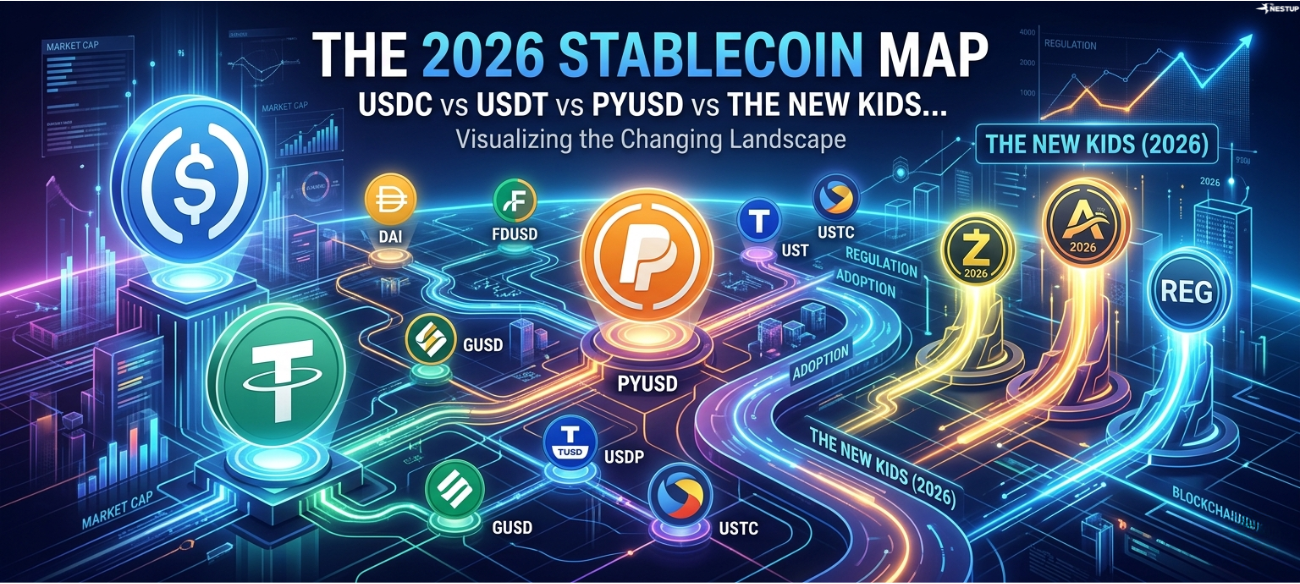
Despite an influx of new competitors, the market remains defined by an extraordinary concentration of power. Two titans—USDT and USDC—control nearly 89% of the total market share. However, their dominance is built on two very different philosophies of trust and infrastructure.
| Stablecoin | Approx. Market Cap | Primary Strength | Network Dominance |
| USDT | $189B | Liquidity King: Global availability and volume. | Tron: High-speed offshore settlement. |
| USDC | $78B | Institutional Standard: Regulatory alignment. | Ethereum & Solana: Enterprise & DeFi. |
This duopoly highlights a fundamental truth of the digital economy: network effects often trump ideological purity. USDT remains the undisputed "Liquidity King," particularly in emerging markets across Africa, Latin America, and Southeast Asia. In these regions, users don't demand an audit from a Big Four firm; they demand an asset that is accepted by every merchant and exchange in the world. Its dominance is anchored by the Tron network, which has become the preferred rail for high-speed, low-cost offshore settlement.
Conversely, USDC has won the "Institutional Standard" war. By aligning with Europe’s MiCA framework and securing attestations from Deloitte, USDC has become the programmable money of choice for Western fintechs and treasury departments. While USDT wins on global volume, USDC wins on the "institutional-grade" blockchains like Ethereum and Solana, where transparency and regulatory clarity are the primary currencies of trust.
The Transparency Paradox
One of the most counter-intuitive findings of recent years is what we call the "Transparency Paradox." In theory, more transparency should lead to more stability. In practice, the digital dollar market has shown that higher transparency can actually trigger faster, more violent panic reactions during times of market stress.
Because transparent issuers like USDC disclose their reserve compositions in near real-time, the market is able to react instantly to any perceived flaw or "haircut" in the underlying assets. This creates a hyper-reactive environment where even minor discrepancies can lead to rapid-fire de-pegging events. Meanwhile, the relative opacity of an issuer like Tether can, paradoxically, act as a psychological buffer, slowing down the "bank run" reflex by denying speculators the real-time data needed to fuel a panic. This suggests that while transparency is essential for long-term institutional trust, it introduces a unique form of short-term volatility that traditional finance is only beginning to understand.
The Arrival of the "New Kids" (and the Consortium Model)
The narrative is no longer about crypto firms trying to replace banks; it is about banks and fintech giants using stablecoins to upgrade themselves. We are witnessing a shift from "crypto-native" assets to "banking-grade" infrastructure.
PayPal's PYUSD (3.4B) represents the ultimate distribution play. By embedding a digital dollar into an ecosystem with hundreds of millions of users, PayPal has bypassed the "onboarding" friction that has long limited crypto adoption. But the more systemic change is the rise of the **Consortium Model**, exemplified by **USDG** (~2.4B). Unlike the single-issuer model of the past, USDG is supported by a multi-bank alliance, distributing issuance and risk across a network of regulated financial institutions. This, alongside Ripple's RLUSD ($1.6B), marks the beginning of the "Banking Stablecoin Era"—systems designed not for retail speculation, but to compete directly with aging global settlement systems like SWIFT.
Stablecoins as Geopolitical Tools
Stablecoins have officially graduated from financial experiments to instruments of national interest. This is most visible in the bond market: Tether has become one of the largest buyers of U.S. Treasury bills globally, effectively acting as a massive, private-sector support pillar for the U.S. dollar's dominance.
This has created a fascinating geopolitical tension. On one hand, stablecoins extend the reach of the dollar into every corner of the internet; on the other, they operate outside the direct control of the Federal Reserve. This tension has birthed a new era of oversight, characterized by the MiCA framework in Europe and the GENIUS Act in the United States. These assets are now inextricably linked to national sanctions policies and dollar hegemony. The "crypto firms" of yesterday are now the unlikely—and perhaps existential—allies of the U.S. Treasury.
Conclusion: The Internet-Native Dollar
By 2030, it is highly likely that we will stop using the word "stablecoin" entirely. We will simply call them "dollars," and the distinction between a dollar held in a traditional bank account and one held in a digital wallet will feel as antiquated as the distinction between "long-distance" and "local" phone calls.
The silent takeover is nearly complete. The U.S. dollar has been successfully upgraded into a financial operating system for the internet era. As we move forward, the only remaining question is one of custody and control:
Who do you trust to hold your dollars—a global crypto-native firm, a fintech giant, or a regulated banking consortium? Your answer will likely define your financial reality for the next decade.