
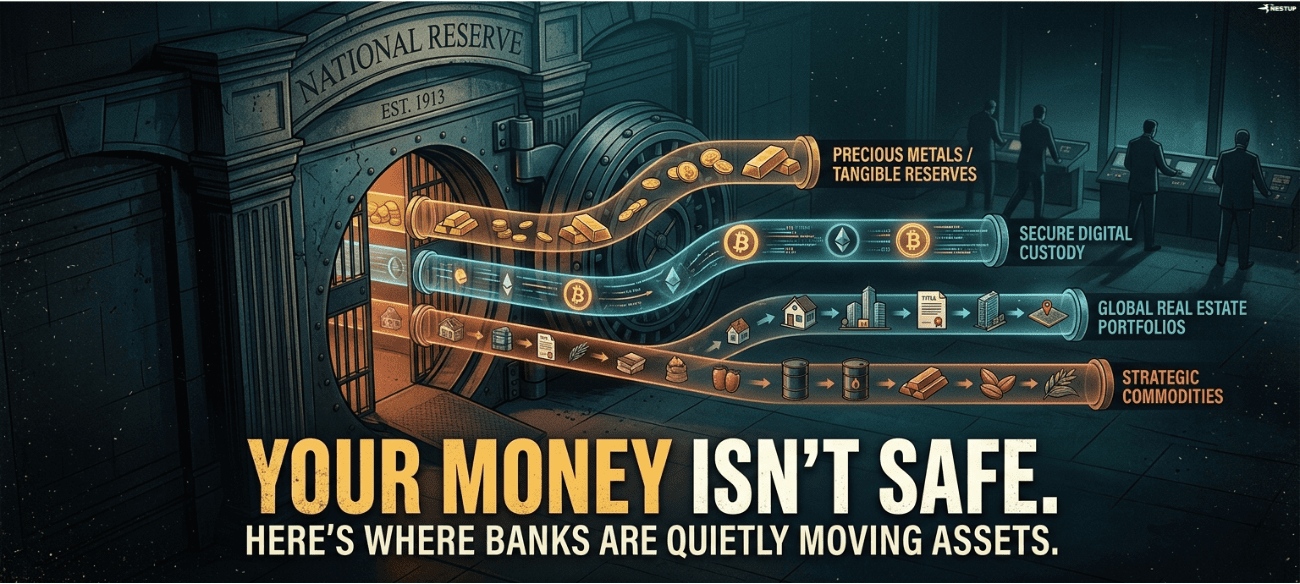
The Death of the "Static Cash" Mental Model
For decades, the cultural perception of banking was rooted in a simple, sedentary image: you deposited your money, and the bank stored it in a dormant, vault-bound state. This "bank vault" myth is not just outdated; it is a dangerous delusion in the 2026 financial landscape. In reality, the modern bank has been hollowed out and replaced by a high-speed asset-allocation machine, a digital engine that relentlessly shunts capital through a labyrinth of wholesale funding markets and synthetic liquidity structures.
This post reveals the invisible transformation of banking infrastructure—a process where your money is no longer a static store of value, but fuel for a software-driven global network. If you believe your capital is sitting still, you are blind to the fact that it is currently being funneled into a sophisticated web of tokenized assets and shadow banking protocols designed for maximum yield efficiency. Those who fail to grasp this shift are not just behind the curve; they are unknowingly tethered to a level of systemic complexity they cannot see, let alone manage.
Your Money is Being Reprogrammed as "Synthetic Cash"
In the modern ecosystem, "cash" has been fractured into layered, interchangeable components. Financial institutions no longer view a deposit as a singular asset; instead, they treat bank deposits, money-market funds, and repo-backed instruments as "synthetic cash." To maintain profitability amidst margin compression, banks move your liquidity through collateral chains and engage in collateral rehypothecation—the practice of re-using the same underlying asset to back multiple transactions across the system.
This financialization of cash creates a pervasive, hidden fragility. The engine of this new economy is built on securitized exposure, where every dollar is optimized for speed. However, when an entire global system optimizes for liquidity simultaneously, it becomes hyper-sensitive to interest-rate shocks. This interconnectedness means that a tremor in a remote funding market can trigger a cascade across the entire chain.
"The structure matters because liquidity systems work beautifully — until they suddenly do not."
The Rise of Internet-Native Treasuries (Tokenization)
The migration of capital is currently accelerating toward tokenized U.S. Treasuries. These are not merely digital versions of bonds; they are "on-chain money-market funds" that bypass the friction of traditional brokerage rails. This shift isn't driven by a fascination with technology, but by the cold reality of elevated short-term U.S. rates. Institutions are chasing yield in a high-rate environment by moving assets onto digital ledgers to achieve 24/7 liquidity and programmable settlement.
Industry titans like BlackRock, Franklin Templeton, and WisdomTree have moved aggressively into this space, recognizing that tokenized structures offer a level of balance-sheet optimization that traditional plumbing cannot match. The benefits of this "internet-native" infrastructure include:
- 24/7 Liquidity: Global markets that never close, allowing for the instant movement of capital.
- Programmable Collateral: Assets that are automatically re-allocated based on software-defined rules.
- Faster Settlement: Eliminating the days-long operational friction of legacy banking.
- Global Access: Seamlessly moving yield-bearing instruments across international borders without traditional intermediaries.
The Shadow Banking Explosion in Private Credit
As traditional banks retreated under the weight of stricter capital requirements, the "shadow banking" sector expanded to fill the vacuum. This is most evident in the surge of private credit, where direct lending to corporations and real estate projects is handled by non-bank asset managers rather than regulated depositaries. Today, the capital that once resided in traditional bank loan portfolios is managed by firms like Blackstone, Apollo, KKR, and Ares.
This shift introduces a significant Opacity Risk. Unlike public markets, private credit is less transparent, making "fair value" harder to determine. This creates a hidden refinancing risk; stress remains invisible until conditions tighten and the lack of liquidity is suddenly exposed. Because banks, insurers, and pension funds are all deeply interconnected through these same funding markets, this lack of transparency is no longer a "Wall Street problem"—it is a direct risk to the stability of the retirement funds and institutional liquidity products that underpin the global economy.
Stablecoins are the New Treasury Power Players
The barrier between "crypto" and traditional banking has effectively vanished. Stablecoin issuers have transitioned from the periphery of finance to become central pillars of the U.S. Treasury market. By holding vast quantities of short-term Treasury bills and repo instruments to back their tokens, these issuers have become some of the largest global buyers of government debt, effectively acting as "shadow" liquidity providers for the U.S. government.
Regulators are increasingly unnerved by this development, not because of the underlying technology, but because of the potential for a systemic feedback loop. If a digital liquidity system experiences a sudden rush for redemptions, the "spillover effect" could be catastrophic. A panic on the digital side could force a mass liquidation of Treasury bills, triggering a liquidity freeze in the traditional financial backbone. The concern is no longer a "crypto crash," but a digital contagion that paralyzes the world's most vital credit markets.
The "Yield Trap" and Structural Complexity
In an era of programmable finance, high yield is never a "bonus"—it is a risk premium for structural complexity. When a product offers returns that significantly outpace a standard savings account, it is typically because the assets are buried deep within a complex web of custody, counterparty exposure, and liquidity constraints. As the source context reminds us: "Yield never appears magically."
Before chasing yield in 2026, every investor should run through this Survival Checklist:
- What specific assets are backing this product? (Are they Treasuries, or is it securitized exposure to private debt?)
- What happens during a period of extreme liquidity stress? (Can the assets be sold quickly without massive losses?)
- Is the redemption of funds guaranteed? (What are the "gates" or rules that might prevent you from accessing your cash?)
- Is the asset protected by insurance? (Does it have the backing of a sovereign guarantee, or is it purely private risk?)
Conclusion: The Era of Programmable Money
We have moved past the era of static balances and into the age of programmable infrastructure. Money is now a software-defined asset, integrated with digital collateral and real-time settlement rails. This transformation has made the global financial system undeniably faster and more efficient, but it has also made it profoundly less intuitive and more dangerously interconnected.
While the system is not in a state of imminent collapse, the definition of "safe" has been fundamentally rewritten. The greatest risk you face is no longer the failure of a single institution, but a failure to understand the complexity of the networks your money now inhabits. The old "vault" is gone, replaced by a global, invisible machine. In this new landscape, you must ask yourself: Do you truly understand what your money is connected to?