
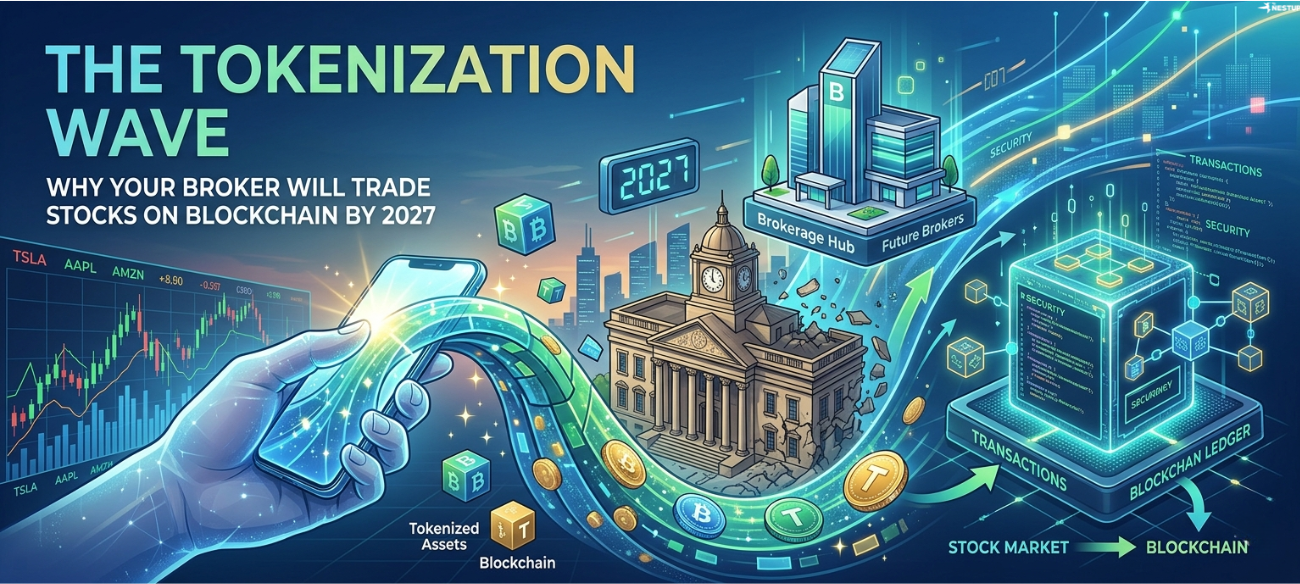
To the average investor, "blockchain" still sounds like a volatile frontier of Bitcoin, speculative meme coins, and offshore crypto exchanges. But while the public fixates on the noise of the tokens, a far more significant shift is occurring in the quiet corridors of Wall Street. The world’s largest financial institutions are not being replaced by a decentralized revolution; they are absorbing its technology to rebuild their foundation.
This is the "Invisible Upgrade." It is a transition where the plumbing of our financial lives—how we buy stocks, hold bonds, and trade funds—is being replaced with blockchain-based infrastructure. The goal is to move beyond the paper-based legacy of the 20th century into a world of global, programmable software.
Takeaway 1: From "Replace Wall Street" to "Upgrade Wall Street"
The early vision of decentralized finance (DeFi) was total disruption: a world without banks. However, institutional momentum has settled on a far more pragmatic "hybrid model." Instead of dismantling the system, asset managers and banks are replacing fragmented, traditional databases with distributed ledger technology to represent ownership through digital tokens.
This shift acknowledges that while blockchain is an efficient tool for recording transactions, it cannot replace the regulatory role of traditional institutions. Firms like BNY Mellon or JPMorgan provide essential compliance, trust, and legal frameworks that are non-negotiable for institutional capital. By adopting blockchain, these firms are targeting the friction within existing layers of intermediaries—the brokers, custodians, clearinghouses, and settlement systems—that currently make the system expensive and operationally complex.
"The conversation shifted from: ‘replace Wall Street’ to: ‘upgrade Wall Street.’ That is a massive difference."
Takeaway 2: The "BlackRock Effect" and the Power of Stablecoins
The entry of BlackRock into the on-chain market via its BUIDL fund signals the end of the "hype" phase. BlackRock is not a crypto-native startup chasing a trend; it is one of the most influential financial institutions on Earth. By tokenizing U.S. Treasury exposure, BlackRock has designated Treasuries as the "safe" entry point for the migration of global capital.
However, this transition didn't happen in a vacuum. Stablecoins—digital tokens pegged to the dollar—quietly prepared the infrastructure for years. By moving trillions in dollar value on-chain, stablecoins functioned as the first large-scale financial tokenization experiment. Once institutions became comfortable moving dollars and treasury exposure on-chain, moving stocks and private equity became the logical next step.
Takeaway 3: Programmable Finance—More Than Just a Faster Database
If tokenization were only about speed, it would be a minor optimization. The real transformation lies in "programmable financial assets." Unlike a traditional share of a stock that sits passively in a brokerage database, a tokenized asset can have logic embedded directly into its code.
This enables specific capabilities that were previously impossible or prohibitively expensive:
- Automated Dividends: Payments are distributed to holders instantly via code, eliminating manual processing and reconciliation.
- Smart Contract Integration: Assets can interact directly with digital protocols to execute trades when certain conditions are met.
- Fractional Investing: Infrastructure that allows for the ownership of tiny equity slices or micro-shares of high-value assets (like private equity or real estate), broadening access to the non-wealthy.
- 24/7 Liquidity: Markets that never close, providing global accessibility and removing the "banking hours" constraint.
- Automated Collateralization: The ability to use your assets as collateral for a loan instantly and efficiently without having to sell them, unlocking liquidity with a few clicks.
Takeaway 4: The Robinhood Factor and the 24/7 Investor Psychology
Retail brokerages like Robinhood are driving this shift from the bottom up. They recognize that younger, mobile-native investors expect their money to behave like their social media feeds: instant, continuous, and globally accessible. These investors have no interest in "T+1" settlement (waiting a business day for a trade to clear) or waiting for the opening bell of a physical exchange.
But this 24/7 market is a double-edged sword. While it offers unprecedented access, it introduces "investor exhaustion." As seen in the crypto markets, a system that never sleeps can amplify emotional trading, heighten volatility, and intensify speculative behavior. We are moving from a world with built-in "cool-down" periods to one of permanent, high-stakes market activity.
Takeaway 5: The "Internet Analogy"—Blockchain as Invisible Plumbing
For the majority of users, the blockchain will be invisible. Much like you use the internet every day without understanding the TCP/IP protocol, you will soon buy tokenized stocks through familiar apps without ever seeing a "wallet address." The user experience (UX) will eventually hide the technology entirely.
The primary hurdle for strategists now is "Liquidity Fragmentation." If a stock trades across traditional exchanges and multiple different blockchains simultaneously, liquidity can become scattered and inefficient. The industry is currently racing to develop "interoperability solutions" that allow these different digital ledgers to talk to one another. Only when these assets can move seamlessly between platforms will the "Invisible Upgrade" be complete.
Takeaway 6: The 2027 Roadmap and the Risks of Democracy
The timeline for this transformation is moving from "if" to "when."
- 2026–2027: This is the era of the pilot and the foundational product. Expect a surge in tokenized treasury products, institutional settlement system trials, and the first cautious scaling of retail tokenized equities.
- Late 2020s: Larger global exchanges and custodians will likely integrate blockchain settlement as a standard backend feature. Hybrid systems—half traditional, half digital—will become the norm.
However, the "democratization of finance" is not inherently safer. While tokenization provides easier access to exotic or private assets, it does not guarantee their quality. Furthermore, the shift introduces new technical risks, such as smart-contract vulnerabilities and cybersecurity threats. Regulators have pivotally moved from trying to "ban" crypto to "regulating tokenized finance safely," recognizing that the infrastructure itself is a significant net positive for systemic stability, provided the code is secure.
Conclusion: Finance as Software
We are witnessing a fundamental philosophical shift. Finance is moving away from its origins in paper-based records and centralized ledgers toward a future where assets are global, programmable software.
The plumbing of your financial life is changing whether you notice it or not. Your brokerage account will soon be faster, more flexible, and perhaps more volatile than ever before. As the barriers between traditional markets and digital rails dissolve, we must ask ourselves: are we ready for a world where our investments never sleep, and our wealth behaves like software?