
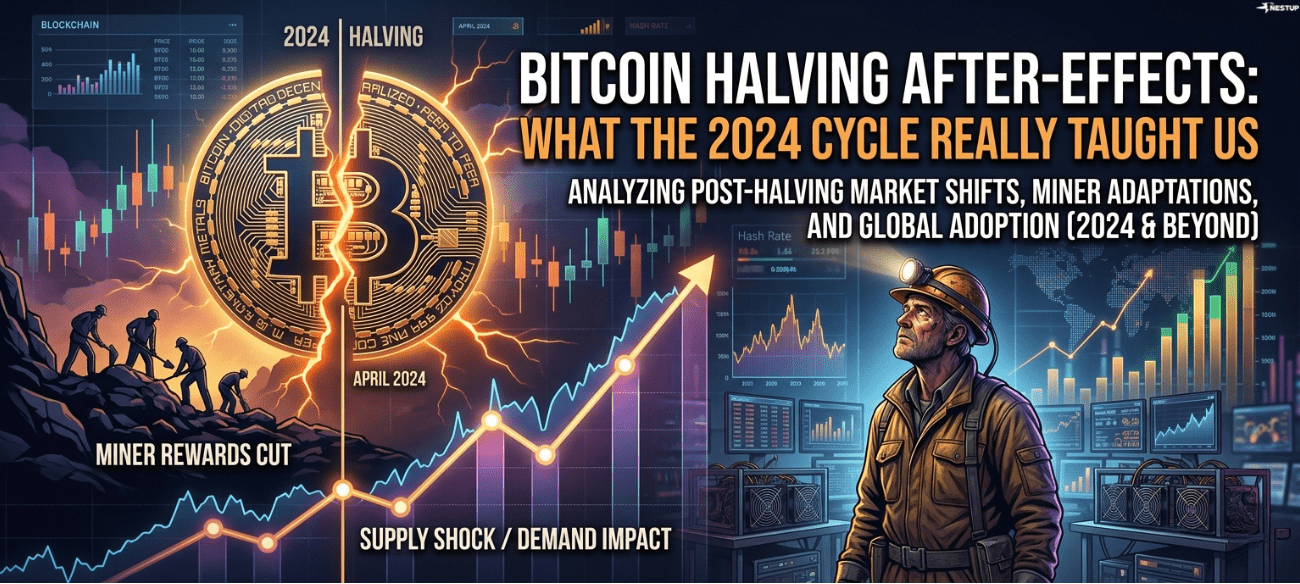
For over a decade, the Bitcoin halving was treated as a "law of nature." The traditional investment playbook was straightforward: accumulate before the rewards dropped, survive the ensuing volatility, wait for a post-halving supply shock, and sell into the inevitable retail euphoria. This "accumulate-wait-moon" strategy served many well through the cycles of 2012, 2016, and 2020.
However, the 2024–2026 cycle has complicated this narrative. We are witnessing a fundamental market shift that challenges the reliability of rigid historical patterns. A core tenet of market reflexivity is that the more widely known a pattern becomes, the more markets adapt around it. The central reality is not that the halving has stopped working, but that Bitcoin has simply grown into a different kind of asset. We are no longer looking at a retail-driven speculative vehicle; Bitcoin has matured into a globally integrated financial instrument.
Wall Street Now Outweighs the Miners
In previous eras, the internal mechanics of the Bitcoin protocol—specifically the reduction in block subsidies—were the primary drivers of price action. The 2024 halving reduced the block subsidy from 6.25 BTC to 3.125 BTC, technically lowering the rate of new supply.
In the 2024–2026 cycle, however, the influence of the miner has been eclipsed by the influence of the institution. With the entry of major firms, demand flows now dominate the equation more than the internal protocol mechanics. This shift suggests that the "demand side" of the ledger has officially taken the wheel, rendering the traditional supply-shock narrative a secondary factor.
"In earlier eras, daily miner issuance could materially affect market liquidity. In 2025 and 2026, institutional flows often overwhelmed those supply mechanics entirely."
The Institutional Dampening: Why Volatility is Compressing
The approval and scaling of spot ETFs from firms like BlackRock, Fidelity, and ARK Invest have fundamentally altered Bitcoin’s market structure. Historically, Bitcoin was characterized by episodic retail mania—violent "boom and bust" cycles driven by hype. The current cycle has introduced "continuous demand flows" tied to portfolio allocations, retirement accounts, and wealth management.
Several factors are contributing to this structural volatility compression:
- Long-Duration Custody: ETFs accumulate enormous quantities of Bitcoin into custody structures not intended for frequent trading, reducing the liquid circulating supply on exchanges.
- Derivatives Market Maturity: The presence of sophisticated derivatives and deeper institutional liquidity creates a more stable, professionalized trading environment.
While speculators may find the lack of 10x moves disappointing, this compression is a significant win for Bitcoin’s long-term credibility.
"As it evolves into a 'globally integrated financial instrument,' stability is a prerequisite for broader adoption."
The End of the Crypto-Only Narrative
The days of Bitcoin existing as a "crypto island"—disconnected from the rest of the financial world—have ended. The 2024–2026 cycle demonstrated that Bitcoin is now a sophisticated hybrid between digital gold, a risk asset, and a macro liquidity proxy. It has become a liquidity-sensitive asset that acts as a neutral reserve alternative for a new class of investors.
Bitcoin's price action is now increasingly correlated with:
- Central bank policy and Federal Reserve interest rate decisions.
- Global liquidity conditions and broader risk sentiment.
- Real yields, inflation expectations, and geopolitical uncertainty.
There is a distinct irony in this maturation: as Bitcoin becomes more successful, it is being absorbed into the very global financial systems it once sought to bypass. It now trades within broader liquidity cycles rather than purely internal crypto narratives.
The Trillion-Dollar Gravity: Respecting Diminishing Returns
The "Diminishing Returns Thesis" has moved from theory to structural reality. As an asset’s market capitalization grows, it requires exponentially more capital to move the price by the same percentage. A trillion-dollar asset simply cannot behave with the same physics as a billion-dollar asset.
- Early cycles delivered moves exceeding 100x as the asset grew from obscurity.
- The 2024–2026 cycle appears more compressed and less parabolic, reflecting the sheer volume of capital required for growth.
Respecting this "trillion-dollar gravity" is essential for any strategist. The era of easy 10x gains in a single cycle is likely ending, replaced by more measured, structural appreciation that aligns with other major asset classes.
From Rebellion to Infrastructure
The "emotional profile" of the current cycle feels markedly different from those of the past. Earlier cycles were defined by retail-driven mania. In the current landscape, that speculative energy has migrated away from Bitcoin and into high-risk corners such as AI tokens, memecoins, and the Solana ecosystem.
Bitcoin itself has transitioned from a "rebellion asset" to alternative monetary infrastructure. The participant profile has shifted from retail speculators to:
- Sovereign interests and national treasuries.
- Pension funds and insurance companies.
- Corporate treasury departments.
This shift toward "quiet adoption" signifies that Bitcoin is now viewed as a permanent part of the global financial system. While the "chaos" of the past was exciting for traders, the "permanence" of the future provides the stability required for institutional and sovereign-level trust.
Conclusion: The Maturation Paradox
Bitcoin is growing up. We are witnessing a transition from a niche, speculative internet asset to a legitimate, globally integrated financial instrument. While the cycles are becoming more complex, less volatile, and less parabolic, the asset itself is becoming more permanent.
The strongest takeaway from this cycle is that rigid historical certainty is becoming less reliable. Success in the new environment requires balancing supply dynamics, institutional demand, and global macroeconomics simultaneously.
This leads to a fundamental question for the modern investor: Do you prefer the chaotic, explosive growth of Bitcoin’s youth, or the stable, institutional permanence of its maturity? Your answer likely dictates your strategy for the cycles ahead.