
 N
N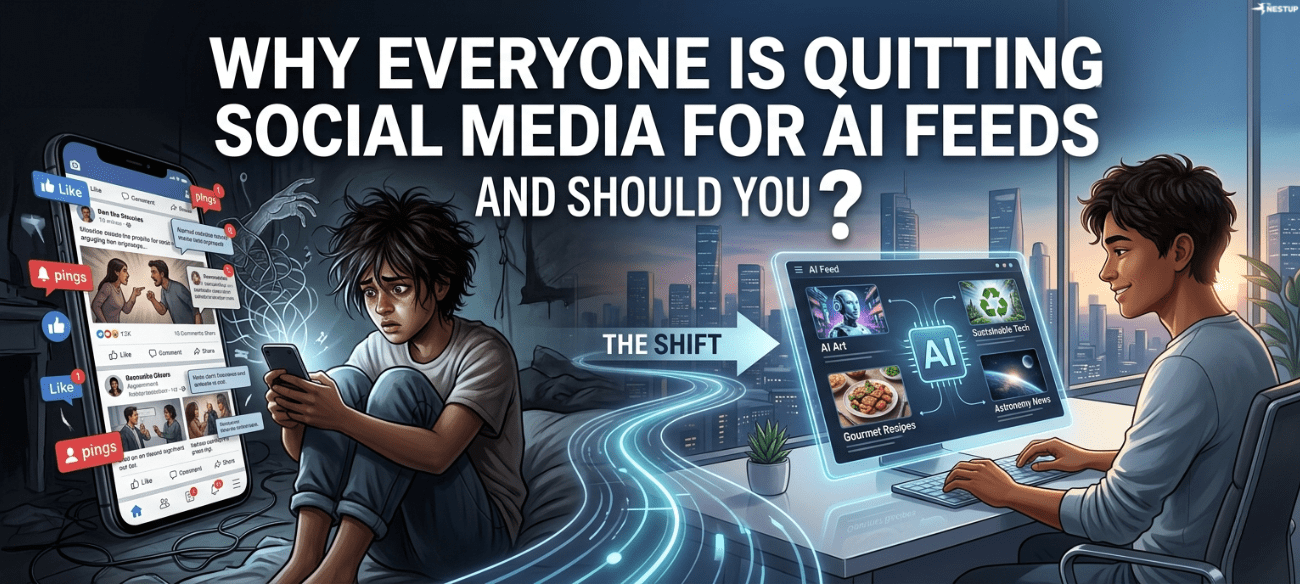
The Great Digital Fatigue
For over a decade, the digital experience was defined by the "infinite scroll." Social giants like TikTok, Instagram, and X (formerly Twitter) perfected the art of algorithmic addiction, leveraging dopamine-heavy loops of rage bait, engagement farming, and social comparison to keep users tethered to the glass. However, as we move through 2026, a profound shift has become undeniable. The era of "attention fragmentation" is yielding to a new paradigm of intentionality.
The core thesis is clear: we are transitioning from feeds optimized for engagement to feeds optimized for usefulness. Driven by a desperate need to escape the cognitive load and emotional fatigue of the modern web, users are abandoning the stimulation of the scroll for the curation of the agent. We are no longer content to be the product of an engagement machine; we are seeking tools that respect our intent.
From Algorithmic Addiction to Agentic Assistance
The fundamental difference between the old world and the new lies in the shift from recommendation to agency. Traditional algorithmic feeds are designed by the platform to keep you consuming for as long as possible. Agentic feeds, conversely, are directed by the user to achieve a specific informational goal.
The Structural Shift:
- Algorithmic Feeds (The Attention Economy):
- Optimization: Engagement probability, click-through rates, and session duration.
- Priority: Outrage amplification and virality.
- Result: Compulsive refresh behavior and "stimulation" that masks a lack of substance.
- Agentic Feeds (The Intelligence Economy):
- Optimization: Relevance, context, intent, and personal goals.
- Priority: Informational density and signal-to-noise ratio.
- Result: Maximum value per minute spent; a feeling of "assistance" over consumption.
This evolution represents a move from mere stimulation to deliberate curation. As a tech ethicist, I view this as a necessary recovery of human focus from the "infinite engagement" machines of the 2010s.
"The difference feels like: entertainment versus assistance; stimulation versus curation; infinite scroll versus guided discovery."
Browsing is Becoming a Conversation
The traditional browsing experience has long been plagued by "tab chaos" and the exhausting need to filter through SEO spam, repetitive listicles, and low-quality AI-generated clutter. In 2026, tools like Arc Search have redefined the browser as an "active intelligence layer" rather than a passive window.
Through features like "Browse for Me," the browser no longer just opens links; it synthesizes the web. By compressing complex research into concise summaries and contextual information clusters, these tools dramatically reduce the cognitive load on the user. We are moving away from manual navigation toward a conversational interface where the "research assistant" does the heavy lifting, allowing the human to focus on high-level analysis rather than scrolling through noise.
The Death of the Influencer? Following Knowledge Over People
A fascinating cultural pivot is occurring: users are increasingly following topics and research domains instead of personalities. In the previous era, the "creator economy" thrived on aspirational and often performative content. Today, we see the rise of the curation economy.
Users are beginning to trust AI-generated synthesis over influencer commentary because it feels fundamentally less tribal and less emotional. In an age of high political polarization, the "less performative" nature of AI its ability to aggregate expertise without the baggage of personal branding is seen as more reliable for knowledge acquisition. While creators will not disappear, their influence is being challenged by a system that prioritizes "topic intelligence" over "personality-driven engagement."
The "AI Newspaper" and the Calm Feed
The rise of the "AI Newspaper" is best exemplified by Perplexity’s "Discover" feature. Unlike social timelines that trigger "doomscrolling," this model functions like a personalized analyst or a smart librarian. This shift is supported by a new professional stack including Feedly AI for niche monitoring, Beehiiv AI for custom newsletters, and Notion AI or Zapier workflows that scrape and rank sources for daily briefings.
The Emotional Benefits of the "Calm Feed":
- Lowered Anxiety: Removing the outrage-triggering algorithms reduces the "fight or flight" response typical of social media.
- Addictive Efficiency: Paradoxically, the efficiency of these tools is "addictive in its own way," but it satisfies a hunger for clarity rather than a craving for dopamine.
- Intentionality: Consumption becomes a choice made to achieve a goal, rather than a reflex to boredom.
The Hidden Danger of "Hyper-Personalized Reality Tunnels"
As a tech ethicist, I must warn that this shift is not without peril. While we are escaping the "chaos" of social media, we are entering the risk of "over-optimization." AI agents are exceptionally skilled at preference modeling and behavioral prediction.
The hidden danger lies in the AI’s ability to map a user's emotional triggers, ideological preferences, and cognitive biases. If an AI agent optimizes too aggressively for your comfort, it may create a "hyper-personalized reality tunnel" even tighter than the social media filter bubbles of the past. By eliminating the randomness and serendipity of the open web, we risk losing the "intellectual blind spots" that allow for growth. The challenge of the next decade will be ensuring our agents don't just echo our thoughts back to us.
The Platform Dilemma - Infrastructure vs. Interface
Traditional social media giants are facing an existential crisis. As users shift to asking AI layers, "What actually mattered today?" the underlying platforms TikTok, X, Facebook risk being relegated to raw-content infrastructure.
If a conversational agent sits above the platform and summarizes its most relevant data, the platform’s traditional engagement model and the ad impressions that sustain it crumbles. This is why we see a desperate rush by legacy platforms to integrate their own AI assistants. They are fighting to remain the "interface" through which we view the world, rather than just the "database" that the agents mine for information.
The Hybrid Future
We are witnessing a transition from the era of optimized attention to the era of optimized intelligence. This shift offers a path out of information overload and toward cognitive clarity, but it requires us to redefine what we value in our digital lives.
The most resilient strategy for the 2020s is a hybrid approach:
- Utilize Agentic AI Feeds for high-density knowledge acquisition, professional research, and efficiency.
- Retain Social Feeds for human connection, cultural spontaneity, and the unpredictable humor that only humans can provide.
The internet of the future will no longer ask how it can keep you scrolling. Instead, it will attempt to answer: "What is actually worth your attention?" In an environment optimized for intelligence rather than distraction, the ultimate question remains: how will you choose to redefine the value of your saved time?