
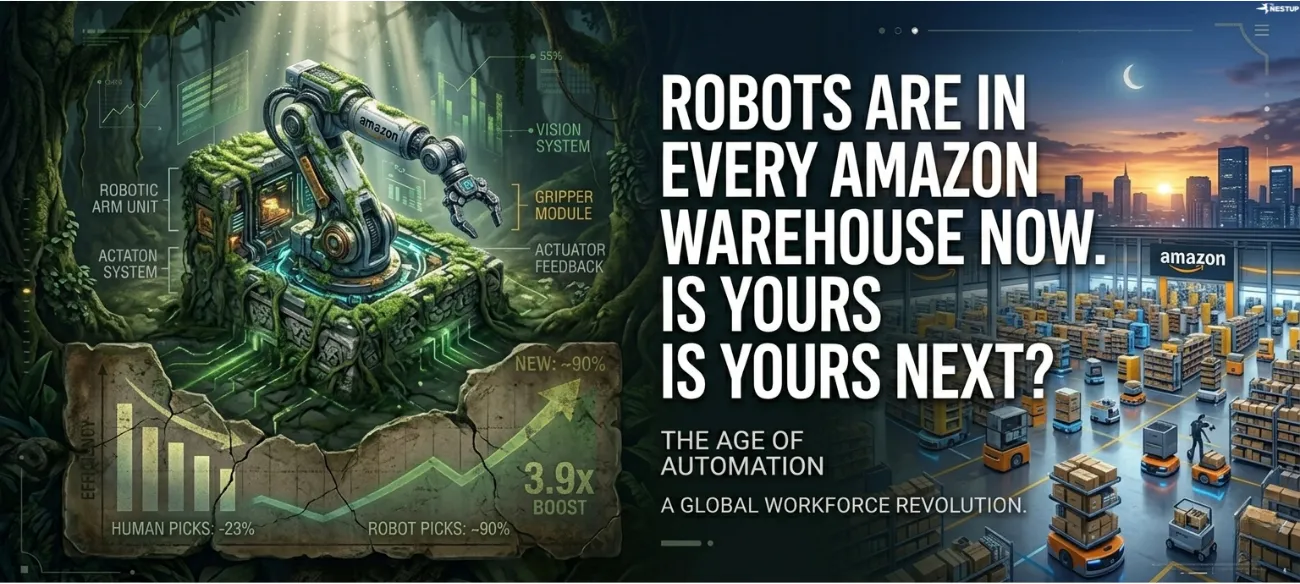
The "robots are coming for your job" headline is an oversimplification; the reality is a fundamental reconfiguration of the labor floor. Walk into any major fulfillment center today, and you will see that the classic image of the warehouse—rows of human workers hurriedly walking miles of aisles to grab boxes—is rapidly becoming a relic of the past. We have entered the era of the automated warehouse, where logistics networks are increasingly defined by complex, physical AI. Amazon alone has deployed over 750,000 mobile robots, signaling a shift where the question is no longer if a warehouse will automate, but how fast it can happen before the competition pulls ahead.
Robots are Learning the "Human Touch"
For decades, industrial robotics was limited to the "clunky" movement of uniform, heavy boxes. The nuanced dexterity required to pick a single item from a bin remained a uniquely human trait—until now. Modern robotics is finally mastering the "human touch" through a combination of computer vision and soft robotics.
- Sparrow: This robotic arm represents a massive leap in fulfillment capability. Using AI-driven suction grippers, Sparrow can detect and select millions of individual, randomly shaped products. It handles everything from a fragile tube of lipstick to a flexible, crinkly bag of dog treats with the same precision as a human hand.
- Digit: Developed by Agility Robotics, Digit is a bipedal robot designed with a human-centric form factor. This isn't for aesthetics; it's a strategic choice to allow the robot to navigate tight corners and stairs in facilities originally built for people. Digit’s primary role—moving and consolidating empty inventory totes—fills a gap where wheeled machines simply cannot fit.
This transition from rigid automation to "Physical AI" allows machines to manipulate the messy, unpredictable inventory of modern e-commerce, effectively removing the last barrier to full-scale automation.
The End of the Robotic "Cage"
One of the most significant architectural shifts in modern logistics is the disappearance of the safety cage. Historically, heavy robots were restricted to "human-free zones" to prevent accidents. Amazon’s Proteus has shattered that boundary. As a fully autonomous mobile robot (AMR), Proteus is designed to roam freely alongside human associates.
"Equipped with advanced sensors, Proteus effortlessly navigates around obstacles and safely maps out paths on the fulfillment floor, functioning as a 'Star Player' in the integrated warehouse ecosystem."
Beyond its navigation, the true innovation lies in its interface. The latest versions of Proteus utilize generative AI, allowing floor supervisors to command the robot using plain, spoken language. This eliminates the need for complex coding or specialized tablets, making the robot a collaborative partner rather than a fenced-off machine.
Extreme Efficiency Through Cube Storage and Physical AI
The success of proprietary systems has forced the rest of the retail world to seek out commercial automation giants like Symbotic and AutoStore. Their rapid adoption by industry leaders is what has moved automation from an experiment to an industry standard.
- Symbotic and the 25-MPH Warehouse: Symbotic builds massive, end-to-end architectures powered by physical AI. Their high-speed bots travel at up to 25 miles per hour within high-density structures. This tech is so effective that Walmart is currently implementing it across all 42 of its regional distribution centers. They are even shrinking this tech into "SymMicro" units to turn retail back rooms into high-speed micro-fulfillment hubs for grocery pickup.
- AutoStore and "Cube Storage": Hailing from Norway, AutoStore replaces aisles with a dense vertical grid. Robots move across the top like chess pieces, digging down to retrieve bins. This "Cube Storage" is the backbone for brands like Puma, Best Buy, and DHL. Interestingly, the tech has even been adapted for automated vertical farming, where robots handle living crops with near-zero human contact.
The Tipping Point: Automation as a Baseline Necessity
We have reached a critical juncture in global logistics. Recent data indicates that over 35% of large-scale retail distribution centers globally have now integrated autonomous picking or robotic sorting.
For retailers, the "steep curve" is no longer a metaphor—it is a matter of survival. Companies relying on manual sorting are finding their unit economics unsustainable. When a competitor’s warehouse is powered by bots moving at 25 mph in a lightless, climate-optimized cube, the speed and cost-per-unit of manual labor simply cannot compete. In this environment, automation is no longer a luxury; it is the baseline requirement for market participation.
Eliminating the "3 Ds" (Dull, Dirty, and Dangerous)
The transition to a bot-run warehouse does not mean the end of the human worker, but it does mean the end of the "3 Ds": tasks that are Dull, Dirty, or Dangerous. By offloading the heavy lifting and the repetitive ten-mile walks to machines, the industry is forcing a massive "Upskilling Race."
Workforce Evolution: Role Comparison
| Old Warehouse Role | New Automated Role | Skills Required |
| Floor Picker | Tote / Grid Operator | Managing fleet queues via tablets and software interfaces. |
| Manual Stacker | Fleet Maintenance Technician | Troubleshooting sensors, mechanical repairs, and software updates. |
| Route Checker | Exception Handler | Resolving complex errors or product jams that robots cannot resolve. |
To facilitate this shift, Amazon has committed over $1 billion to train floor workers as certified robotics technicians. The goal is to move the human element from "muscle" to "orchestrator."
Closing: The Orchestration Era
The future of fulfillment is not a zero-sum game between humans and hardware. We are entering the "Orchestration Era," where the most successful facilities will be those that best integrate human intuition with robotic scale. While robots provide the raw speed and physical labor, skilled human operators remain the essential brain trust required to monitor software ecosystems and troubleshoot the inevitable "edge cases" of a global supply chain.
The next time a package arrives at your door in record time, consider the invisible labor involved. We are no longer just buying products; we are engaging with a massive, synchronized ballet of AI-managed rovers and robotic arms. As the line between software and physical muscle continues to blur, how will we perceive the value of "human-handled" goods in a world where the most efficient touch is a digital one?