The Blind Spot in the AI Arms Race
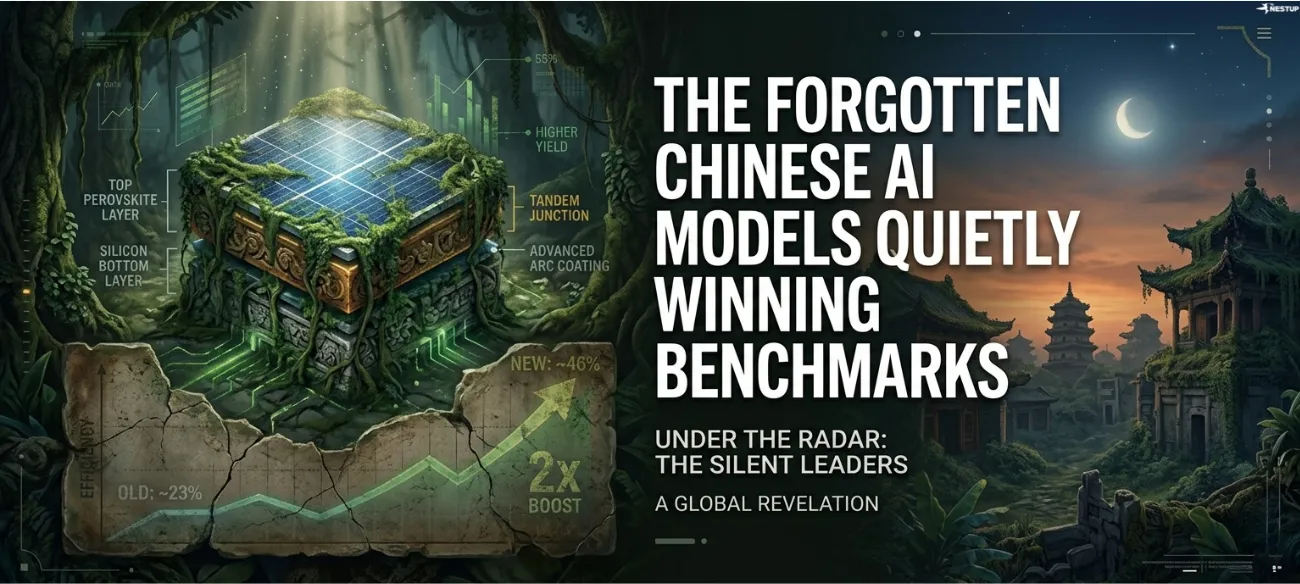
For the past eighteen months, the Western tech discourse has been hyper-fixated on the incremental updates from San Francisco’s "Big Three"—OpenAI, Anthropic, and Google. But while we debate the nuances of the latest GPT-4o variant, a tectonic shift has occurred across the Pacific. The "China Lag" is now a legacy myth; the performance gap hasn't just closed—it’s been inverted in critical agentic categories. We are witnessing the "silent rise" of a new cohort of powerhouses that are no longer just chasing the frontier; they are redefining it. This post reveals the strategic reality of the Chinese AI landscape: a world where the East is winning on efficiency, autonomy, and open-weight disruption.
The "Hidden" Leaderboard Kings (Outperforming the Giants)
Western analysts often overlook that Chinese models are now routinely clustering at the peak of independent leaderboards like LMArena. These systems have evolved past the "copycat" phase into sophisticated reasoning engines designed for complex systems engineering.
- Qwen 3.7-Max (Alibaba Cloud): In a definitive blow to the narrative of Western superiority, Qwen 3.7-Max achieved a staggering 92.4% on GPQA Diamond, surpassing Claude Opus 4.6’s 91.3%. It further cemented its status as an office automation powerhouse with a score of 87 on SpreadSheetBench.
- GLM-5 (Zhipu AI): A 744-billion parameter Mixture-of-Experts (MoE) behemoth that integrates DeepSeek’s Sparse Attention (DSA) to radically slash inference costs. It currently ranks #1 globally among open-source models on Vending-Bench 2, a simulator requiring an AI to manage a business over a one-year horizon.
- Baichuan AI: While others fight for general chat supremacy, Baichuan has pivoted to vertical expertise, dominating medical and legal reasoning benchmarks to become the hidden backbone of enterprise integration.
Reflecting on the Shift: This isn't about "stochastic parrots" anymore. The dominance in benchmarks like GPQA and Vending-Bench suggests these models are becoming the preferred engines for high-stakes industrial automation, where strategic resource management outweighs simple text generation.
From Chatbots to Autonomous Agents: The 35-Hour Marathon
The most significant technical leap in this cohort is the pivot toward "agentic intelligence"—the shift from reactive prompting to long-horizon, autonomous execution.
- Continuous Execution: Alibaba’s Qwen 3.7-Max recently completed a 35-hour autonomous coding task, executing 1,158 tool calls without suffering from "memory drift" or context collapse.
- Agent Swarms: Moonshot AI’s Kimi K2.5 (a 1-trillion parameter MoE that activates only 32B parameters per request) utilizes a "self-directed swarm" paradigm. It can deploy up to 100 sub-agents to run parallel workflows, slashing engineering execution times by over 400%.
"Kimi K2.5 natively processes video-to-code, allowing developers to upload a screen recording of a website and watch the model reconstruct the exact front-end animations from scratch."
Reflecting on Execution: Moving from a single prompt to a 1,000-call autonomous workflow represents the transition from AI-as-assistant to AI-as-employee. These models are being built for production-grade reliability, not just conversational flair.
The Open-Weight Disruption: Democratizing the Frontier
There is a fundamental divergence in strategy between East and West. While OpenAI and Anthropic retreat behind gated, metered "API Moats," Chinese labs like Zhipu AI and Moonshot AI are aggressively weaponizing the open-weights model.
By releasing 700B+ parameter architectures under permissive licenses, they are evaporating the competitive advantage of Western proprietary models. This provides three critical strategic levers:
- The End of Vendor Lock-in: Enterprises can run frontier-level models locally via orchestration tools like vLLM or SGLang, avoiding the pricing whims of San Francisco’s giants.
- Privacy-First Fine-Tuning: Massive models can be tuned on sensitive proprietary data with zero risk of data leaks to third-party providers.
- Infrastructure Democratization: This strategy offers "GPT-level" performance as a public good, disrupting the Western business model that relies on charging for access to intelligence.
The Stealth Integration: One Line of Code Away
Despite geopolitical rhetoric, Chinese frontier models are penetrating Western workflows through a pattern of "stealth adoption." They have become the silent engines of the global developer ecosystem.
- Model Routing Irony: Multi-LLM routers like OpenRouter and DeepInfra are seeing a surge in traffic to Qwen and GLM. Developers are making a purely economic choice: they get Western-level quality at a fraction of the inference cost.
- Protocol Compatibility: Newer Chinese APIs natively support OpenAI and Anthropic API protocols. A developer can drop Qwen 3.7 into tools like Cursor or Claude Code by changing exactly one line of code (the base-URL).
Western developers are inadvertently subsidizing the data loops of Chinese labs because, in the world of high-velocity engineering, cost-efficiency and repository mapping quality trump brand loyalty every time.
Breaking the Silicon Ceiling: The Rise of Hardware Self-Reliance
The consensus was that U.S. export controls on advanced semiconductors would create an insurmountable "silicon ceiling." That theory has officially been debunked.
Zhipu AI has confirmed that GLM-5—one of the world’s most complex MoE models—was trained entirely on Huawei Ascend processing chips and the open-source MindSpore framework. This is a milestone of immense strategic weight. It proves that Chinese labs have found a "software-shaped hole" in hardware sanctions, optimizing their software stacks to achieve world-class results on domestic silicon. The "hardware curse" has failed; we are now in a multi-polar AI landscape where training is no longer tethered to a single Western chip supplier.
A Multi-Polar Future
The global AI landscape has shifted from a monopoly to a fragmented, highly competitive battlefield. Models like Qwen, GLM, and Kimi have demonstrated that performance parity is a reality, and in the case of agentic autonomy, they may already be setting the pace.
As these models become more open, more efficient, and more compatible with global standards, we must ask: Is the traditional "West vs. East" framing still relevant? When a developer in London or San Francisco can swap a proprietary Western model for a high-performance open-source model from Beijing with a single line of code, the borders of the AI race effectively vanish. We are no longer watching two separate races; we are watching the birth of a single, global, and increasingly invisible AI infrastructure.