
The Death of the Expert?
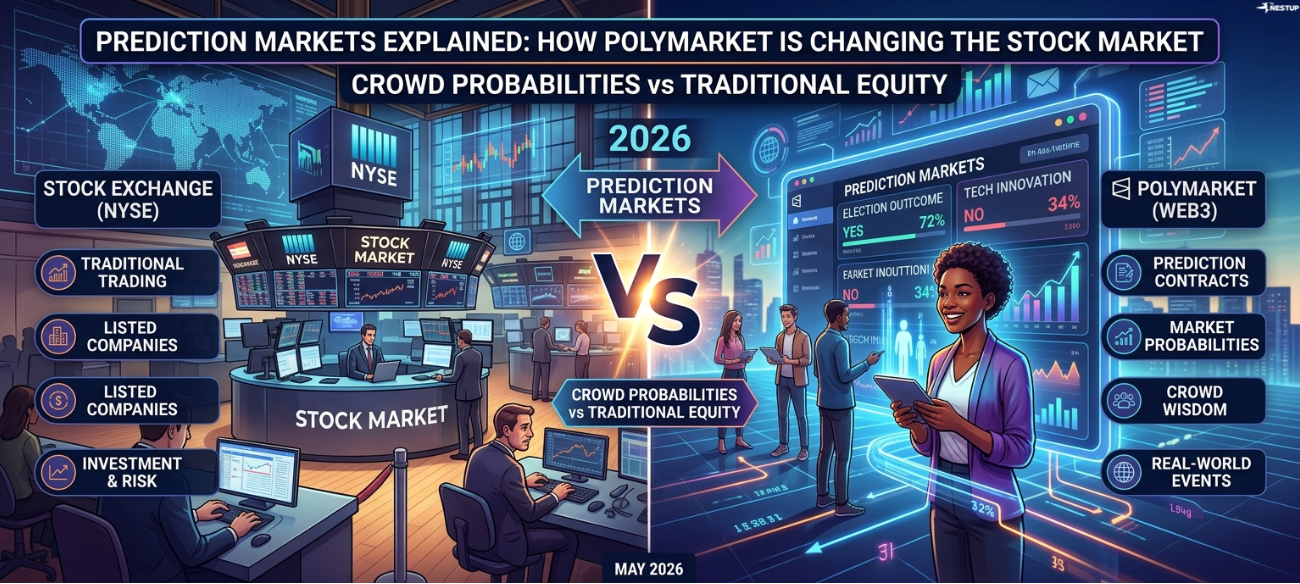
We are witnessing a systemic failure of traditional information gatekeepers. In an era of high-decibel punditry, polarized polling, and "talking heads" who face zero consequences for being wrong, the public’s trust in institutional truth has hit an all-time low. Whether the topic is a Federal Reserve rate cut or a geopolitical shift, the noise is deafening, yet the signal remains elusive. Enter the prediction market: a disruptive mechanism that replaces institutional authority with skin in the game. By 2026, these platforms have evolved from niche curiosities into the internet’s primary forecasting layer. At their core, these markets allow users to trade probabilities. The mechanics are elegantly binary: a contract resolves to 1 if the event happens (YES)** and **0 if it does not (NO). Therefore, if a contract trades at $0.72, the market is signaling a 72% probability of occurrence. It is a cold, calculated filter for a world exhausted by empty opinions.
Takeaway 1: Skin in the Game and the Efficient- Prediction markets Hypothesis
The power of these markets lies in the Wisdom of the Crowd, but with a crucial financial twist. While social media rewards the loudest voice, prediction markets reward the most accurate. This is essentially the Efficient-Market Hypothesis applied to global events rather than just corporate earnings. The theory suggests that markets rapidly price in all available information, creating a real-time "truth" that is difficult for any single expert to match.
However, a rigorous analyst must acknowledge that these are not perfect "truth machines." They are prone to "bugs" like low liquidity, whale manipulation (where a single large bet shifts the price), and misinformation incentives. Despite these flaws, the incentive structure is fundamentally different from a poll. When capital is at risk, the goal shifts from being "merely opinionated" to being "correct."
"When money is involved, participants are incentivized to: be correct, not merely opinionated. That changes behavior dramatically."
Takeaway 2: Speed is the New Alpha (Real-Time Information Aggregation)
In the modern economy, information is the most valuable commodity, and information aggregation is the new battlefield. Traditional media and academic institutions operate on a significant lag. By the time an analyst firm publishes a report, the market has already moved. Platforms like Polymarket operate in real-time, 24/7.
As news breaks, the price updates instantly, synthesizing news, expertise, and crowd sentiment into a single live probability. We are seeing a fundamental shift in behavior: sophisticated observers are moving from "watching the news" to "watching the price" to understand breaking events. This real-time signal provides a level of macro probabilities that traditional newsrooms simply cannot replicate.
Takeaway 3: The Three Pillars—Crypto Agility, Regulatory Legitimacy, and Social Reputation
The prediction market ecosystem in 2026 is defined by three distinct approaches, each serving a different segment of the market:
- Polymarket (The Crypto-Native Giant): Built on blockchain, it offers global liquidity and decentralized access. It has become the breakout success for "internet-native" participation, thriving on crypto and political events.
- Kalshi (The Regulated Challenger): Operating within U.S. regulatory frameworks, Kalshi offers institutional-grade safety. Its focus on inflation, weather, and Fed decisions appeals to financial firms seeking legitimate financial hedging tools.
- Manifold Markets (The Social Layer): Using a "play-money" and reputation-driven model, Manifold proves that forecasting can be a social internet activity. It lowers the barrier to entry, focusing on intellectual competition and information discovery.
The critical bridge to mainstreaming remains regulatory clarity. For large-scale institutional participation to move beyond retail speculation, governments must decide if these platforms are "gambling" or essential risk-management tools.
Takeaway 4: The Most Valuable Skill is Probabilistic Thinking
The ultimate "product" of these markets isn't just profit; it is the cultivation of probabilistic thinking. The biggest mistake beginners make is confusing probability with certainty.
Consider a high-signal example: a contract asking if the SEC will approve a Solana ETF in 2026. If the "YES" shares trade at $0.68, the market implies a 68% probability. A novice sees this as a "likely yes," while a probabilistic thinker sees a 32% chance of failure. Moving away from binary "yes/no" thinking toward nuanced odds is the most important skill for modern decision-making. These markets estimate odds—they do not dictate destiny.
Takeaway 5: Society’s Future Forecasting Layer (AI and Beyond)
The "bigger vision" for this technology is the creation of a real-time forecasting layer for all of human endeavor. We are already seeing these markets compete with analyst forecasts, polling companies, and traditional market research. In many cases, market odds are indirectly shaping broader market behavior, influencing defense stocks or tech valuations before the news even hits the tape.
The next frontier is the integration of Artificial Intelligence. AI systems are no longer just tools for traders; they are becoming "automated participants" that provide liquidity and analyze sentiment faster than any human. Some researchers believe AI-assisted systems will eventually outperform traditional forecasting institutions entirely, replacing the "expert white paper" with a live, tradable price.
"In a world overwhelmed by noise, opinions, and misinformation, markets that force people to put money behind beliefs may become increasingly valuable."
The Final Word: Prediction markets More Than Just a Bet
Prediction markets have graduated from niche internet betting sites to serious information infrastructure. While they won't replace the stock market, they are fundamentally reshaping how information is priced in the digital economy. They provide a mirror to reality that is unclouded by the biases of pundits or the flaws of traditional polling.
As we navigate an era of unprecedented uncertainty, the question is no longer whether you should pay attention to these markets, but whether you can afford not to. Are you ready to trust a professional pundit’s opinion, or would you rather trust the market price?