
Introduction: The Classroom You Won’t Recognize
The classroom your child enters in 2026 is no longer a relic of the Digital Age; it has become the front line of the Intelligence Age. For parents, the traditional hallmarks of education—standardized lectures, heavy textbooks, and handwritten notes—have been replaced by an environment where artificial intelligence is woven into the very fabric of the school day.
This shift creates a high-stakes tension. AI is simultaneously a revolutionary educational advantage and a seductive shortcut that threatens to bypass deep learning. As we navigate this "nuanced reality," we must look beyond the binary of whether AI is "good" or "bad" and recognize that the fundamental goal of school is being rebuilt from the ground up.
Banning Is Dead: Why Schools Stopped Fighting the Algorithm
In the early days of generative AI, many institutions reacted with panic, attempting to block tools like ChatGPT, Claude, and Gemini. However, these bans were doomed from the start. Students adopted the technology with a speed and fluidity that far outpaced institutional regulation, integrating AI into their brainstorming, drafting, and research workflows before schools could even draft a policy.
Forward-thinking districts are now pivoting from total prohibition to "teaching responsible usage." This transition acknowledges a productive reality: because AI has blended into normal digital workflows, policing it is impossible. Instead of fighting a losing battle against technology, schools are focusing on preparing students to use these systems ethically and effectively.
The End of the "Embarrassing" Question
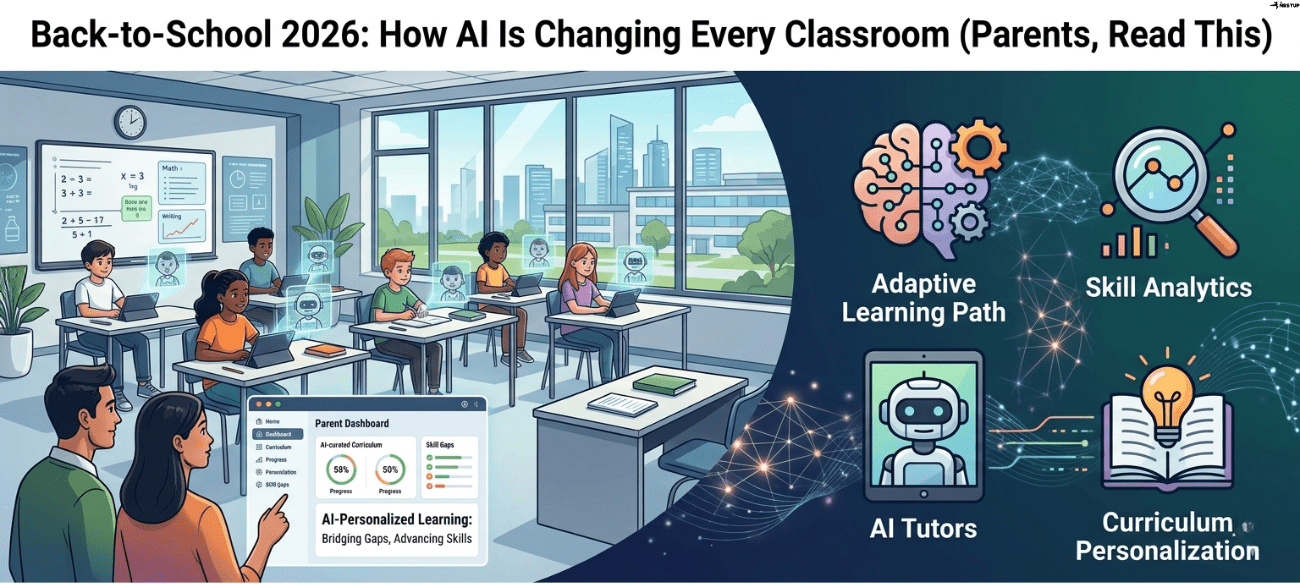
The 2026 classroom has finally achieved what was once a luxury for the elite: high-quality, one-on-one tutoring for every student. AI has collapsed the economics of education, providing 24/7 assistance and instant feedback at near-zero marginal cost.
Beyond the cost, AI removes the social friction that inhibits learning. Many students are paralyzed by the fear of asking a "simple" question in front of peers or admitting they are lost. AI acts as a judgment-free tutor, allowing students to repeat concepts endlessly or request simpler explanations at their own pace. Tools like Khanmigo illustrate this shift by being designed specifically to avoid acting as an answer engine. Instead, the AI asks guiding questions and explains concepts step-by-step to ensure the student is actually doing the cognitive work.
"Good educational AI should ideally function less like a cheating machine and more like an interactive tutor."
Teachers: The Hidden Power Users of AI
While public attention often focuses on students, teachers are adopting AI even faster as a structural fix for educator burnout. Historically, teaching has involved an enormous amount of unpaid preparation time; AI is now being used to reclaim that time.
By automating administrative and preparatory tasks—such as generating lesson plans, adapting reading materials for various skill levels, creating quizzes, and translating materials for non-native speakers—AI acts as a force multiplier. This shift allows the teacher’s role to evolve from the "sage on the stage" delivering content to a mentor focused on emotional support, social development, and high-level reasoning.
Why Homework is Being Redesigned from Scratch
In a world of information abundance, the "take-home essay" is officially dead. When AI can generate a polished analysis in seconds, traditional homework no longer serves as a reliable measure of knowledge. Furthermore, the reliance on AI-detection software has created significant fairness concerns, as these tools frequently produce false positives—incorrectly flagging original human writing as AI-generated.
To combat this, schools are aggressively redesigning how they assess learning. The focus has moved from the production of information to critical thinking about that information. New assessment methods include:
- In-class writing assignments: Ensuring work is performed in a controlled, human-verified environment.
- Oral presentations: Requiring students to defend their ideas and demonstrate mastery in person.
- Iterative drafting: Evaluating the progression and evolution of a project rather than just the final submission.
- Collaborative projects: Emphasizing social application and group problem-solving.
The New Survival Skills: Prompting and Skepticism
Foundational knowledge still matters because it provides the context required for critical thinking, but "AI literacy" has become the primary survival skill. Students must learn to think alongside machines. The four future-proof skills for the Intelligence Age are:
- Asking Good Questions (Prompting): The ability to frame problems clearly and provide the precise context required to get high-quality results from AI.
- Verification and Skepticism: The essential habit of cross-referencing AI outputs and validating claims to identify "hallucinations" or misinformation.
- Communication Skills: The human-centric ability to persuade, collaborate, and explain complex ideas clearly to other people.
- Original Thinking and Creativity: Leveraging authentic lived experience and novel judgment—areas where AI’s pattern-remixing remains fundamentally weak.
The Hidden Risks: Inequality and the "Productive Struggle"
Despite the promise of AI, it carries the risk of becoming a "privilege amplifier." We are seeing a new educational divide that is not just about who has access to the software, but who has the prompting skills and the supportive digital environment to use it effectively.
There is also a deep concern regarding the loss of "productive struggle." Learning requires cognitive effort and a certain level of discomfort; it is a mental muscle that must be exercised. If AI removes all friction by providing instant answers, students may fail to develop the persistence and independent problem-solving habits necessary for life.
"If AI removes all friction instantly, deeper understanding may suffer."
Conclusion: Remaining "Intellectually Human"
The paradigm shift in education is a move from information scarcity to information abundance. For centuries, schools were the gatekeepers of knowledge. Today, answers are infinite and instant.
For parents, the most effective strategy is to treat AI as a tool that requires active supervision and gradual skill-building. Explore these tools with your children, discuss their limitations openly, and consistently prioritize the process of thinking over the ease of the shortcut. As education becomes more personalized, the ultimate challenge for the next generation is not to find the answer, but to learn how to judge that answer.
How do we remain "intellectually human" in a world of infinite, instant answers?