
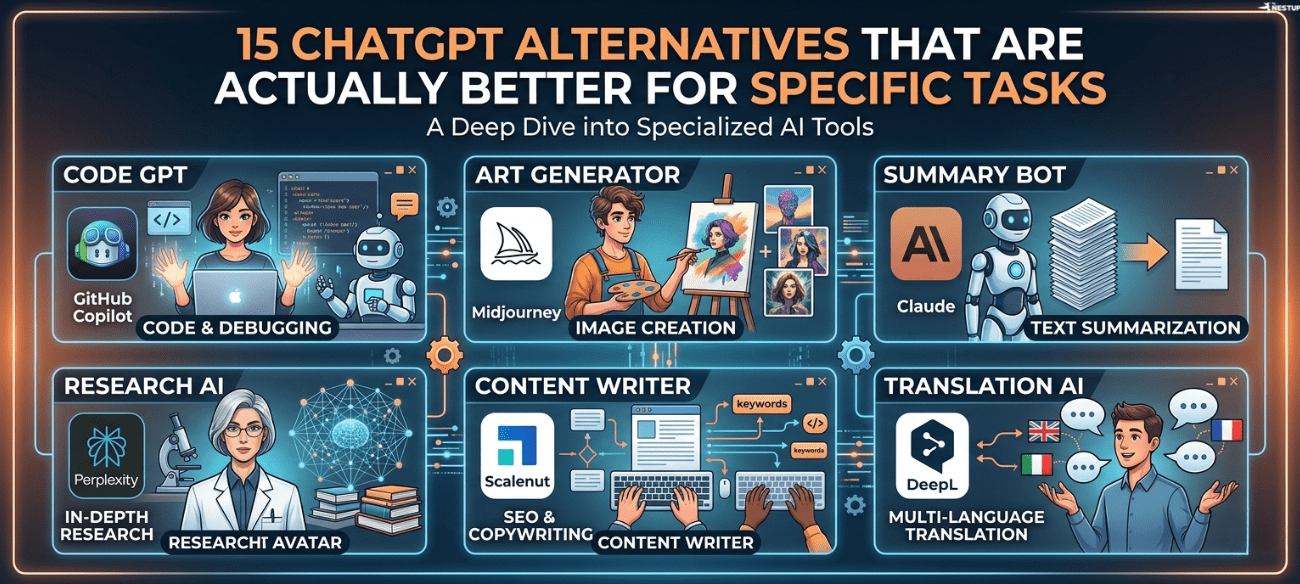
The "Hammer" Problem: An Introduction to AI Specialization
By 2026, the novelty of the "all-purpose" chatbot has finally worn off. For years, ChatGPT was the default entry point—the digital "hammer" for every professional nail. But as the AI market matured, the industry shifted from a winner-take-all race to a modular ecosystem where generalists are being outpaced by specialists.
The smartest professionals have stopped asking which model is "best" and started asking which model is best for the task. We are moving away from tool loyalty toward a curated "specialized stack." In this environment, efficiency isn't found in a single chat window, but in the strategic handoff between models that dominate specific niches.
The Writer’s Architect: Anthropic’s Claude for Deep Reasoning
Anthropic’s Claude has emerged as the "architect" of the AI stack, favored by those who require structural integrity in their work. While other models might prioritize conversational flair, Claude focuses on cognitive stability and nuanced output.
- Best For: Technical writing, research synthesis, and complex code refactoring.
- Key Strengths: Long context windows and industry-leading instruction following.
- The Edge: It is noted for explaining logic more clearly and hallucinating slightly less in large codebases than its peers.
- Workflow Role: Once you’ve gathered raw data via a search-first tool, you bring it to Claude to preserve architectural consistency and draft sophisticated, natural prose.
"The smartest AI users now treat models like specialized tools rather than ideological teams."
3. The End of "Hallucinated" Facts: Perplexity’s Research-First Approach
When the half-life of information is measured in minutes, latency and accuracy are the primary enemies. Perplexity AI has effectively rebuilt the search experience by prioritizing verification over conversation.
- Best For: Journalists, market analysts, and fact-heavy workflows.
- Key Strengths: Aggressive citation of linked sources, academic material, and live web references.
- The Edge: It behaves as a high-speed research engine rather than a chatbot, providing evidence-based answers that eliminate the "hallucination" risks of standard generative AI.
- Workflow Role: Perplexity is the top of the funnel—the engine you use to verify breaking news or gather citations before moving that data into a writing or analysis tool.
The Ecosystem Advantage: Google Gemini’s Contextual Power
For those whose professional lives reside in Google Workspace, Gemini provides a level of contextual awareness that external models cannot replicate. Its value lies not just in what it knows, but in what it knows about you.
- Best For: Enterprise document analysis and Google Workspace power users.
- Key Strengths: Massive context windows capable of processing entire folders of documentation or large research corpora.
- The Edge: Seamless integration with Gmail, Docs, Drive, and Sheets allows for unparalleled access to personal and enterprise data.
- Workflow Role: Use Gemini to summarize a 50-email thread or extract insights from a massive dataset in Drive, then port those insights into Claude to polish the final report.
Real-Time Pulse: Grok and the Power of Social Awareness
In a world where information shifts by the second, xAI’s Grok finds its niche in the "now." While its tone can be described as chaotic, its utility for real-time awareness is unmatched.
- Best For: Traders, news junkies, and those tracking internet culture or crypto trends.
- Key Strengths: Deep integration with live social data from X (formerly Twitter).
- The Edge: It captures the pulse of global conversation and breaking news long before traditional search engines or static models can index them.
- Workflow Role: Use Grok to identify a emerging trend or market sentiment, then use Perplexity to verify the underlying facts.
The Logic Bargain: DeepSeek’s High-End Reasoning for Less
DeepSeek has shocked the industry by proving that high-performance reasoning is no longer a premium-only service. It has become the premier choice for users who need raw logic without the high API costs of Western commercial giants.
- Best For: Students, budget-conscious developers, and math-heavy reasoning.
- Key Strengths: Competitive performance in classification and math tasks relative to much larger models.
- The Edge: It provides high-end reasoning at an extremely low cost, though it faces geopolitical trust concerns for certain Western enterprise deployments.
- Workflow Role: DeepSeek serves as the "logic engine" for high-volume technical tasks or API-heavy experimentation where cost-efficiency is as vital as accuracy.
Death of the Chat Window: The Rise of AI-Native Environments
We are witnessing the end of "copy-paste productivity." The most significant shift in 2026 is the move from the browser-based chat window into AI-integrated environments like Cursor and GitHub Copilot.
- Cursor (The Editor): An AI-native code editor that allows developers to refactor repositories and query entire codebases contextually.
- GitHub Copilot: The dominant tool for inline, autocomplete-style coding assistance and boilerplate generation.
Inline productivity is replacing the browser-based chat workflow; the tool is no longer an external assistant, but a built-in feature of the professional environment.
Privacy and Sovereignty: The Open-Source Alternative
For organizations concerned with data control, the choice has moved away from proprietary American labs toward open-source sovereignty.
- Mistral AI: The choice for infrastructure. Focused on European AI compliance and "open-weight" models that appeal to businesses requiring local sovereignty.
- Meta (Llama): The choice for ecosystems. A flexible framework that allows startups and infrastructure companies to self-host, fine-tune, and run models locally.
This shift allows businesses to build custom AI layers without the risk of handing sensitive internal data to a centralized third party.
Conclusion: Embracing the Modular Future
The era of the "all-in-one" AI assistant is over. The future belongs to an ecosystem of specialized systems working together—a stack that leverages the reasoning of Claude, the citations of Perplexity, the integration of Gemini, and the speed of Grok.
This modular approach is ultimately healthier for users. It prevents a single algorithm from controlling the entire AI layer of the internet and puts the professional back in the driver's seat of their own workflow.
Your Next Step: Audit your weekly workflow. Which tasks are you still forcing into a "generalist" model? Identifying the specific "specialist" currently missing from your personal software stack is the first step toward true 2026-level optimization.