
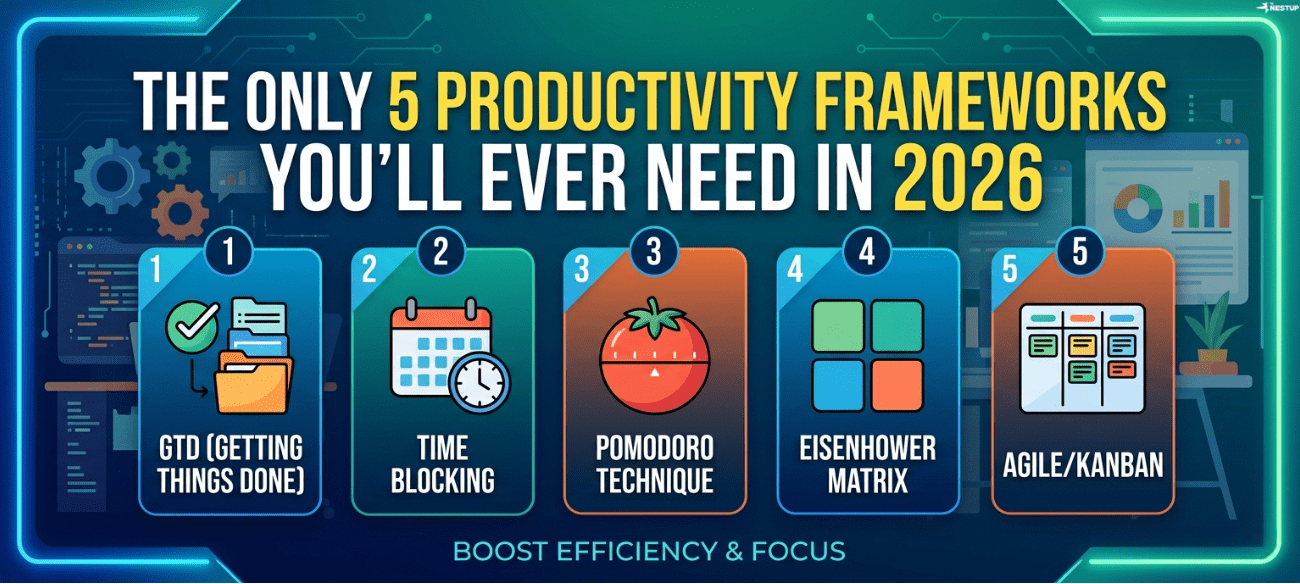
By 2026, the "automated age" has revealed a major irony. Artificial intelligence did not give us more leisure time. Instead, it raised the minimum expectations for our output. As a result, we now process more emails and handle more projects at once. We also filter more noise than any previous generation. Today, the core problem is not a lack of information. Rather, we struggle to decide what truly deserves our limited attention.
As a strategist, I have noticed that the most effective professionals are not chasing the latest AI-powered app. Instead, they rely on a "stack" of five timeless frameworks that address basic human limitations. To succeed in this noisy era, you do not need a faster processor. You need a better operating system for your mind.
David Allen’s "Getting Things Done" (GTD) remains the foundation of modern work management. The main idea is simple: your mind is not a good place to store to-do lists. When you keep unfinished tasks in your head, you create "open loops" that drain your energy. GTD solves this by moving every task into an external system.
1. Your Brain is for Thinking, Not Remembering (The GTD Philosophy)
In 2026, GTD is even more important. Now, AI assistants can handle the "Capture" phase by summarizing meetings and pulling out action items from your digital life. However, the system only works when you move from vague ideas to clear steps. For example, instead of writing "work on business," GTD asks you to define the next action. You might write "email designer about homepage revisions." This small change removes mental friction. It helps you avoid procrastination.
"Your brain is for thinking, not remembering."
The strategist’s warning: Many people fall into the "Perfectionist Trap." They spend more time building complex task lists than doing the actual work. If your GTD system feels like a full-time job, you have started managing your tools instead of your work. Therefore, keep your system simple. Focus on action.
2. Organizing Your Digital Life by Action, Not Topic (The PARA Method)
Once you capture your tasks, you need a place for the knowledge that supports them. Tiago Forte’s PARA framework (Projects, Areas, Resources, Archives) is a proven way to organize digital life. It works because it focuses on action, not just categories.
A Project is a short-term effort with a clear deadline and a specific result. For example, "launching a new website." In contrast, an Area is an ongoing responsibility that needs regular attention. This includes "health," "finances," or "marketing." While a project ends, an area is something you must always maintain.
By separating your digital world this way, you make sure the information you need for active work (Projects) does not get lost. It will not be buried among general interests (Resources) or old files (Archives). The strategist’s warning: Watch out for the "Hoarder’s Failure Mode." In the AI era, it is easy to collect endless research and notes. However, a system that stores every PDF you might read someday is not helpful. It is just digital clutter.
3. The Eisenhower Matrix and the "Urgency Trap"
After you organize your information with PARA, you must choose what really matters. Modern work is designed around urgency. Notifications and instant messages keep us reacting all day. The Eisenhower Matrix helps you break this cycle. It divides work into four groups based on Urgency and Importance.
High-value, long-term success comes mostly from Quadrant 2. These are tasks that are Important but Not Urgent. They include strategic planning, building relationships, and developing skills. Because these tasks do not demand your attention, they are often the first to be ignored.
The strategist’s warning: The main risk here is "Misclassification." People often call everything "Important" to justify staying busy. The most successful people are strict about finding Quadrant 3 tasks. These are tasks that feel urgent but add no value. They delegate or remove these tasks to protect their Quadrant 2 time.
4. Why Deciding Tomorrow’s Tasks Tonight is a Superpower (The Ivy Lee Method)
The Ivy Lee Method is over 100 years old. It is a simple filter for daily action. At the end of each workday, write down the six most important tasks for tomorrow. Rank them by priority. The next morning, start with the first task and finish it before moving to the next one.
This method is powerful because of its simplicity. In a 2026 world full of algorithm-driven distractions, the Ivy Lee Method removes decision fatigue. You do not waste your best morning energy wondering, "What should I do now?" Instead, the answer is already on your list.
The strategist’s warning: "Unrealistic Planning" can ruin this system. If you list six huge projects that each need four hours, you will not finish them. This method works only when you are honest about what fits into one day. Therefore, choose tasks you can actually complete.
5. Deep Work as the Only Remaining Human Competitive Advantage
Cal Newport’s "Deep Work" means focusing without distraction on hard tasks. While AI now handles "shallow work"—like summarizing documents, drafting text, and managing schedules—human value in 2026 comes from original thinking. It also comes from solving complex problems and offering strategic insight.
These results require long, uninterrupted focus blocks. If you check your messages every ten minutes, you are splitting your attention and lowering your quality. Deep focus is a skill you can build. In a world where most people are distracted, the ability to focus for two hours on one hard problem is a true advantage.
The strategist’s warning: Many people fall into the "Addiction Failure Mode." They plan a deep work session but leave notifications on "just in case." You cannot do deep work if you stay reachable. If you are not willing to go offline, you are not truly doing Deep Work.
The Master System: How to Stack the Frameworks
Real change happens when you stop seeing these as separate tips. You need to start using them as one system. Here is how information flows through the master system in 2026:
- GTD (Capture): Your AI assistant summarizes a client meeting. It adds the action items to your GTD inbox.
- PARA (Organization): You move the meeting notes and research into the right "Project" folder in your PARA setup.
- Eisenhower Matrix (Prioritization): During your weekly review, you see this project is a Quadrant 2 priority. It is important but not urgent. You decide to work on it now.
- Ivy Lee Method (Daily Planning): On Tuesday evening, you add the next milestone of that project to your six tasks for Wednesday.
- Deep Work (Output): On Wednesday morning, you spend your first two hours in a focus block. You finish that task without checking notifications.
Conclusion: Moving Beyond the Productivity Myth.
The biggest productivity myth of 2026 is that being "productive" means filling every minute with work. True productivity is not about doing more tasks. Instead, it is about reducing the gap between your intentions and your actions.
As AI-generated noise keeps flooding our digital world, these timeless frameworks are your best defense. They help you move from reacting to acting with purpose. As a result, your energy goes to work that truly matters. Ask yourself: Is your current "system" helping you reach your long-term goals, or is it just making you react faster to the noise?