
Introduction: The Terrestrial Ceiling
We are approaching a physical threshold where the digital world can no longer be sustained by the physical one. As artificial intelligence matures from a silicon novelty into the primary engine of global industry, it has developed an insatiable hunger for energy and space—resources that are becoming increasingly finite within the confines of our atmosphere. The terrestrial grid has become a straitjacket. When Google’s Sundar Pichai recently discussed the potential for orbital data centers, it wasn't merely the "moonshot" whimsy of a tech titan. It was a cold recognition of a looming infrastructure crisis. The transition from the terrestrial "cloud" to literal orbit represents a strategic pivot to bypass the hard physical limits of our planet.
The Infinite Battery in the Sky
The primary driver behind this orbital migration is the "Energy Problem." Our current trajectory is unsustainable: data centers already consume approximately 2–4% of global electricity, and the AI revolution is projected to drive that number to precarious heights by 2030. On Earth, compute power is tethered to the constraints of grid capacity, carbon mandates, and the simple reality of the night cycle.
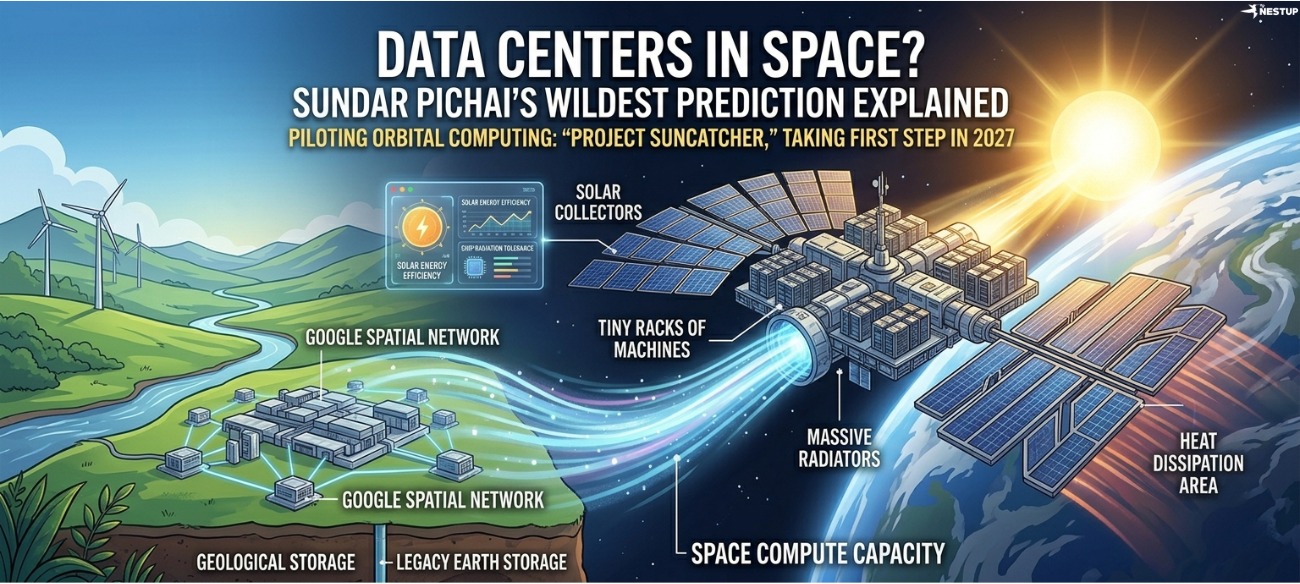
In orbit, the energy mathematics undergo a radical transformation. Beyond the veil of the atmosphere, solar energy is continuous, intense, and immune to the interference of weather. This offers the promise of a power source that never sets. However, harvesting this energy is only half the battle. As the source context highlights, transmitting that power—either to the servers or back to Earth—remains a "hard problem," requiring nascent microwave or laser transmission technologies that are not yet scalable. Yet, the allure of the "infinite battery" remains the central pillar of the orbital argument. As noted in recent analysis:
"AI is driving an unprecedented surge in compute demand—and Earth-based infrastructure is hitting limits."
The Cooling Paradox (Heat Without Air)
One of the most persistent myths of the "final frontier" is that its coldness makes cooling easy. In reality, thermal management in space is a brutal engineering paradox where hardware can simultaneously freeze and fry. On Earth, we rely on the fluid dance of air and water—convection—to carry heat away from humming processors. But the vacuum of space is an insulator, not a coolant.
In a vacuum, there is no matter to touch your heat sink; there is no air to blow away the thermal exhaust. Heat cannot be conducted; it must be radiated. This requires massive, specialized radiator panels that use infrared radiation to bleed heat into the void. These systems are heavy, inefficient, and mechanically complex. While this bypasses the billion-dollar electricity bills associated with terrestrial air conditioning, it introduces a "weight tax" that threatens to break the back of any launch manifesto.
Why Your AI Assistant Isn't Leaving Earth (Yet)
Despite the vision of a celestial cloud, the migration will be surgical rather than total. For the average user, the laws of physics impose a "latency" bottleneck. Because data is bound by the speed of light, the round-trip time for a signal to reach an orbital server and return is too sluggish for real-time applications. High-speed gaming, financial trading, and your conversational AI assistant will remain firmly grounded.
Instead, we are moving toward a hybrid model. The high-cost, high-latency environment of space will be reserved for high-value processing that is already native to the stars. The most immediate application is orbital edge computing: processing Earth observation data directly on the satellite rather than beaming raw, massive datasets back down to the surface. Other use cases include:
- Military & Intelligence: Secure, off-planet compute clusters resilient to terrestrial sabotage.
- Scientific Research: Massive climate modeling and space exploration simulations.
- Asynchronous AI Training: Large-scale model training where a few seconds of latency don't matter as much as the availability of raw power.
The Thousand-Dollar-per-Kilogram Barrier
The transition to orbital compute eventually hits the sobering "cold shower" of economic reality: the cost of gravity. Despite the arrival of reusable rockets, launch costs remain pegged at thousands of dollars per kilogram. When you consider that a modern, hyperscale data center weighs thousands of tons, the "sticker shock" of launching a terrestrial-sized rack into orbit reaches billions of dollars—a cost-prohibitive figure for all but the most specialized agencies.
Furthermore, we must ask why we would head for the stars when Earth still has untapped frontiers. Undersea and Arctic data centers are already being tested as far cheaper alternatives, utilizing the natural heat-sinking properties of the ocean or the polar air.
While early-stage startups like Starcloud are proposing modular compute platforms and Orbits Corp is exploring satellite-based edge processing, they must contend with the maintenance nightmare. On Earth, a technician can swap a failed drive in minutes. In space, a hardware failure is often permanent, requiring robotic intervention or mission-level repairs that the current economy simply cannot support.
It’s Not About Space—It’s About Scarcity
The shift toward orbital compute is a symptom of a deeper, more profound trend: the emergence of compute scarcity. Sundar Pichai’s vision is a reflection of a world where computation is no longer an abstract, infinite cloud service, but a physical commodity subject to the same laws of geography and resource extraction as oil, water, or gold. We are being forced to rethink the physical limits of where computation can exist because we are exhausting the hospitable real estate of our planet.
"Space data centers are less about replacing Earth infrastructure and more about exploring the limits of where computation can exist."
In this era of scarcity, the "cloud" is becoming a visceral, physical entity—one that we are willing to sink to the bottom of the ocean or launch into the radiant void just to keep the algorithms running.
Conclusion: The 2035 Horizon
The timeline for the silicon sun is measured in decades. Between 2026 and 2030, we will see the "scout" phase—prototypes and small-scale experiments in satellite-based edge computing. Only by 2035 might we see the first limited commercial deployments within a mature hybrid model.
We are left with a fundamental question: Will we find a way to break the energy and cooling bottlenecks here on Earth through terrestrial innovation, or is the next generation of human intelligence destined to be written in the stars? The economics are currently a deterrent, but the strategic necessity is becoming a mandate. The AI era is no longer just a software challenge; it is a race to master the physical limits of the universe.