
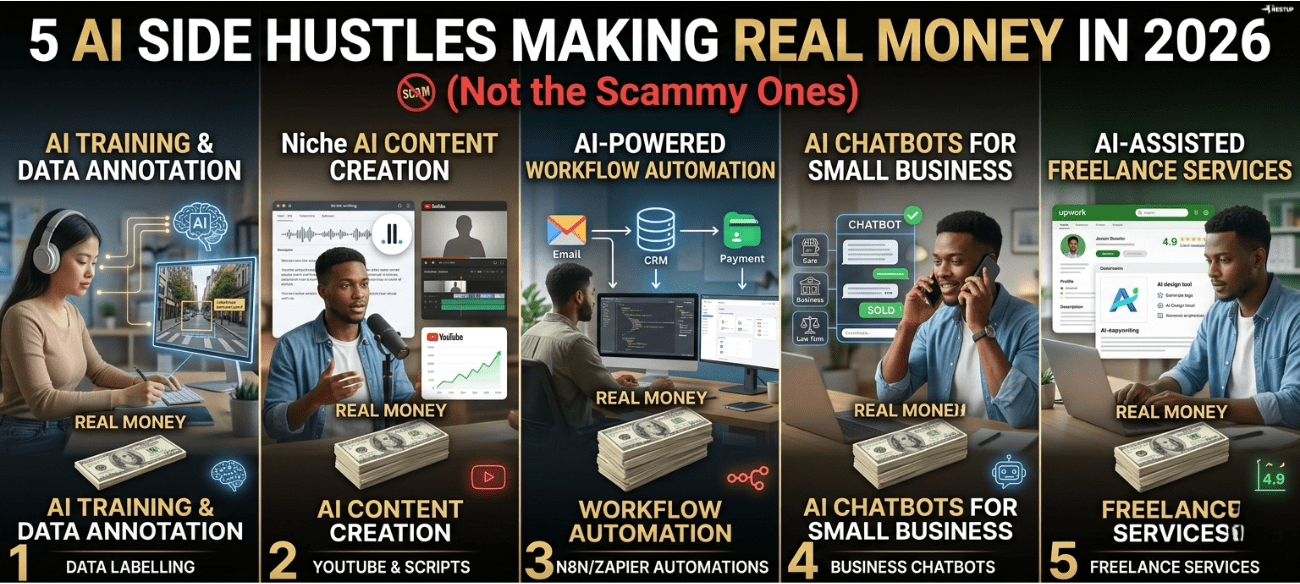
1. The Hook: Debunking the "Magic Button" Myth
Looking back from 2026, the AI "Gold Rush" of 2023 feels like a fever dream of collective naivety. We’ve finally moved past the era of "get rich quick" scams and the hollow promise of the "magic money button." The market has a long memory; it has efficiently purged the grifters who claimed a single prompt could generate a ten-thousand-dollar weekly windfall.
In today’s Utility Era, we recognize AI for what it actually is: a force multiplier. It doesn’t generate income out of thin air; it provides the leverage necessary to solve real-world problems with unprecedented efficiency. The solo economy is no longer about "using AI"—it’s about using AI to produce faster, test ideas with near-zero capital, and operate with the strategic weight of a mid-sized agency. The following five sectors represent the shift from chasing hype to capturing durable value.
2. Technical Writing as a High-Value Bridge
The Quiet Reliability of Technical Documentation
In the 2026 economy, technical documentation has emerged as the unglamorous bedrock of SaaS profitability. As the complexity of software ecosystems has exploded, the gap between "code that works" and "code that users understand" has widened. AI is the engine that speeds up the drafting of API guides and knowledge bases, but the human remains the architect.
The market value here isn't in the raw text—which is now a commodity—but in the human-structured clarity required to navigate technological debt. Companies are desperate for specialists who can audit AI-generated drafts for accuracy and bridge the gap for human developers.
| Experience Level | Earnings Estimate |
| Beginner | $20 – $40 per hour |
| Expert / Niche (SaaS/Dev Tools) | $75 – $150 per hour / $1,000+ per project |
3. The Rise of the Hyper-Specific Micro-SaaS
Specificity Wins: Building Focused AI Tools
The era of the "Generalist AI Assistant" is dead. In 2026, generic tools struggle to survive because general-purpose AI has become a baseline commodity integrated into every OS. To win as a solo founder, you must pivot toward hyper-specificity. Success now belongs to those building Micro-SaaS tools that solve one—and only one—pain point for a high-value niche, such as specialized real estate listing generators or automated legal discovery for boutique firms.
This shift is driven by the power of zero-marginal-cost scaling. When your tool is hyper-focused, AI can handle the bulk of customer support and feature iteration, allowing a solo player to maintain high margins without a headcount. In a world of infinite content, niche context is the only remaining moat.
Scalability and Revenue: These focused applications allow for rapid prototyping. A well-positioned Micro-SaaS can realistically generate between $5,000 and $20,000 per month once it captures a dedicated user base, proving that depth beats breadth every time.
4. Practical AI Consulting for Local Businesses
Solving Real-World Friction for Small Businesses
While Silicon Valley chases AGI, the local dry cleaner and the regional law firm are still drowning in operational friction. They don’t need cutting-edge research; they need "workflow integration." The opportunity for the 2026 consultant is to act as a pragmatic bridge, translating complex tech into bottom-line savings for businesses that the tech giants have ignored.
A consultant delivers value by identifying high-friction tasks and implementing "boring" but effective automations:
- Deploying specialized customer service agents that actually understand local inventory.
- Building proprietary content workflows for local marketing.
- Automating back-office data entry and scheduling.
"The key is positioning yourself as a problem solver, not an 'AI expert.'"
Local businesses value outcome-based pricing. They will happily pay a $1,000 to $5,000 monthly retainer if you can prove you’ve reclaimed twenty hours of their week.
5. The Durable Value of AI-Accelerated Newsletters
Curation and Insight: The New Digital Asset
In an information environment saturated by synthetic media, human-vetted curation has become a luxury good. Newsletters in 2026 have transitioned from "news summaries" to "trusted filters." AI handles the labor-intensive research and structural outlining, but the human author provides the one thing AI cannot: a defensible perspective.
This is a "slow build" asset, but its durability is unmatched. By the time you reach the 5,000-subscriber milestone, you aren't just selling ad space; you are selling trust. In the Utility Era, people pay to have the noise filtered out, making newsletters a primary vehicle for high-ticket sponsorships and deep industry influence, yielding $1,000 to $5,000 per month at the mid-tier level.
6. Moving from Prompts to Repeatable Systems
Selling Outcomes, Not Sentences
The term "Prompt Engineering" has largely been retired to the archives of 2023. In its place, we have Architectural Workflow Design. The market no longer pays for "clever sentences"; it pays for repeatable systems that produce consistent, high-quality business outcomes.
The transition is simple: Stop selling prompts and start selling systems. If you design a workflow that automates a company’s entire legal intake or financial reporting, you are no longer a freelancer—you are a systems architect.
- Basic Workflows: $100 – $500 per implementation.
- Advanced Integrated Systems: $1,000 – $3,000+ based on the complexity and the time saved for the client.
7. The Common Thread: A Pattern of Problem Solving
Every successful solo venture in 2026 shares a DNA of pragmatism. They leverage AI to achieve three specific goals: Speed of execution, radical cost reduction, and quantifiable quality improvement. If a project doesn't hit at least two of these, it’s just a hobby.
Biggest Mistakes to Avoid
- Chasing the Hype Cycle: Building tools for problems that don’t exist just because the tech is "cool."
- Over-reliance on Raw Output: Shipping unedited AI content is the fastest way to destroy your brand's authority.
- Strategic Fragmentation: Trying to master five niches at once. In 2026, the riches are truly in the trenches of the niches.
8. Conclusion: Treat AI as a Tool, Not a Business Model
The maturity of the 2026 solo economy has taught us a vital lesson: AI lowers the barrier to entry, but it does not lower the bar for excellence. AI is a magnificent tool, but it is a miserable business model. Strategy, niche expertise, and the ability to identify human pain points remain the only non-commoditized skills.
As you navigate this landscape, move past the "how" of the technology. Instead, ask yourself: Which specific problem am I uniquely equipped to solve using these new force multipliers?