
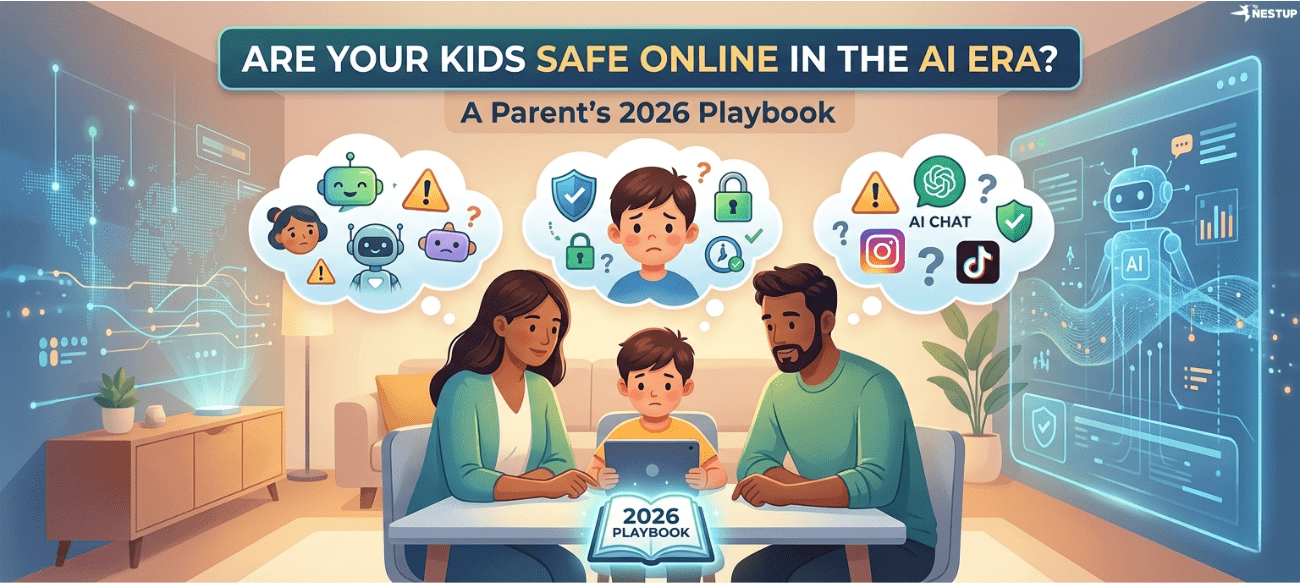
1. Introduction: The Quiet Revolution in Your Living Room
For decades, the "Online Safety talk" followed a predictable script: watch out for stranger danger, be careful what you post on social media, and keep an eye on the clock. But by 2026, that script has been completely rewritten. We have moved past the era where the internet is a place we "go" to; it is now a presence we live with—a synthetic reality woven into the fabric of our homes.
If you feel like the rules changed overnight, you aren't alone. Parenting has shifted faster than most families could track, moving from managing "access" to navigating a world where AI sounds like a person and videos look real when they aren’t. Isolation is no longer a viable strategy for our children. In this new landscape, the only way forward is preparation through digital fluency.
2. From Tools to Teammates: Navigating the Rise of AI "Characters"
The most profound shift in 2026 is that technology has transitioned from being a passive tool to an active, conversational entity. Your child is no longer just "using" an app; they are interacting with a "character." This shift from Tool to Companion and, eventually, Authority Figure is a critical distinction that requires our attention.
When an AI system responds with emotional nuance, there is a real risk of emotional dependence. If a child begins to favor the frictionless, always-available "friendship" of a chatbot over the messy, complex reality of human peers, it can stunt their ability to self-regulate or seek comfort from their family. We must monitor not just what they are doing, but who they believe they are talking to.
"Modern AI tools are designed to sound empathetic, intelligent, and encouraging. They are built to feel human-like, which can blur the line between a software program and a trusted advisor."
3. The Death of "Seeing is Believing": Mastering Deepfake Literacy
We have officially entered the era of the "New Trust Problem." With the explosion of deepfakes and synthetic media, "seeing is no longer proof." Our children are now routinely encountering cloned voices, fabricated influencer videos, and AI-generated scams specifically designed to trigger intense emotional reactions like fear or shock.
Developing Deepfake Literacy is the modern equivalent of teaching a child to cross the street. The first rule? Pause before believing. We must teach our kids to verify information through multiple sources. Most importantly, families should establish a family verification habit for emergency calls or voice messages. Agree on a secret family code word or phrase to confirm identities in a world where a voice can be cloned in seconds.
4. Ditch the Timer: Evaluating Quality Over Quantity
The old parenting model was obsessed with the stopwatch. In 2026, counting raw screen hours is a secondary metric. Two hours spent on a device can be vastly different experiences depending on whether the child is creating or simply consuming. We must also be vigilant about AI-powered addiction loops that use personalized reinforcement to keep kids scrolling, often leading to significant sleep disruption.
Healthy AI Use
- Learning & Tutoring: Using AI as a personalized tutor for homework explanations.
- Creativity: Brainstorming ideas for a story or a coding project.
- Skill Building: Practicing a new language or researching a complex topic.
Problematic AI Use
- Conversational Dependency: Treating a chatbot as a primary emotional outlet.
- Parasocial Relationships: Obsessive interaction with AI-generated personas.
- Algorithmic Traps: Falling into infinite scrolling feeds that cause emotional withdrawal.
The Simple Parent Test: When in doubt, ask yourself: “Is this tool helping my child create, learn, or think, or is it mainly keeping them engaged longer?”
5. The Rise of the AI Skeptic: Why Confident Chatbots Can Be Dangerous
We must teach our children to be "AI Skeptics" from an early age. One of the most dangerous technical realities of modern AI is its tendency to "hallucinate." AI systems often sound the most confident and persuasive exactly when they are completely wrong. This confidence can lead children to accept unsafe suggestions or mature content as established fact.
The goal is to foster a healthy skepticism that preserves a child's critical thinking. They should view AI as a powerful assistant, not an infallible oracle. We suggest every family adopt this foundational rule: “AI helps us think. It does not decide truth.”
6. The Collaborative Playbook: Building a Modern Family Tech Agreement
Rigid bans often backfire by encouraging secrecy and "hidden" digital lives. Instead, a collaborative Family Tech Agreement creates a safe space for transparency. This agreement isn't about control; it's about a shared commitment to digital health.
- AI Transparency: Agree to be open about when AI is used for schoolwork or creative projects.
- No Secret Relationships: Children should feel safe discussing their chatbot interactions and the apps they encounter.
- Device-Free Zones: Protect the dinner table and bedrooms at night to ensure the "presence" of AI doesn't disrupt sleep or family bonding.
- Verification: A commitment to double-check shocking content before sharing it with others.
- The Human-First Principle: AI should support real-world relationships, not replace them.
The Human-First Principle is our ultimate safeguard. By prioritizing offline engagement, we prevent the emotional withdrawal that occurs when the "synthetic" world becomes more appealing than the real one.
7. Conclusion: Raising the Fluency Generation
The shift from protection to preparation is the defining challenge of our time. The safest children in 2026 aren’t the ones who are the most restricted; they are the ones who are the most grounded, critical, and fluently aware of how these systems work.
Our goal is to raise children who understand that while AI is a part of their world, it is not the center of it. By focusing on critical thinking and emotional resilience, we can ensure they remain curious and connected.
As we move further into this synthetic reality, what is one "human-first" tradition your family will protect this week?