
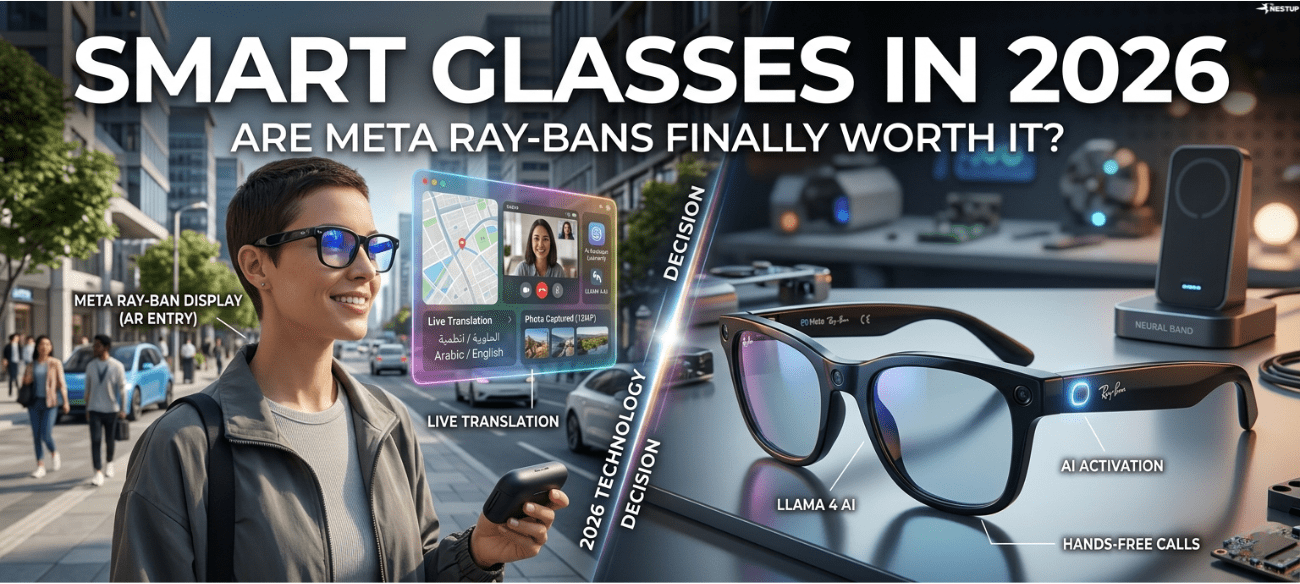
For a decade, the smart glasses category was less of a market and more of a graveyard for silicon-heavy face-jewelry. Early attempts were the antithesis of "cool," making users look like awkward cyborgs and signaling a desperate devotion to experimentation over aesthetics. They were bulky, socially radioactive, and functionally anemic—the kind of tech you’d hide in a drawer rather than wear to a dinner party.
By 2026, the landscape has fundamentally inverted. The "tech-goggle" era is officially over, replaced by sleek, refined frames that pass the "mirror test" with flying colors. We are finally witnessing the slow-motion death of our "phone-leash" addiction. For years, we’ve been tethered to glowing glass rectangles in our pockets, but the arrival of ambient computing is shifting the paradigm.
Ambient computing represents a move from active computing, where you must physically go to a device to perform a task, to passive computing, where the technology lives in the periphery of your life. It is the transition from a tool you use to an assistant that is simply there. In 2026, the screen isn't just getting better; it’s disappearing into the fabric of our daily routines.
Takeaway 1: AI, Not AR, Is the Real Killer Feature
The industry’s pivot away from complex holograms toward invisible intelligence is what saved the category. We spent years waiting for Iron Man-style visual overlays, but it turns out we didn't need a digital world painted over our reality—we needed a layer of intelligence that understands what we are seeing. AI has become the invisible engine driving these devices, acting as a contextual mediator between the user and the world.
Instead of navigating clunky menus projected onto a lens, the modern smart glasses experience is built on sophisticated voice-first interaction and real-time awareness. Users can look at a French menu and ask, “Translate this,” or point their gaze at a landmark and ask, “What am I looking at?” This seamlessness turns the hardware into a lightweight ambient assistant that processes the world in real-time without the distraction of a flickering display.
"The biggest shift: AI made voice-first computing actually usable."
Takeaway 2: Friction Reduction is More Valuable Than Holograms
In the tech world, we often mistake "immersion" for "utility." However, the breakout success of smart glasses in 2026 isn't about deep-diving into a digital world; it’s about friction reduction. Friction is the cognitive and physical tax of reaching into your pocket, unlocking a phone, and navigating an app just to check a notification or snap a photo. By moving these micro-interactions to the face, the "tax" is nearly eliminated, allowing digital life to happen without interrupting the physical flow.
This shift represents a profound behavioral change: users are choosing presence over immersion. We’ve realized that we don’t want to be sucked into a screen; we want to stay grounded in our environment while still being connected. The value is found in the hands-free moments where a phone would traditionally be a barrier:
- Cycling and Commuting: Getting navigation cues and essential notifications without taking eyes off the road or hands off the bars.
- Cooking: Checking ingredient measurements or setting timers while your hands are covered in flour.
- Parenting: Capturing the perfect, spontaneous photo of a child without a smartphone coming between the parent and the moment.
- Exploration: Getting real-time summaries of documents or signs instantly while walking through a new city.
Takeaway 3: The "Normalcy" Mandate (Fashion as Technology)
The Meta Ray-Ban partnership was the watershed moment because it acknowledged a hard truth: looking "normal" is a technical requirement for wearables. Social acceptance was the final boss that earlier iterations like Google Glass could never defeat. If a device makes the user look like a "Glasshole" or a futuristic lab tech, it fails the social contract.
In 2026, we’ve learned that fashion credibility matters every bit as much as processing power. By housing high-end cameras and AI processors inside frames that are indistinguishable from standard Wayfarers, manufacturers bypassed the social discomfort that killed previous attempts. If it looks like a gadget, it stays a niche toy; if it looks like iconic eyewear, it becomes an everyday essential. The technology has finally learned to respect the human face.
Takeaway 4: The Audio-First Hybrid Experience
One of the most transformative features of 2026’s smart glasses is the "audio-first" design. Rather than plugging your ears and isolating you from the world, these devices use open-ear speakers that beam sound directly into your canals while leaving you fully aware of your surroundings.
This creates a unique "audio without isolation" experience. You can listen to a podcast, take a work call, or receive AI-driven navigation cues while still hearing the person walking next to you or the traffic behind you. This hybrid layer of sound makes the glasses a more seamless part of the daily routine than traditional headphones, as they never require you to "switch off" the real world to engage with the digital one.
Takeaway 5: Choosing Your Future (The 2026 Landscape)
The market has matured past the "one size fits all" phase, settling into specific functional niches. Users now choose their hardware based on whether they prioritize stylish AI assistance, developer-level AR, or high-fidelity media consumption.
| The Device | The Ideal User |
| Ray-Ban Meta | Everyday consumers wanting stylish frames and a seamless AI assistant. |
| Snap Spectacles | Developers and creators; an experimental future platform for AR. |
| RayNeo X2 | Utility-focused users needing real-time translation and heads-up info. |
| Xreal Air 2 | Media enthusiasts seeking portable workspaces and virtual cinema screens. |
The Reality Check: We Aren’t at All-Day Power Yet
Despite the hype, the physics of the human face remain the hardest hardware challenge. Smart glasses must balance a delicate triangle of weight, heat, and battery life. Because they must remain light enough for all-day comfort, they cannot yet handle the thermal load or the massive batteries required for true "power-user" operation.
Be blunt: these are currently several-hour devices, not all-day laptop replacements. Heavy use of the camera or constant AI queries will drain the battery long before your workday is over. Furthermore, the "always-on" nature of these cameras continues to create social friction. While standardized recording indicators have helped, the unease of being around a device that could be "watching" or "listening" is a cultural hurdle that technology hasn't fully cleared yet.
Conclusion: The Computer That Disappears
In 2026, we’ve stopped trying to build a computer for the face and started building an assistant for the life. The shift from "gadget" to "ambient assistant" is complete. We are no longer obsessed with how many pixels we can cram onto a lens; we are obsessed with how much friction we can remove from our day.
The bottom line is that the most successful computers of the future are not the ones that demand more of our attention, but the ones that slowly disappear into everyday life. As the hardware becomes more invisible and the AI becomes more contextually intuitive, the "phone-leash" will finally snap.
The Question: Are you ready to trade your smartphone screen for a voice-first wearable that looks like a standard pair of glasses?