

Top 5 This Week

Related Posts

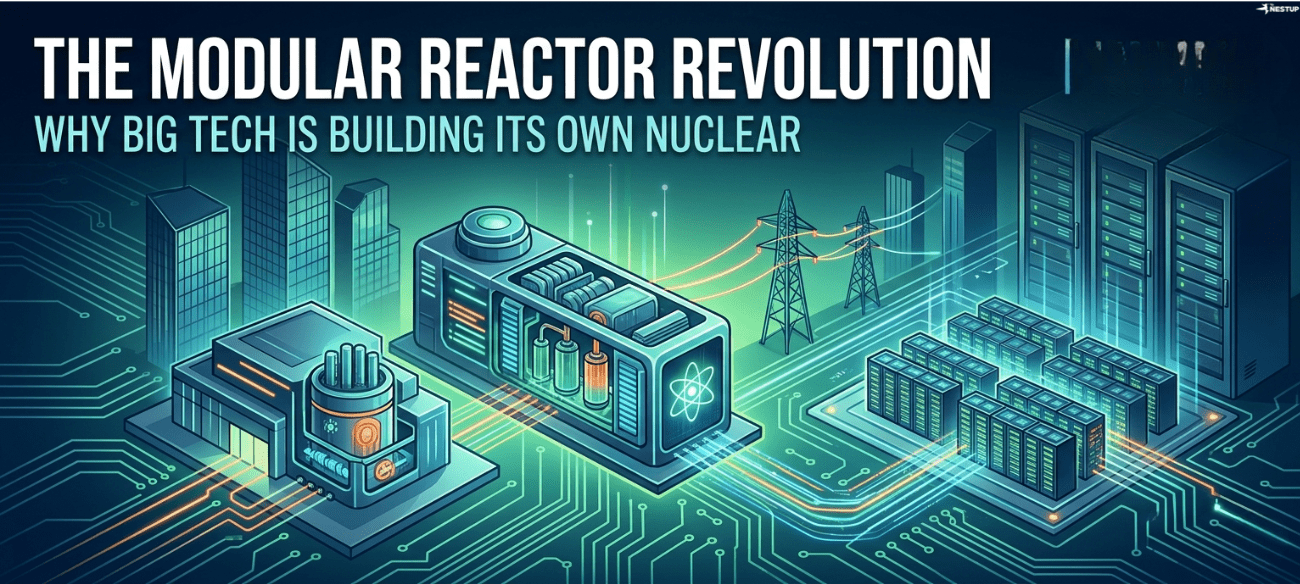
The Modular Reactor Revolution: Why Big Tech Is Building Its Own Nuclear.

For over a decade, Silicon Valley’s guiding light was Marc Andreessen’s mantra that “software is eating the world.” But as the generative AI revolution moves from experimental code to industrial-scale deployment, a new, more visceral reality has taken hold: electricity is eating the world. The shift from traditional cloud computing to the massive appetite of large language models has triggered a brutal reality check. Frontier AI models and hyperscale data centers require energy infrastructure on a scale that few predicted, forcing tech giants to move beyond the digital realm and into the business of heavy atoms.

According to the International Energy Agency (IEA), electricity demand from data centers could more than double by 2030. This surge is almost entirely driven by AI workloads, creating a desperate need for clean, reliable power that the current grid is ill-equipped to provide. To bridge this gap, the world’s most powerful technology firms are pivoting toward a solution once considered politically radioactive: the nuclear renaissance.

Beyond the Grid—The Rise of the “Digital Utility”

Tech giants are undergoing a fundamental transformation in their corporate DNA. No longer content to be mere software providers, firms like Microsoft, Amazon, and Google are aggressively shifting into the role of “digital utilities.” This is a move toward deep vertical integration, reminiscent of the industrial titans of the 19th century who found it necessary to own their own railroads and steel production to ensure their survival.

In this new era, controlling energy infrastructure is no longer a peripheral utility expense managed by procurement teams; it is a core strategic necessity for platform competitiveness. By securing their own power sources, hyperscalers are insulating themselves from the volatility of the commercial grid and the looming scarcity of “firm” power.

“Some analysts now describe AI companies as ‘digital utilities’ because their infrastructure increasingly resembles industrial-scale energy consumers rather than traditional software firms.”

Why Wind and Solar Aren’t Enough for the AI Age

While solar and wind have seen a decade of plummeting costs and rapid expansion, the AI boom has exposed their inherent limitations. The “brutal reality check” mentioned in the industry is the realization that AI inference systems and GPU-intensive clusters operate at a continuous, high-density power demand that intermittent renewables cannot satisfy alone.

Crucially, from an infrastructure perspective, nuclear offers a level of power density and land-use efficiency that renewables cannot match. A solar farm of equivalent output requires significantly more land—a scarce resource near the fiber-rich hubs where data centers are built. AI infrastructure requires “firmness”—unwavering reliability—that dictates five specific requirements:

  • Massive electricity loads to energize increasingly dense GPU clusters.
  • Stable 24/7 uptime to maintain the “always-on” nature of global AI services.
  • Predictable baseload generation that functions regardless of weather variability.
  • High cooling capacity to manage the thermal output of hyperscale hardware.
  • Grid reliability to ensure that localized surges do not trigger cascading failures.

SMRs—The Factory-Built Future of Fission

The technology industry is not betting on the massive, custom-built gigawatt-scale plants of the 20th century. Instead, the focus has shifted to Small Modular Reactors (SMRs). These systems, typically generating between 50 and 300 megawatts, represent a shift from civil engineering mega-projects to standardized industrial manufacturing.

SMRs are particularly attractive for decentralized AI infrastructure, such as remote compute campuses and microgrids, where power can be generated and consumed on-site without taxing the public grid. The goal is to move nuclear power toward a “product” model rather than a “project” model. Key objectives include:

  • Manufacturing standardization to allow for assembly-line production of reactor components.
  • Reduced construction complexity by shifting the bulk of the work to controlled factory environments.
  • Lower upfront costs to mitigate the massive financial risks that historically crippled nuclear investment.
  • Improved safety systems that utilize passive cooling, requiring no human intervention in an emergency.
  • Accelerated deployment timelines to match the breakneck speed of AI scaling.

“Think of [SMRs] less like giant mega-projects and more like deployable industrial energy units.”

The Great Rebranding—Three Mile Island as AI Infrastructure

The most symbolic milestone in this pivot is the historic deal between Microsoft and Constellation Energy to restart Unit 1 at Three Mile Island. For decades, that name was a global synonym for nuclear fear and industrial failure following the 1979 accident. Its return to service specifically to power Microsoft’s data centers marks a remarkable reversal in public and corporate sentiment.

This move signals that hyperscalers have transitioned from being mere customers of utilities to becoming the primary financiers of advanced nuclear systems. By breathing life back into a site once destined for decommissioning, Microsoft is treating energy as strategic infrastructure, turning a relic of the old world into a fuel for the new one.

The Specialized Bets—Amazon and Google’s Diverse Architectures

While Microsoft has focused on the immediate procurement of existing assets, Amazon and Google are executing a two-pronged strategy: securing today’s power while funding the “Generation IV” innovation of tomorrow.

Amazon + X-energy Amazon Web Services (AWS) has anchored its nuclear strategy in X-energy’s high-temperature gas-cooled reactors. These reactors use “pebble-bed” fuel and are designed for high-efficiency industrial power generation. For Amazon, this is a bet on securing a long-term, carbon-free baseload to maintain its cloud dominance, where electricity availability is now the primary bottleneck to growth.

Google + Kairos Power Google’s approach is more experimental and long-term, partnering with Kairos Power to develop fluoride salt-cooled reactors. This architecture is strategically significant because it operates at lower pressures and utilizes passive safety mechanisms, drastically reducing meltdown risks. For a brand as visible as Google, investing in “Generation IV” safety is as much about risk management as it is about energy procurement.

The AI-Energy Feedback Loop

We are now entering a defining industrial cycle where AI and energy are no longer separate sectors, but a single, interconnected feedback loop.

  1. AI models require exponentially larger data centers to achieve higher intelligence.
  2. Data centers require massive electricity loads that exceed current grid capacity.
  3. Electricity demand strains existing power infrastructure, threatening reliability.
  4. Big Tech responds with direct vertical integration, funding and owning energy assets.
  5. More energy allows for the deployment of even more powerful hardware clusters.
  6. Larger AI systems drive a renewed cycle of energy demand and infrastructure investment.

A Cultural and Geopolitical Shift

This renaissance is being propelled by a quiet but profound cultural shift. Younger, climate-focused demographics are increasingly decoupling nuclear energy from old “anti-nuke” narratives, instead viewing it as an essential tool for rapid decarbonization and energy security.

Geopolitically, we are witnessing the dawn of a “Nuclear-AI Arms Race.” Global powers now recognize that AI leadership, semiconductor self-sufficiency, and energy sovereignty are a single strategic priority. In this context, advanced reactors are no longer just power plants; they are instruments of national strategy, essential for any country that wishes to maintain a competitive edge in the era of artificial intelligence.

Conclusion: The Reality Check of 2030

The alliance between Silicon Valley and nuclear power is not a product of ideology, but of a brutal infrastructure reality. As we look toward 2030, the “renaissance” faces existential hurdles that could still derail the timeline. Very few commercial SMRs operate today, and cost projections remain largely theoretical. The industry must navigate a maze of regulatory approvals, secure a fragile fuel supply chain, and solve the long-standing problem of waste management.

The success of the AI revolution will likely depend less on the elegance of its algorithms and more on the scalability of its physical hardware. As the demand for compute continues to climb, the tech industry faces a final, provocative question: Does the future of the internet depend on our ability to mass-produce atoms rather than just bits?

LEAVE A REPLY

Please enter your comment!
Please enter your name here

Popular Articles