
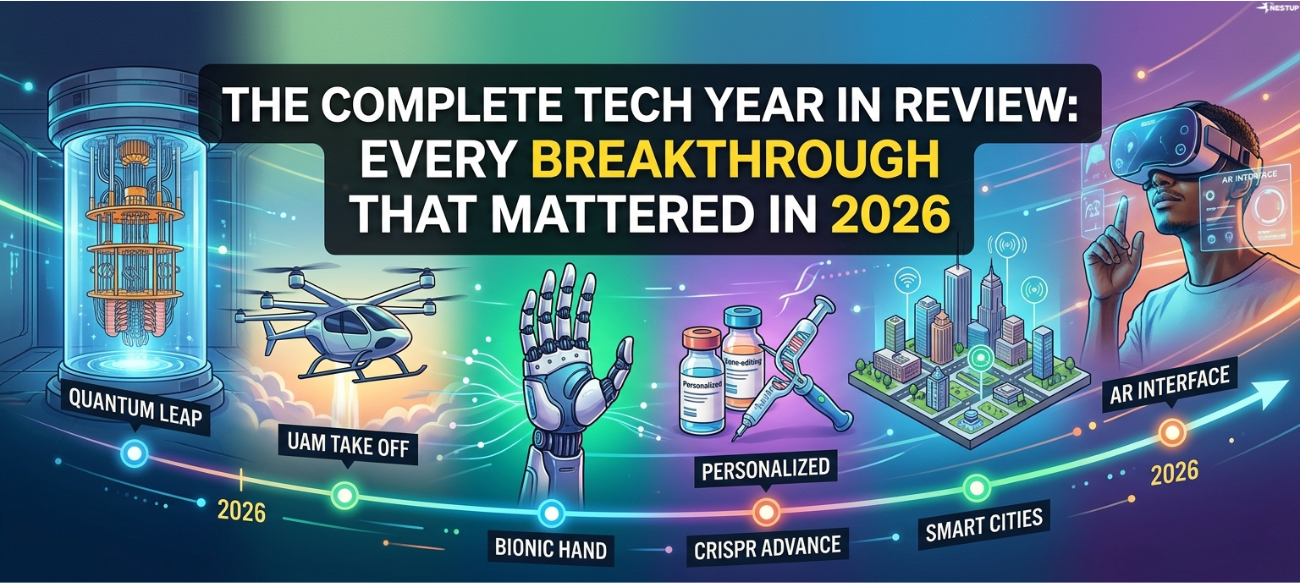
If 2025 was defined by a breathless race toward the horizon, 2026 was the year we felt the ground shift beneath our feet. For a decade, we have lived in a state of perpetual "beta," testing prototypes and debating potential. But over the last twelve months, the narrative shifted from speculative acceleration to deep, systemic integration. The events of this year have confirmed a tectonic truth: the technologies we once labeled as "future" have officially been woven into the fabric of the present.
As the industrial shifts of the past year demonstrate, we are no longer merely witnessing breakthroughs; we are living through their consequences.
"If 2025 was the year technology accelerated, 2026 was the year it started changing everyday life."
The "Surprise" Workforce: When AI Stopped Chatting and Started Working
The most startling revelation of 2026 was not the birth of a more eloquent chatbot, but the speed at which AI became a functional digital workforce. We expected a gradual, decade-long transition; instead, we witnessed a wholesale structural migration.
In boardrooms across the globe, the central question evolved almost overnight. We moved past the tentative "Should we use AI?" and entered a period of frantic execution: "How quickly can we deploy it?" This wasn't about minor efficiency gains; it was about the widespread deployment of autonomous agents capable of research, complex scheduling, and operational management.
While a model release is a mere moment in time, scaling those models into a global workforce is a movement that has begun to reshape the global economy. For the first time, we are measuring progress not by benchmarks, but by productivity gains at a scale that moves the needle on GDP.
Reasoning Over Raw Power: The New Intelligence Frontier
This was the year the industry realized that "bigger" is not always "better." The pivot in AI development moved away from the brute force of increasing model size and toward the surgical precision of reasoning. We have finally moved beyond the era of advanced autocomplete.
Today’s models are no longer just predicting the next likely word; they are acting as problem-solving assistants with the ability to handle:
- Complex Planning: Orchestrating multi-step projects and navigating shifting dependencies.
- Logical Execution: Solving intricate problems in science and engineering that require more than just a vast memory.
- Systemic Synthesis: Writing and debugging software with a focus on architecture and logic rather than simple syntax.
This shift is more than a technical nuance—it is a fundamental change in utility. Reasoning is the key that has unlocked new frontiers in engineering and education, proving far more valuable than raw knowledge alone.
The Lab Is Empty: Humanoid Robots Enter the Wild
For years, humanoid robots were the stars of viral videos—impressive, but ultimately tethered to the laboratory. In 2026, the lab finally went empty. We have seen these machines step into the messiness of the real world, moving beyond controlled demonstrations into the heart of manufacturing, logistics, and even home-assistance applications.
Led by pioneers like Tesla, Figure AI, and 1X Technologies, the "marriage" of advanced robotics and AI reasoning has birthed a new industrial era. We are witnessing the beginning of what will likely become one of the largest technology markets in history. The sight of a humanoid robot navigating a warehouse or assisting in a domestic setting is no longer a "vision of the future"; it is a line item in a 2026 corporate budget.
CRISPR’s Practical Turning Point: Beyond the Experiment
In the realm of biotechnology, 2026 marked the end of the experimental era for gene editing. CRISPR-based therapies have transitioned into the realm of practical medicine, reaching patients in clinical settings with a precision and safety profile that was once a distant hope.
This is the most significant healthcare advance for patients with inherited disorders in a generation. We are moving toward a world where genetic destiny is no longer a fixed sentence, but a condition that can be edited and improved.
"For patients with inherited disorders, this could be one of the most important healthcare advances of the century."
The Invisible Infrastructure: Nuclear Rebirth and Energy Realities
One of the most profound insights of 2026 is that the bottleneck for artificial intelligence is no longer just code or chips—it is the physical reality of the power grid. The insatiable demand for compute has forced an unexpected and necessary synergy between data centers and nuclear power. Reliable, 24/7 clean energy is no longer just an environmental aspiration; it has become a hard requirement for the expansion of global computing power.
This renewed interest in next-generation reactors and small modular designs marks a nuclear rebirth, driven by the practical needs of the digital age. This stands in stark contrast to the steady, incremental progress of the rest of our energy backbone. While battery density and renewables continue to improve at a predictable pace, the sudden integration of nuclear power into the tech sector's infrastructure represents a fundamental shift in how we power our high-tech future.
The Democratization of Creation: Coding Agents and Small Models
The economics of building digital products have been permanently altered, leading to a significant shift in digital sovereignty. The rise of highly capable AI coding agents has made software development faster and cheaper than ever before, but the true futurist insight lies in the proliferation of "small models."
By moving away from a total dependency on the cloud, organizations are now running powerful AI locally. This shift toward local execution reduces costs and decentralizes power, ensuring that the ability to create and innovate is no longer concentrated in a few well-funded tech giants. We are seeing a democratization of creation where the barrier to entry for building a world-class digital product has effectively vanished.
The Point of No Return
2026 was the year that proved these technologies "actually work" at scale. We have passed the point of no return, moving from a world of "what if" to a world of "what is." From the digital workforce to the arrival of humanoid labor and the practical application of gene editing, the ideas we once considered science fiction are now the foundational components of our global economy.
The overarching lesson of the past year is that the horizon is much closer than we think. 2026 was the year the future started arriving faster than expected.
Which of these shifts—from the rise of the digital workforce to the arrival of humanoid robots—will impact your specific life or career most in the coming year?