
The February Fade
Every December 31st, we experience the same ritual: a blazing fire of inspiration and a surge of motivation to completely reinvent our lives. But by mid-February, for most, that fire has dwindled into a faint glimmer. Old patterns reclaim the driver’s seat, and we’re left wondering where our discipline went.
If you find yourself slipping, it’s time to stop the self-flagellation. This isn't a character flaw or a lack of "grit." It is a biological reality. Your brain is simply doing its job, performing exactly as it is wired to do. To make your 2027 resolutions stick, you must stop trying to bully your biology and start designing a strategy around it. The following insights provide a science-backed "exit ramp" from old habits and a blueprint for sustainable success.
Willpower is a Resource, Not a Character Trait
We’ve been sold a lie: that willpower is a moral muscle you just need to flex harder. In reality, neuroscience tells us that willpower is a strictly limited cognitive resource managed by the prefrontal cortex—the front part of your brain responsible for high-level decision-making and planning.
Think of it as a battery. Every time you resist a distraction at work, navigate a difficult conversation, or force yourself through a tedious task, you drain that battery. By the time you get home, tired and stressed, your prefrontal cortex is exhausted. When the battery is dead, your brain defaults to its old, energy-saving programming.
"Relying on willpower alone isn't a strategy; it's a design flaw."
The shift from seeing a "lack of willpower" as a moral failing to a biological limit is incredibly empowering. It provides immediate psychological relief, stripping away the shame that often causes people to quit entirely after one slip-up. Once you remove the weight of character judgment, you are free to stop being a "tough guy" and start being a strategist.
Hacking the Habit Loop for Dopamine Rewards
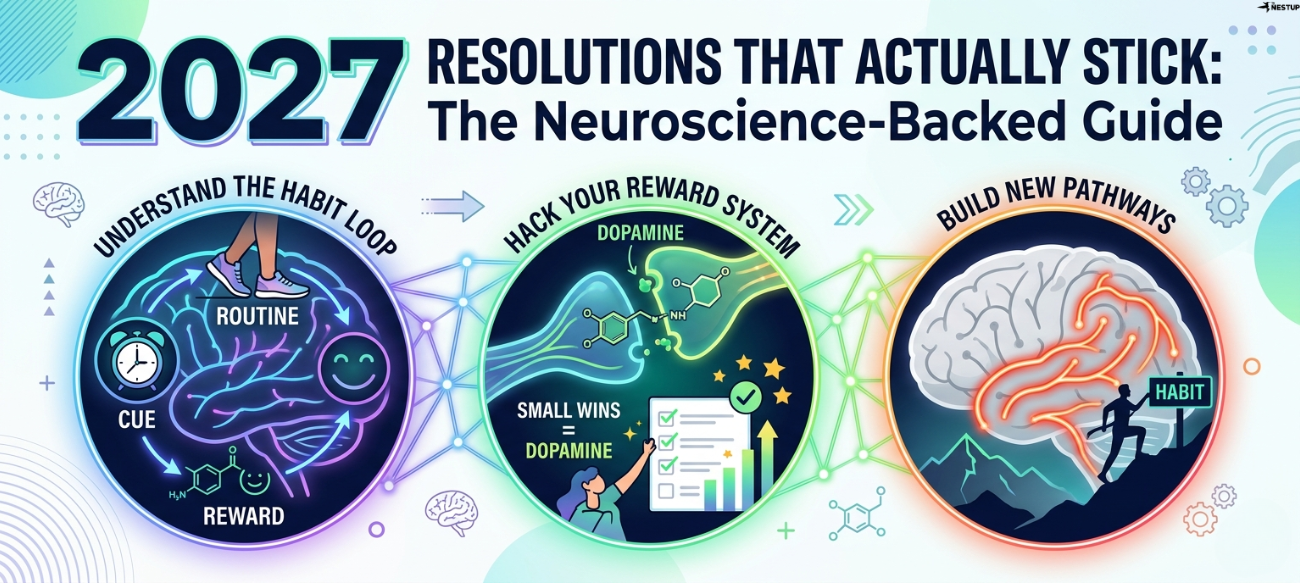
To change behavior effectively, you must understand the Habit Loop—the process by which the brain automates actions to save energy. This loop is composed of three distinct parts:
- The Cue: A situational trigger (a time of day, a specific location, or an emotion) that tells your brain to go on autopilot.
- The Routine: The actual behavior or habit you perform.
- The Reward: The chemical payoff—specifically a hit of dopamine. This neurotransmitter signals to the brain that the action was "worth it," reinforcing the neural pathway for next time.
Trying to break a bad habit through sheer force is like trying to manually tear down a deeply carved neural highway. Instead of fighting the highway, your goal is to build a smoother, more attractive "exit ramp"—a new routine that utilizes the same cues but offers a better, more accessible reward.
The "Lazy Brain" Strategy: Environment Design
The human brain is inherently "lazy"; it is evolutionarily programmed to choose the path of least resistance to conserve calories. You can turn this biological laziness into your greatest advantage by manipulating "friction"—the physical or mental effort required to complete a task. Because your physical environment is the most powerful generator of cues, design is your best defense.
To Build Good Habits (Reduce Friction):
- For writing: Leave your laptop open on your desk with your document already pulled up the night before.
- For hydration: Place a filled water bottle at your workspace first thing in the morning so it’s within arm's reach.
To Break Bad Habits (Increase Friction):
- For social media: Move apps off your home screen or log out after every session so you have to re-enter your password.
- For phone usage: Place your phone in another room while you work to make checking it a conscious physical effort.
Leveraging Evolutionary Social Stakes
Humans are deeply social creatures. From an evolutionary perspective, our brains are hardwired to prioritize social status because, historically, group survival was the only survival. You can leverage this hardware by creating an accountability system.
By sharing your goals with a partner or community, you introduce "social friction." Suddenly, skipping a habit has a social cost that your brain actively wants to avoid. Conversely, celebrating small wins with others triggers a healthy dose of dopamine. This ties back into the "Reward" phase of the Habit Loop, creating a powerful external reinforcement that makes you want to repeat the behavior.
The Power of Micro-Habits and the Identity Shift
The most common mistake in resolution-setting is the "big, fast" approach. Attempting to go from zero to sixty shocks the nervous system and triggers the brain’s "fear response" to drastic change, leading to swift burnout.
The "micro-habit" strategy is the consultant’s secret weapon. By keeping the barrier to entry incredibly low, you perform actions that are "below the radar" of the brain’s alarm system.
- Instead of reading a book, read two pages.
- Instead of a full workout, commit to five minutes.
The goal isn't the scale of the action; it's the establishment of an identity. When you read two pages every single day, you are no longer "someone trying to read"—you are a reader. Once the identity is established through consistency, scaling the habit up becomes the easy part.
Beyond the Planner
Sustainable change is not about the intensity of your desire; it is about the architecture of your life. By respecting the limits of your prefrontal cortex, hacking the habit loop, and masterfully designing your environment, you move from the state of "overwhelm" into a state of focused action.
The 2027 strategy isn't about fighting a war with yourself; it's about building a system where success is the easiest option. If you stopped trying to force your willpower and started designing your environment today, which "impossible" goal would suddenly become inevitable?