
 N
N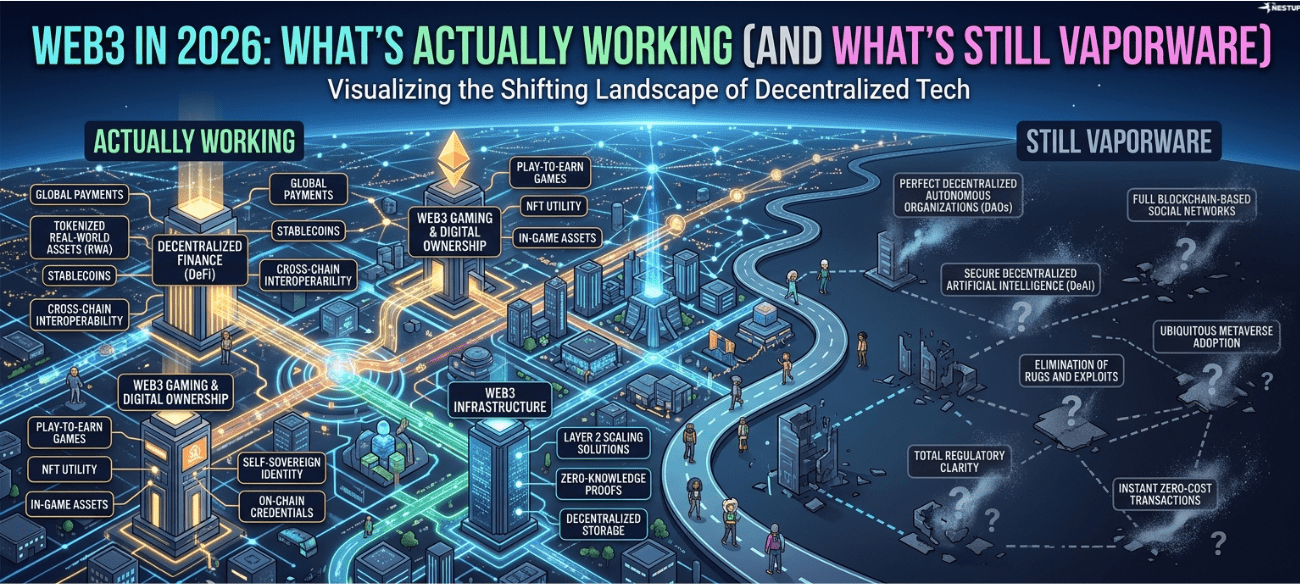
Introduction: What's Working in Web3 by 2026?
By 2026, the Web3 landscape has shifted from speculative hype to practical applications that solve real-world problems. Key successes include the $300 billion stablecoin market, mature prediction markets, institutional adoption of tokenized assets, purposeful use of NFTs, and a hybrid model of decentralization that combines blockchain technology with user-friendly interfaces.
Key takeaways
- The stablecoin market has surpassed $300 billion, providing essential liquidity and facilitating global transactions.
- Prediction markets have become reliable sources of information, surpassing traditional media in accuracy.
- Institutional adoption of tokenized real-world assets is transforming finance by reducing friction in asset management.
- NFTs have evolved from speculative assets to valuable tools for ownership verification and loyalty programs.
- The ideal of complete decentralization has shifted to a hybrid model that combines decentralized technology with centralized user interfaces.
What is the $300 Billion Stablecoin Revolution?
The stablecoin market, now exceeding $300 billion, has emerged as a vital component of the digital economy. Assets like USD Coin (USDC) and Tether (USDT) dominate global digital-dollar liquidity, enabling users to access the U.S. dollar seamlessly.
Stablecoins have gained traction by addressing key issues in global money movement. They are now the standard for:
- Global Dollar Access: Offering liquidity in emerging markets with volatile local currencies.
- Remittances and Cross-Border Payments: Facilitating near-instant settlements that bypass traditional banking systems.
- AI-Agent Payments: Serving as programmable currency for autonomous digital entities.
Their success lies in the fact that users rely on them for their utility rather than ideological reasons.
How are Prediction Markets Changing Information Reliability?
In a world filled with misinformation, prediction markets have emerged as reliable information systems. Platforms like Polymarket provide real-time, probabilistic data on various topics, outpacing traditional media sources.
By 2026, these markets have become essential tools for hedge funds and research firms, as financial stakes encourage participants to focus on factual information. As traditional polling struggles, prediction markets offer a clearer view of geopolitical events and economic forecasts.
What is the Institutionalization of "Boring" DeFi?
The initial anti-finance vision of Decentralized Finance (DeFi) has evolved into a modernization effort focusing on Tokenized Real-World Assets (RWAs). Institutions are now embracing blockchain technology to tokenize:
- U.S. Treasury bills and money-market funds.
- Private credit and commodities.
- Real estate exposure.
This shift aims to reduce administrative friction rather than overthrow the financial system, demonstrating that "boring" can be synonymous with functional.
How Have NFTs Found Purpose Beyond Speculation?
The speculative nature of NFTs has faded, but their underlying technology remains vital for ownership verification. Today, NFTs are utilized in:
- Ticketing and Loyalty Programs: Enhancing fraud prevention and market control.
- Gaming Assets: Supporting interoperable inventories and true ownership.
- Luxury Verification: Authenticating high-value physical goods through on-chain records.
- Memberships: Streamlining digital identity for exclusive access.
The infrastructure for digital ownership has survived, while the speculative culture has diminished.
What is the Reality of Decentralization in 2026?
The ideal of complete decentralization has given way to a more practical hybrid model. DAOs have shown limitations, leading to a focus on:
- Decentralized Settlement: Using blockchain for secure, transparent transactions.
- Centralized Interfaces: Providing user-friendly applications and compliance support.
While AI has taken center stage in tech narratives, Web3 now serves as the foundational infrastructure for the AI era, ensuring verification and security in a rapidly evolving digital landscape.
Conclusion: Embracing the Infrastructure Era
The transition from 2021 to 2026 reflects a shift from a decentralized utopia to a focus on practical infrastructure. The loud promises of revolutionary change have given way to the quiet yet impactful advancements in digital ownership and financial systems.
As we assess the digital landscape of 2026, we must consider whether we miss the hype of 2021 or appreciate the technology that now works seamlessly behind the scenes.