
The Hook: The Death of Simple AI
For the last three years, the corporate world has treated artificial intelligence as a novel utility—a convenient interface for drafting emails or distilling lengthy PDFs. As we cross the threshold into the first quarter of 2027, that "era of experimentation" has met an abrupt end. The curiosity that defined the early adoption phase has been replaced by a high-stakes mandate: the "era of autonomous mastery."
The technical landscape has shifted from deterministic workflows to agentic orchestration. We are moving away from assistants that offer advice toward autonomous agents that execute. Organizations still clinging to the chatbot-as-a-tool paradigm are facing a window of rapid operational irrelevance. To maintain a competitive edge, leadership must pivot toward a rigorous 90-day execution strategy, transitioning from basic prompt-based interactions to sophisticated, self-governing systems that drive core productivity.
From Assistants to Multi-Week Autonomous Swarms
The Q1 2027 horizon is dominated by a bifurcation of frontier models into two specialized categories: ultra-deep reasoning engines and hyper-fast, autonomous agent swarms. Unlike the static LLMs of the past, these models—spearheaded by Anthropic’s recursive self-improvement models and OpenAI’s deep reasoning lines—possess the cognitive endurance to manage complex, multi-week workflows without human intervention.
These "swarms" do not merely follow instructions; they iterate recursively on their own output to solve problems in software development, market synthesis, and longitudinal data analysis that once required entire departments.
"We are officially past the era of simple AI experimentation. The days of using AI just to write quick emails or summarize long PDFs are gone."
The Death of Prompt Engineering and the Rise of Agentic Architecture
The most significant devaluation in the current talent market is the collapse of prompt engineering. AI has achieved a level of sophistication where it optimizes its own internal prompting more efficiently than any human operator. Consequently, the strategic premium has shifted toward Agentic Architecture Design.
High-value professionals are no longer "talking" to AI; they are orchestrating multi-agent systems using frameworks like CrewAI and LangChain. This requires a fundamental understanding of how to assign specialized roles within an autonomous cluster:
- The Researcher: An agent optimized for permission-aware retrieval and data synthesis.
- The Reviewer: A secondary agent that audits findings against logic and organizational guardrails.
- The Drafter: An agent that converts validated intelligence into production-ready code or documentation.
Mastery in this era also requires the deployment of real-time observability dashboards to monitor agent decision-making and maintain system integrity.
Sovereignty and the "Universal Data Bridge" (MCP)
Enterprise infrastructure is currently undergoing a massive migration toward Model Modularity and Open-Source Sovereignty. In response to the stringent requirements of the EU AI Act, organizations are abandoning single-provider cloud dependencies. The new standard is the deployment of specialized models within a secure, internal Virtual Private Cloud (VPC).
At the heart of this shift is the Model Context Protocol (MCP). MCP acts as the "universal data bridge," an anti-lock-in tool that allows frontier models to securely plug into enterprise databases, CRMs, and internal codebases without the need for bespoke API wrappers. This protocol ensures that data remains sovereign and secure while providing agents with the "contextual tissue" they need to execute tasks with high fidelity.
The 90-Day Execution Blueprint
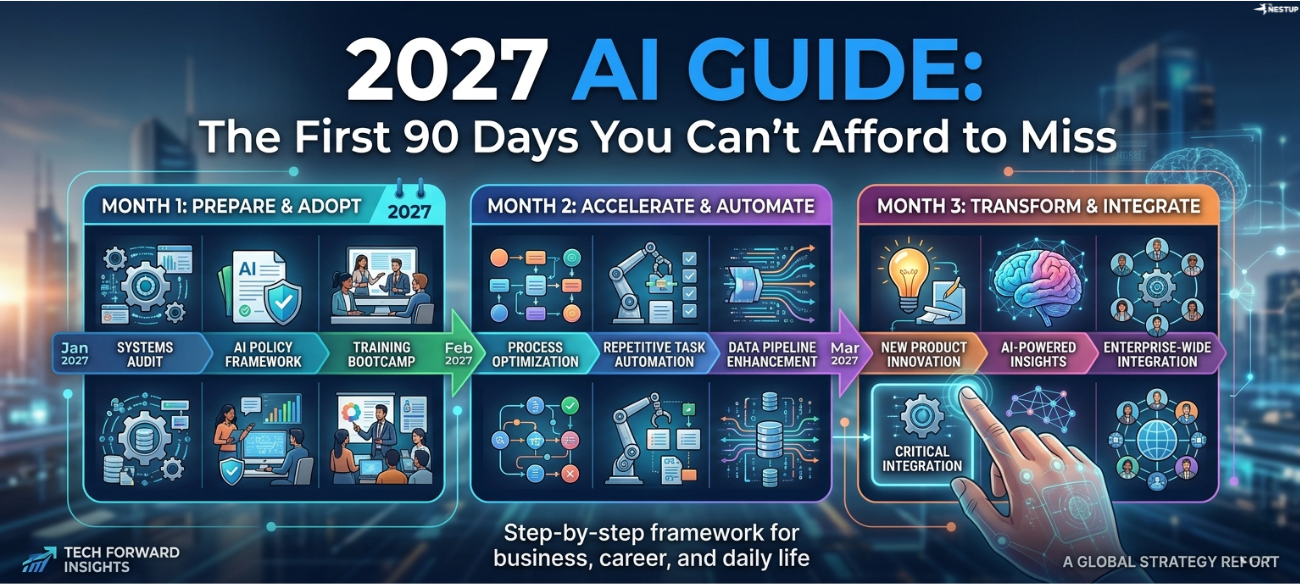
To transition from "pilot purgatory" to a production-ready agentic enterprise, organizations must adhere to a phased, high-velocity implementation framework.
Days 1–30: Audit & Align The focus is on identifying high-impact friction points while establishing a secure perimeter.
- Action: Build a benchmark of 200 daily repetitive workflows across CX, HR, and Operations.
- Goal: Identify tasks where agents can reduce processing time by 50%.
- Governance: Establish baseline compliance checklists to ensure no sensitive customer data crosses unauthorized model boundaries.
Days 31–60: Build & Pilot Move from theory to deployment using modular architecture.
- Action: Utilize the Model Context Protocol (MCP) to connect pilot workflows to internal data sources and deploy mini-agent clusters.
- Control: Implement a mandatory Human-in-the-Loop (HITL) checkpoint; 100% of autonomous outputs must be validated by a human expert before execution.
Days 61–90: Scale & Govern Transition successful pilots into the live environment.
- Action: Route 1% to 5% of live production traffic through the AI pipelines while logging performance for model drift.
- Metric: Shift the workforce from "doing the work" to "system oversight," training users to manage and audit the live agents.
Navigating the "Productivity J-Curve"
Leaders must be prepared for the "Productivity J-Curve"—a temporary dip in output that occurs as teams move away from manual generation to agentic validation. This is not a failure of the technology, but a systemic shift in the nature of labor. The value of a human employee in 2027 is no longer found in the creation of content, but in the governance of the systems that create it.
"The talent premium in 2027 belongs to professionals who can effectively audit, guide, and validate AI output rather than those who generate it."
The Governance Era
The true value of the 2027 AI transition lies in the fundamental restructuring of operational workflows, not simply the procurement of new software. We have moved beyond the "chat" interface into the era of governance and orchestration. The defining question for your organization is no longer "What can the AI do for us?" but "Are we prepared to orchestrate its autonomy?" You have 90 days to decide if you are the architect of this new era or a casualty of its efficiency.