
The "Smarter Google" Trap
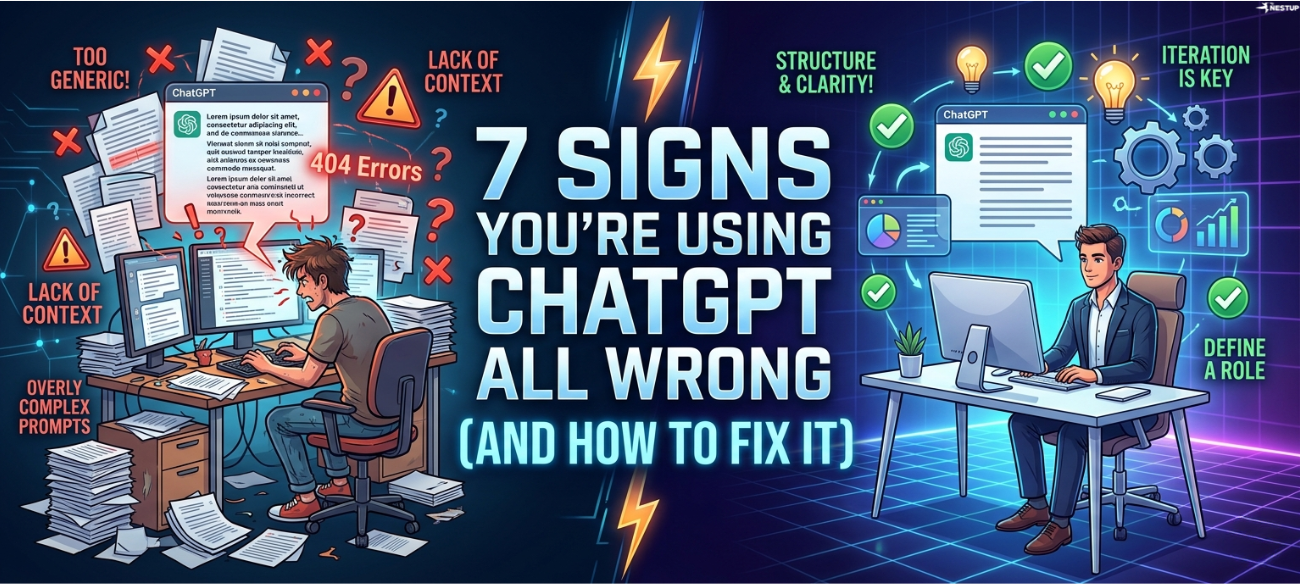
The average user is currently operating with a legacy mental model that is fundamentally obsolete. They approach generative AI as if it were a "smarter Google"—a sophisticated search box designed to fetch answers. This approach is the primary reason most people receive outputs that are generic, shallow, and frustratingly off-target.
By 2026, the landscape shifted. AI tools evolved from simple chatbots into "operating systems for thinking." High-performance strategists have realized that the value of these systems is not unlocked through better "magic words," but through a sophisticated working relationship. If your output is mediocre, it is a direct reflection of a failed collaboration. To extract massive value, you must stop searching and start architecting.
The Cognitive Cost of Vague Instructions
The most common mistake is the "search query" prompt. When you provide a vague instruction, you force the AI to guess your goals, audience, tone, and level of expertise. This creates a massive cognitive gap that the AI fills with "middle-of-the-road" fluff.
To fix this, you must stop "prompting" and start "briefing." A high-performance brief provides structured context and explicit constraints, removing the AI's need to guess.
| Vague Prompt (The Legacy Way) | Structured Brief (The Strategist Way) |
| "Write email to client." | "Write a concise but friendly email to a freelance client explaining a 2-day project delay caused by revised scope. Reassure them the timeline is under control and propose a revised delivery date." |
| "Write a productivity article." | "Write a 1,500-word article for tech-savvy freelancers explaining why AI scheduling tools reduce cognitive load. Use a conversational but analytical tone. Include examples, headings, and practical workflows." |
The "After" versions succeed because they provide emotional direction and clear constraints. By defining the objective and the audience, you provide the AI with the rails it needs to stay on track. When the AI is given a specific destination, it stops generating generic responses and starts producing targeted results.
Stop Starting Over: The Power of Persistent Context
A significant workflow error is the "disposable session" mentality—opening a fresh chat for every new task. This habit destroys continuity and forces the AI to "relearn everything" from scratch. Every time you reset the context, you throw away the institutional memory, writing style, and prior decisions the AI has already assimilated.
Advanced strategists maintain "long-lived conversations" and "project workspaces." This allows the AI to function not as a temporary tool, but as a dedicated operator that understands your strategic preferences.
"In ChatGPT Projects, for example, users can group files, instructions, chats, documents, and workflows around persistent goals. This transforms AI from a 'temporary chatbot' into an 'operational workspace.'"
Transitioning to Context Engineering
In the early days of generative AI, "prompt engineering" was the buzzword—a focus on micro-managing specific words to trigger better responses. Today, that is a legacy skill. The modern requirement is Context Engineering: the macro-management of information structures and memory.
While modern AI has massive context windows, performance declines when chats become overloaded with unrelated topics or conflicting instructions. A strategist must curate this "working memory" intentionally. To maintain high-level alignment, employ a "State Recap" every 30–50 messages. This flushes the noise and re-centers the AI on the current objective.
State Recap Example:
"Here’s the current project state: we are writing a long-form article series
for startup founders focused on AI infrastructure trends. Tone should be
analytical but conversational. We have finished the outline; now move to Section 1."
The "Creative Director" Workflow
One of the most profound shifts in AI usage is moving from treating the tool as an "answer machine" to treating it as an "iterative collaborator." The average user expects a perfect first-pass answer; the strategist knows that AI is strongest at synthesis, reframing, and critique.
To demonstrate this, high-performance users adopt a layered, iterative workflow rather than a one-shot request:
- Generate multiple positioning angles to explore the creative space.
- Refine the tone (e.g., "make this more premium or skeptical").
- Evaluate the appeal for a specific target audience.
- Sharpen and condense the language to remove "AI fluff."
- Finalize and polish the specific copy.
"The best AI users operate more like creative directors than passive consumers."
Shift Your Mindset: Think Like a Manager
To reach peak productivity, you must stop acting like a "worker" asking for a result and start acting like a "manager" directing a junior analyst. High-performance users do not just provide a task; they provide a comprehensive framework consisting of a Goal, Context, Constraints, and Examples.
This shift transforms the AI into a strategist or an operator rather than a magical oracle. Below is the managerial framework used by high-performance AI users to ensure consistent, elite-level output.
The High-Performance AI Workflow
| Step | Action |
| 1 | Define clear objective: State exactly what the final goal is. |
| 2 | Provide audience + constraints: Define who this is for and what is forbidden. |
| 3 | Generate multiple options: Never accept the first path; explore angles. |
| 4 | Refine strongest direction: Choose the best option and double down. |
| 5 | Add examples + nuance: Show the AI what "good" looks like. |
| 6 | Critique weaknesses: Ask the AI to find the holes in its own logic. |
| 7 | Final polish: Edit aggressively for the final 10%. |
Conclusion: The Mirror Effect
The greatest myth of the current era is that AI replaces thinking. In reality, AI acts as an amplifier of cognitive organization. It does not just mirror your output; it mirrors your clarity of thought. If your thinking is messy, your AI output will be a garbled mess of generic text. If your thinking is structured and your context is engineered, the results will be extraordinary.
The final verdict is simple:
"The quality of AI output is usually a reflection of the quality of the working relationship you build with it."
As you approach your next session, look at your workspace. Is it a reflection of a high-performance strategist, or a confused consumer? The quality of your next breakthrough depends entirely on how you answer that question.