From Digital Library to Algorithmic Casino
For the better part of internet history, the digital experience was defined by the architecture of the library. Information was something you sought out; you visited websites with intent, curated bookmarks like personal collections, and navigated the web through active selection. This model required agency, but it offered a profound sense of sovereignty over one's mental landscape.
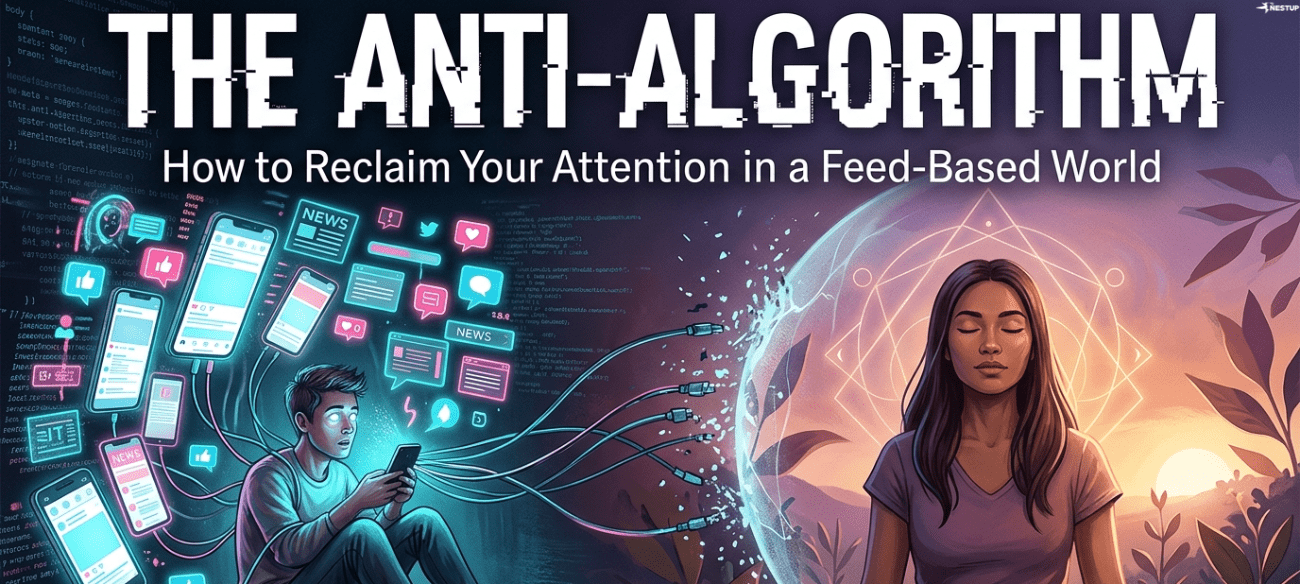
Today, that library has been razed and replaced by an algorithmic casino. Our modern online life is almost entirely mediated by feeds—TikTok’s "For You" page, Instagram Reels, and X’s relentless timelines. This is no longer a tool we use, but an environment we inhabit. The shift from active searching to passive, unconscious scrolling has fundamentally re-architected the human psyche. We have traded the quiet dignity of the search for the high-stimulation, dopamine-driven volatility of the engagement loop.
We Have Outsourced Our Intentionality to Optimization Engines
Modern algorithmic feeds are not neutral delivery mechanisms; they are adaptive behavioral systems that have outsourced our intentionality to high-frequency optimization engines. These platforms are not organized around truth, importance, or even our own stated interests. Instead, they optimize for "engagement efficiency," a cold metric that prioritizes whatever triggers the highest probability of a click or a linger.
To achieve this, platforms have weaponized our own biology against us. By prioritizing tribal conflict, simplified narratives, and outrage, the algorithm ensures we stay tethered to the screen. Our intent is no longer the driver of our digital journey; it is merely a data point to be refined by the system.
"Modern recommendation systems... are adaptive behavioral systems trained on enormous amounts of human interaction data. Every pause, click, scroll, like, comment, and rewatch feeds optimization models. Over time, platforms become frighteningly good at predicting what will hold attention."
In this environment, we lose the habit of asking, "What do I want to learn?" and instead adopt a posture of cognitive passivity, silently asking the machine, "What do you have for me?"
The High Cost of "Cognitive Fragmentation"
The cost of this passive consumption is more than just lost time; it is corrosive to the human spirit and debilitating to our collective focus. Feeds force the nervous system into a state of constant, violent context switching. Within a sixty-second window, a user might jump from a harrowing report on geopolitical tragedy to a trivial comedy meme, then directly into a hyper-personalized advertisement.
This level of high-frequency stimulation is fundamentally at odds with the human brain’s design. We are witnessing a widespread "cognitive fragmentation" that manifests as:
- Chronic informational overload: A saturation point where the brain ceases to process meaning.
- Shortened attention spans: The atrophy of the "long-form" muscle required for deep thought.
- Emotional exhaustion: The "empathy fatigue" caused by jumping between tragedy and trivia.
- Ambient anxiety: A persistent state of low-level stress born from constant algorithmic agitation.
The Quiet Resurgence of RSS and Sovereignty Infrastructure
As a reaction to this fragmentation, a "Slow Internet" movement is quietly gaining ground among those who refuse to let their minds be mined for engagement. This movement is not about Luddism; it is about the strategic reclamation of agency through "sovereignty infrastructure."
The hero of this resurgence is the return of RSS (Really Simple Syndication) and direct email subscriptions. These tools provide the "friction" that serves as the necessary antidote to the casino’s infinite scroll. While the tech industry spent a decade trying to "remove friction," the Slow Internet movement recognizes that friction is where intentionality lives. A newsletter that arrives once a week requires a conscious decision to open and read, shifting the user from a state of compulsive grazing to one of deep attention.
Modern power users are building this infrastructure using sophisticated tools:
- Feedly: For research-heavy workflows and industry monitoring.
- Inoreader: For those who require advanced automation and filtering to stay ahead of the noise.
- Readwise Reader: A nexus where RSS feeds, newsletters, and personal highlights converge into a unified knowledge management system.
Digital Literacy in 2026 is About "Filtering," Not "Finding"
In an age of algorithmic abundance, the most vital skill a person can possess is no longer the ability to find information, but the discipline to filter it. We must adopt a "nutritional" approach to our digital intake, distinguishing between content that provides genuine intellectual nourishment and "empty calorie" content designed only to trigger a compulsive loop.
True digital literacy in 2026 requires a shift from mass-engagement feeds toward curated, trust-based networks. This involves:
- Choosing sources deliberately: Moving away from "discovery" and toward direct, intentional subscriptions.
- Limiting feed exposure: Treating algorithmic streams as occasional entertainment rather than primary information sources.
- Leaning into human curation: Prioritizing niche communities, expert newsletters, and private recommendation networks over mass-market algorithms.
- Curation as a habit: Recognizing that the highest-value information today is found through human-to-human trust, not machine-to-human optimization.
Reclaiming Your Agency in the Age of AI
The battle for our attention is entering a more dangerous phase. The economic incentives of the attention economy—which reward emotional activation and behavioral predictability—are now being supercharged by Generative AI. We are moving toward a world of hyper-individualized attention systems, where "synthetic influencers" and AI-generated content can be tuned to our specific psychological vulnerabilities with unprecedented precision.
Reclaiming agency in this environment is the ultimate act of modern rebellion. It is about asserting that our minds are not merely a resource to be harvested by advertising models. We must decide whether technology will remain a tool or become our default cognitive environment.
"In an era where algorithms constantly compete for cognitive control, intentional attention may become one of the most important forms of freedom left."
Conclusion: The Path to Digital Intentionality
The goal of the Slow Internet movement is not total digital asceticism, but a return to a state where the human is the architect of the experience. We can use the feed for entertainment, provided we do not live inside it. We must build a digital life where our emotions and ideas are the result of our own choices, rather than the byproduct of an optimization model’s quest for quarterly growth.
As you close this page and return to the digital stream, ask yourself: Are you the architect of your own attention, or merely a data point in someone else’s behavioral experiment?