
Our planet is defined by a cruel, liquid irony: more than 70% of the Earth’s surface is covered by water, yet we are increasingly a world parched. Only a tiny fraction of that vast blue expanse is accessible freshwater, and as global populations surge and climate-driven droughts harden into permanent features of our landscape, the math of survival is no longer adding up. For decades, we have relied on traditional solutions—drilling deeper wells, building massive reservoirs, and diverting entire rivers—but these methods are hitting a wall of environmental and economic exhaustion.
In this context, desalination—the process of stripping salt from seawater—is undergoing a radical rebranding. Long dismissed as an "expensive last resort" reserved for wealthy, oil-rich autocracies, it is fast becoming a "strategic necessity" for the global stage. We are currently witnessing a technological revolution that aims to transform the ocean from a saline barrier into a viable, affordable tap for humanity. From atomic-scale materials to sunlight-driven evaporation, the physics of water is being rewritten to ensure that geography is no longer destiny.
Graphene is transforming the physics of filtration.
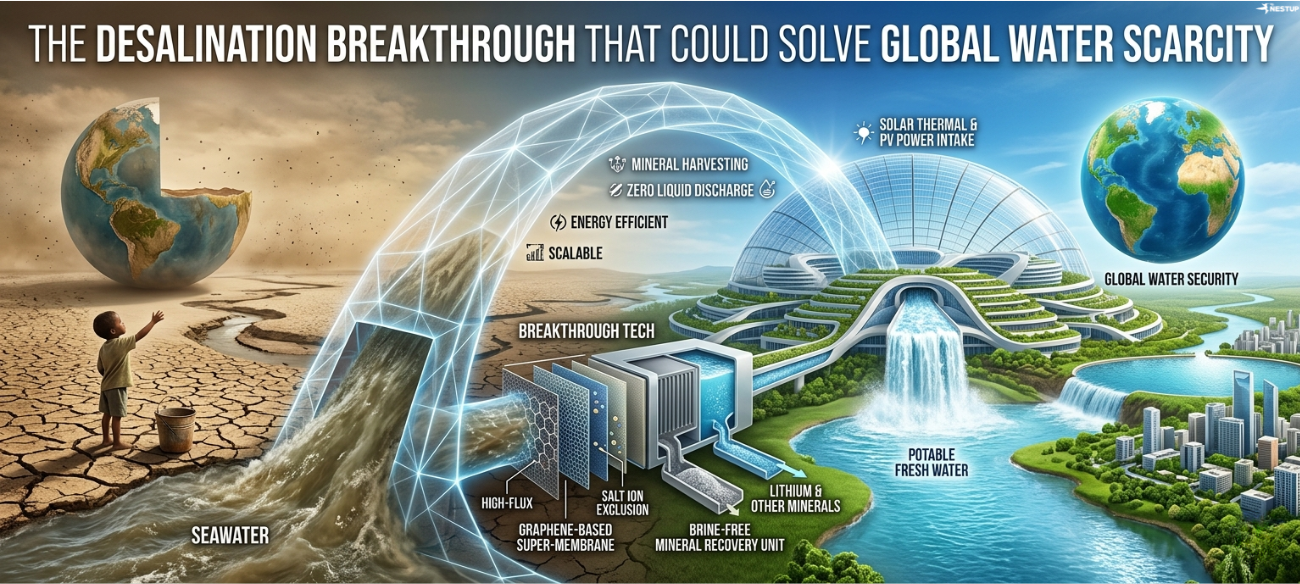
At the heart of modern desalination is the membrane. In traditional reverse osmosis, seawater is forced through thick semi-permeable filters at high pressure. This process is essentially an "energy tax"; the more resistance the membrane provides, the more electricity you need to move the water. Graphene, a "miracle material" consisting of a single layer of carbon atoms arranged in a honeycomb lattice, is poised to slash that tax.
Because graphene is incredibly strong yet atomically thin, researchers are developing membranes with nanoscale pores. These filters allow water molecules to pass through with almost zero friction while effectively blocking salt ions. By replacing thick traditional membranes with these nanoscale structures, the energy required to push water through the system drops significantly.
This atomic-thin revolution offers four primary theoretical benefits:
- Higher Water Flow: Water moves through ultra-thin surfaces more easily, radically increasing plant output.
- Lower Energy Requirements: Reduced resistance means pumps don't have to work as hard, lowering the primary operating cost of desalination.
- Longer Lifespans: The inherent durability of graphene could mitigate the "membrane fouling" that plagues traditional plants.
- Greater Efficiency: More freshwater is produced for every unit of energy consumed, making the process viable in energy-poor regions.
However, the path from the laboratory to the ocean is not without friction. While theoretically perfect, the "next great challenge" for engineers is manufacturing. Producing high-performance graphene membranes consistently and economically at an industrial scale remains an active hurdle that must be cleared before this miracle material can truly quench the world's thirst.
Sunlight isn't just for power—it’s for evaporation.
While reverse osmosis currently dominates the industry, thermal desalination—the process of evaporating water to leave salt behind—is making a sophisticated, sustainable comeback. Historically, this was the most energy-intensive method imaginable, requiring the burning of massive amounts of fossil fuels to boil water. The new generation of solar-thermal systems has flipped this script, moving from "active" energy consumption to "passive" harvesting.
Instead of converting sunlight into electricity to run a high-pressure pump, these systems use advanced solar absorbers and nanomaterial coatings to capture heat directly. These coatings drive passive evaporation, essentially mimicking the natural water cycle within a controlled environment. This is particularly transformative for the world's most "sun-drenched" and "water-parched" regions, where the very heat that causes drought is harvested to solve it. This shift away from energy-intensive boiling toward passive, heat-managed systems marks a return to ancient logic, supercharged by modern materials science.
"Throughout history, civilizations have been constrained by access to water. Cities emerged near rivers. Empires fought over waterways. Communities migrated when wells ran dry. Desalination changes that equation."
Infrastructure is a "real-world laboratory" in the Middle East.
The theoretical breakthroughs of the lab are currently being stress-tested in the Middle East, where water security is treated as a matter of national survival. In these arid landscapes, the ambition of engineering is driven by the desperation of geography. Saudi Arabia has emerged as a global "superpower" in this field, investing billions into next-generation infrastructure that focuses on massive scale and the integration of renewable energy to power its plants.
However, the "Israel Lesson" suggests that hardware is only half the battle. Israel transformed its chronic water vulnerability into relative security by treating desalination as just one piece of a larger, integrated puzzle. By combining high-tech desal facilities with aggressive wastewater recycling, leak reduction, and "smart" water management, Israel proved that technology is most effective when it is part of a broader strategic framework. For these nations, the desalination plant is not just a utility; it is a vital organ in a national life-support system.
We are entering a "feedback loop" of affordability.
The most significant trend in the industry isn't a single material or a specific plant; it is the precipitous move of the cost curve. Historically, desalination costs fell incrementally through better pumps and energy recovery systems. We are now entering a new, accelerated phase where a "feedback loop" of adoption and investment is driving innovation faster than ever before.
This economic shift is no longer just about better filters. It is being driven by a multi-pronged technological assault:
- AI-driven optimization to manage plant efficiency and membrane health in real-time.
- Modular plant designs that allow for faster, cheaper, and more flexible deployment in developing regions.
- Advanced materials that reduce maintenance and improve energy recovery.
- Renewable energy integration that finally decouples the cost of water from the fluctuating price of oil.
As these factors converge, desalination is moving from being a luxury for wealthy nations to a viable tool for the global stage, making freshwater accessible to coastal populations that were previously priced out of the market.
Solving for the ocean, not just for the tap.
Despite the engineering optimism, desalination remains a controversial solution, and its expansion brings heavy environmental responsibilities. If we are to engineer a "tap" for the world, we must also solve for the health of the ocean. The primary challenge is brine disposal: the process of creating freshwater leaves behind a highly concentrated salt byproduct that can devastate marine ecosystems if pumped back into the sea carelessly.
This tension is perhaps most visible in California, where the state's relationship with desalination is fraught with debate. While California faces recurring cycles of drought and agricultural demand, the move toward large-scale desalination has been slowed by concerns over marine impacts, energy usage, and the ecological cost of water intake systems.
These challenges are not seen by the engineering community as deal-breakers, but as the next frontier for innovation. From redesigning intakes to protect marine organisms to finding ways to repurpose brine, the goal is to solve the environmental "tax" of desalination with the same intensity we applied to the energy "tax."
The Great Decoupling
For the first time in human history, we are approaching a "great decoupling." Our growth, our urban centers, and our survival may no longer be strictly dictated by the geography of natural freshwater. By converting the planet's most abundant resource into its most precious one, we are moving toward a level of civilizational resilience that was previously unthinkable.
If the current trends in graphene, solar-thermal tech, and AI optimization continue to converge, the next decade won't be remembered for the worsening of the water crisis. Instead, it will be marked as the moment technology finally outpaced the constraints of nature.
Final Thought: As we move toward a world where water is a product of human ingenuity rather than a gift of geography, how will the decoupling of "water" and "place" reshape the political and environmental map of our planet?