
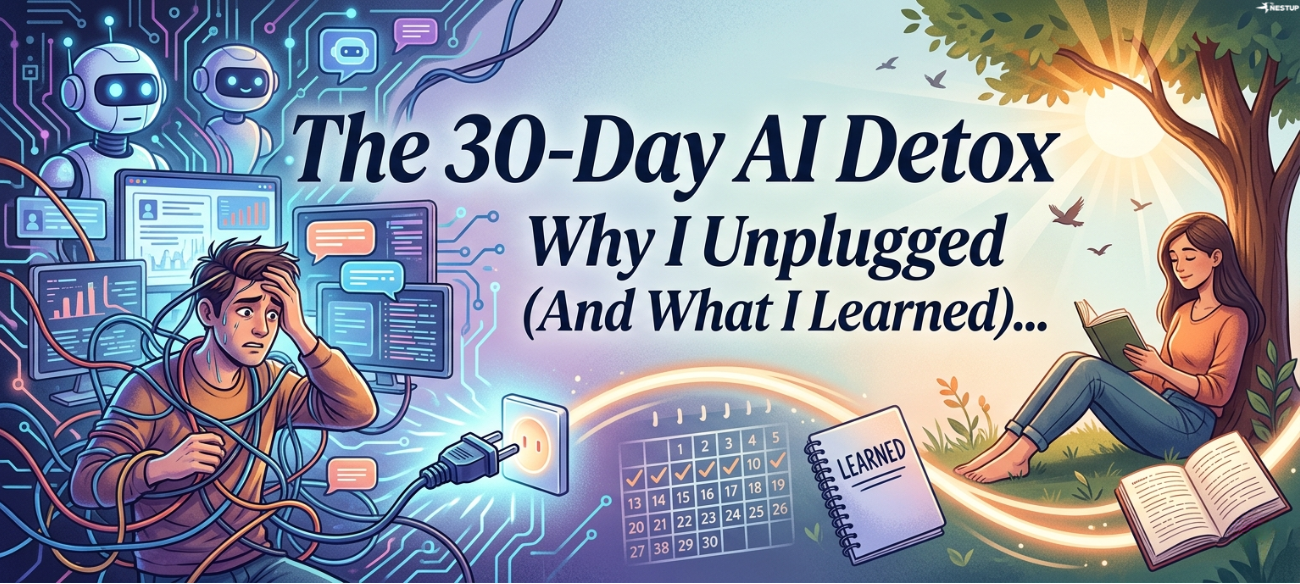
At first, it feels like a superpower. You feed a prompt into the void and, seconds later, a polished email, a research summary, or a project plan materializes. For months, I lived in this state of artificial enhancement, outsourcing the "heavy lifting" of my cognitive life to large language models. But eventually, a subtle, unsettling realization set in: I had stopped reaching for my own thoughts. Whenever a problem felt slightly too heavy or a blank page too daunting, my first instinct wasn't to think—it was to ask.
To reclaim my cognitive sovereignty, I committed to a 30-day AI detox. The rules were absolute: no chatbots, no AI writing assistants, and no automated research tools. I wanted to see what remained of my independent mind once the digital crutch was kicked away.
1. The Cognitive Calisthenics of Week Two
The first week of the detox was defined by a jittery sort of frustration. Tasks that had become frictionless—like summarizing an article or outlining a report—suddenly felt like wading through deep water. Without the "instant answer" button, I was forced to re-engage with intellectual friction.
By the second week, however, that friction began to feel like strength. I noticed my focus was no longer fractured by the temptation to jump between AI-generated perspectives. Instead, I was "sitting with problems" for extended periods. This deeper exploration wasn't just a slower way to work; it was a more satisfying way to live. My workdays grew calmer as I traded the frantic pace of automated output for the steady rhythm of deep work.
"I was thinking more and searching less."
2. The Architecture of Empty Space
There is a common modern myth that AI is a creativity "co-pilot" that helps us bypass the boring parts of ideation. My third week taught me the opposite: true creativity requires the very empty space that AI usually fills.
When I couldn't lean on a chatbot for a list of ideas, I was forced back into analog habits. I started carrying a physical notebook again. I took long walks without podcasts or prompts. I began observing the world with more intentionality, and I found that my best ideas didn't come from an active search—they emerged from the silence. By removing the AI’s immediate suggestions, I allowed room for original thinking to breathe. The "muscle" of focus I built in week two became the foundation for the creative resurgence of week three.
3. Finding Health in the "Uncertainty Gap."
By the fourth week, I encountered the most profound discomfort of the experiment: the uncertainty gap. AI specializes in eliminating doubt, providing confident answers to almost any query. Without it, I had to get comfortable not knowing.
Sometimes I spent an hour researching a topic only to find there was no "perfect" answer. I had to make decisions based on my own incomplete information and independent judgment. While this was objectively less efficient, it was significantly healthier. Struggling with information is how we build confidence; by bypassing the struggle, we bypass the growth. I realized that the "uncertainty gap" isn't a bug in the human experience—it’s the space where character and conviction are formed.
4. Why AI is a Better Editor Than an Architect
The detox forced a hard look at which habits were serving me and which were eroding my voice. I realized that using AI for first drafts was a shortcut to mediocrity. While it saved time, it resulted in a homogenization of thought—my writing began to sound like everyone and no one at the same time.
I have since retired the "AI-authored" draft. I want the "soul" of my work to remain human, born from the messiness of my own first principles. However, I have restored AI as a high-level administrative tool. It remains an excellent editor for clarity, a master of scheduling, and a clinical summarizer of dense data. The trade-off is clear: I will take the hit to my productivity in exchange for the preservation of my personal voice.
5. The "Think First" Protocol
The most enduring change to my workflow is the "Think First" protocol. Before the detox, my workflow was: Problem -> AI -> Refinement. Now, it is: Problem -> Deep Thought -> Original Draft -> AI for Leverage.
The experiment proved that my brain hadn't lost the information I thought I needed AI to find; it had simply lost the habit of retrieving it. Often, when I force myself to think through a problem first, I discover I already possess the solution. We have become so used to the convenience of the bot that we have forgotten the vastness of our own internal libraries.
"Just because a tool can do something for you doesn't mean it always should."
Toward a More Intentional Intelligence
This 30-day journey was never about rejecting progress; it was about re-establishing intentionality. AI is a tool of immense leverage, but leverage is only useful if the person holding the lever has a firm place to stand.
I have returned to using AI, but with a new philosophy: Use AI where it creates leverage; keep human thinking where it creates understanding. We must be careful not to outsource the very parts of our lives that make us feel alive—the struggle, the discovery, and the unique expression of our own voices.
As you look at your own workflow today, ask yourself: Which part of your own thinking have you inadvertently outsourced, and what would happen if you took it back?