
 A
A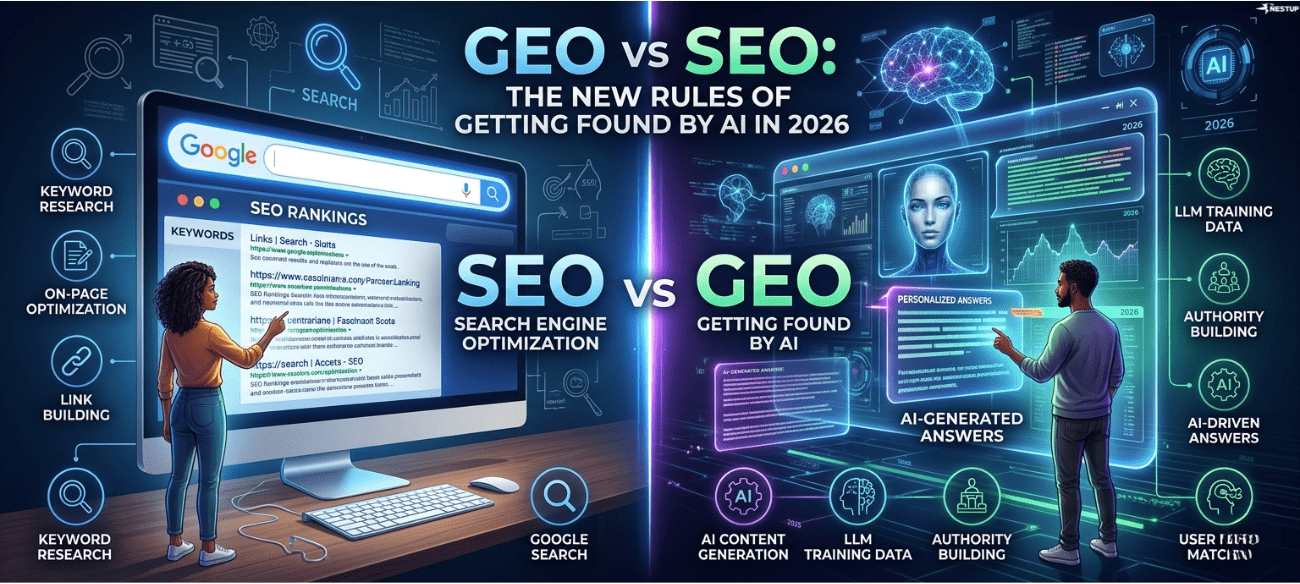
Search is no longer limited to ten blue links. Today, users increasingly ask questions directly to AI assistants such as ChatGPT, Gemini, Claude, Perplexity, and Google AI experiences. Instead of presenting a list of webpages, these systems often generate complete answers while citing only a small number of trusted sources.
This shift has introduced Generative Engine Optimization (GEO) the practice of improving the likelihood that AI systems will reference your content. However, GEO does not eliminate the need for Search Engine Optimization (SEO). Strong technical SEO, crawlability, and high-quality content remain the foundation upon which AI visibility is built, especially within Google's search ecosystem.
GEO (Generative Engine Optimization) is how I make my content discoverable and quotable by AI systems. SEO still matters, but GEO now decides whether my work appears inside AI-generated answers at all.
By 2026, the old “search-and-click” habit has broken. For twenty years, people typed a query, skimmed ten blue links, and clicked through to a site. Now, many people simply ask an AI assistant and stop there. They receive a synthesized answer, not a list of pages.
This guide combines publicly available documentation from Google Search Central, research into generative search systems, and practical observations from AI search platforms. Where recommendations reflect interpretation or opinion, they are clearly identified as such.
Because of this shift, visibility is no longer about ranking #1 on a search results page. It is about passing through the filters of AI-generated summaries. If my content never makes it into the synthesis layer, it might as well not exist.
Comparison between SEO vs GEO
| SEO | GEO |
|---|---|
| Optimizes for rankings | Optimizes for AI citations |
| Success measured in clicks | Success measured in mentions, citations, and answer inclusion |
| Targets search engines | Targets AI assistants and answer engines |
| Heavy focus on keywords and intent | Heavy focus on factual completeness, entity clarity, and trust signals |
| Blue-link visibility | Answer visibility |
Why You Can Trust This Guide
Artificial intelligence is changing how people discover information online, but it is also creating confusion. New terms such as Generative Engine Optimization (GEO), Answer Engine Optimization (AEO), AI SEO, and AI Search Optimization are often used interchangeably, even though they describe different aspects of digital visibility. This guide was written to separate marketing hype from practical reality.
My work focuses on researching AI, search technologies, digital marketing, and content strategy from both a publisher's and technical perspective. Rather than relying on opinions or recycled blog posts, I analyze documentation from search platforms, academic research, official developer resources, and real-world implementation patterns to understand how AI systems retrieve, evaluate, and reference online content.
The conclusions presented in this article are based on publicly available research from Google Search Central, OpenAI, Anthropic, Microsoft, academic publications, and observations of how modern AI assistants retrieve and cite information. Where recommendations involve interpretation or future expectations, they are clearly presented as analysis rather than established fact.
Although no optimization strategy can guarantee inclusion in AI-generated answers, the principles discussed throughout this guide align with established search quality guidelines and the growing emphasis on helpful, trustworthy, experience-driven content.
This article is intended for marketers, publishers, business owners, developers, and content creators who want to build long-term visibility across both traditional search engines and AI-powered discovery systems rather than chasing short-term ranking tactics.
How AI Search Engines Actually Choose Content
Understanding how AI assistants generate answers is essential before attempting to optimize for them.
Traditional search engines primarily rank webpages and present users with a list of links. Modern AI assistants work differently. Instead of returning only webpages, they often retrieve information from multiple trusted sources, synthesize those findings, and generate a single conversational response. This process is commonly supported by Retrieval-Augmented Generation (RAG), which combines large language models with external information retrieval.
When a user submits a question, an AI system typically evaluates several signals before deciding which sources to reference. While the exact ranking systems are proprietary and vary between platforms, the following characteristics consistently increase the likelihood that content will be considered useful:
Topical Relevance
The content should directly answer the user's question rather than mentioning related keywords. Comprehensive coverage of a topic is generally more valuable than superficial explanations.
Factual Accuracy
AI systems increasingly prioritize information that can be verified through reliable, authoritative sources. Unsupported claims, exaggerated marketing language, or outdated statistics reduce confidence.
Source Reputation
Well-established websites with demonstrated expertise, editorial standards, and consistent publishing quality are more likely to be trusted. Author credentials, transparent sourcing, and organizational credibility all contribute to this assessment.
Structured Content
Clearly organized articles using descriptive headings, concise summaries, comparison tables, bullet points, definitions, and frequently asked questions make information easier for both search engines and AI systems to interpret.
Entity Clarity
Modern search relies heavily on entities—people, companies, products, organizations, technologies, and concepts. Clearly identifying these entities and explaining their relationships improves semantic understanding and reduces ambiguity.
Freshness
For rapidly evolving subjects such as artificial intelligence, cybersecurity, finance, and healthcare, current information often carries greater value than older content. Regular updates help maintain accuracy and relevance.
Original Value
AI systems increasingly benefit from content that contributes something unique. First-hand experience, proprietary research, case studies, original data, expert interviews, and practical demonstrations provide value that cannot easily be replicated by summarizing existing articles.
The goal of GEO is therefore not to manipulate AI models but to produce content that demonstrates expertise, answers questions comprehensively, and earns sufficient trust to become a reliable source of information.
Research Methodology
This guide was developed using a research-first approach designed to prioritize accuracy, transparency, and long-term relevance over speculative trends.
Information was gathered from multiple categories of sources, including:
- Official documentation published by Google Search Central and Google Search Quality guidelines.
- Public research and documentation from OpenAI, Anthropic, Microsoft, and other leading AI developers.
- Academic literature examining large language models, retrieval-augmented generation (RAG), semantic search, and information retrieval.
- Industry publications covering AI search, search engine optimization, and content quality.
- Practical observations from publicly available AI search experiences, including ChatGPT, Google AI-powered search experiences, Microsoft Copilot, Perplexity AI, Claude, and Gemini.
Whenever possible, factual statements are supported by primary or authoritative sources. Interpretations and strategic recommendations reflect the author's independent analysis of current technologies and should be viewed as informed professional opinion rather than guaranteed ranking factors.
Because AI search continues to evolve rapidly, this guide will be periodically reviewed and updated to reflect significant platform changes, new research findings, and revised search quality guidance.
The Five Principles That Will Define Search Visibility in 2026
Search is no longer driven solely by keyword rankings. AI assistants increasingly evaluate content based on relevance, credibility, structure, and trust. These five principles capture the most significant shifts every publisher, marketer, and business should understand when developing a long-term content strategy.
Takeaway 1: I Now Compete in the “Citation Economy”
The web has moved from a “Click Economy” to a “Citation Economy.” Previously, I measured success by traffic. I wanted as many people as possible to land on my site. Now, I measure success by inclusion. I want AI systems to cite me as a source.
Citations are the new backlinks. When tools like ChatGPT or Perplexity answer a question, they often become the final stop for the user. Therefore, the economic value has shifted from driving visits to building authority.
To stay relevant in this zero-click environment, I have to stop thinking only as a destination. Instead, I need to become essential source material that AI models trust when they assemble their view of a topic.
Then explain that this is a simplification and the two disciplines overlap substantially.
My goal is no longer only “rank #1.” Increasingly, my goal is “be the source AI systems rely on.”
Takeaway 2: My “Direct Answer” Is My New Homepage
For AI, extractable content wins. Systems like ChatGPT and Perplexity do not reward long, meandering narratives. They reward high-density information that can be lifted, quoted, and recombined into a clear answer.
This has pushed me toward what I call Answer-Oriented Content (AOC).
- I front-load definitions, explanations, and how-tos.
- I keep key answers within the first one or two paragraphs.
- I write in short, scannable sections that a parser can easily segment.
By 2026, the traditional blog post stuffed with filler and “SEO-friendly” fluff has become a liability. If an AI system cannot find a clean answer to a “What is…” or “How does…” question near the top, it will favor a source that offers more immediate utility.
- Bad (Vague): Content that hides the main point behind narrative hooks, clickbait intros, or long stories designed only to increase time-on-page.
- Good (Structured): Content that opens with direct, quotable explanations, clear “What is” and “How does” sections, and formatting that makes extraction trivial.
When I write, I now assume an AI will skim my content faster than any human. Therefore, I make the answer obvious.
Takeaway 3: It’s Not About “AI Keywords” — It’s About Structure and Entities
A common myth about GEO is that I need a new set of “AI keywords.” That is not how these systems work. AI engines reward utility, clarity, and structure, not robotic phrase stuffing.
However, different engines do prioritize different signals:
- Perplexity favors factual clarity, dense citations, and sources that normalize attribution.
- Google’s AI Overviews still lean heavily on classic SEO signals like authority, links, and technical hygiene.
To be citable across platforms, I focus on Entity Clarity. That means I clearly define the relationships between:
- People
- Products
- Companies
- Concepts
- Events
AI models do not just read strings of text. They build knowledge graphs. Therefore, I help them by using strong structure:
- Aggressive use of H2 and H3 headings
- FAQ sections that map common questions to clean answers
- Tables and lists that organize comparisons or steps
When I give AI engines this scaffolding, they can understand who I am, what I offer, and why my content matters.
Takeaway 4: Original Data Beats AI-Generated Spam
By 2026, the internet is flooded with generic AI-written content. As a result, original data and firsthand insight have become the most valuable ranking signals.
AI systems increasingly down-rank content that looks like a rewrite of existing material. They favor sources that bring something new:
- Fresh data
- Unique angles
- Real experience
- Live context
In high-stakes areas like finance, health, and technology, freshness is now non-negotiable. AI engines look for:
- Recent timestamps
- Live web references
- Updated statistics
- Context that reflects current conditions
To build and keep topical authority, I publish consistent clusters of content that show real expertise. For example, I focus on:
- Proprietary research and original data sets
- Case studies based on my own or my clients’ experiences
- Statistics roundups that synthesize complex information
- Technical explainers and step-by-step guides with my commentary
When I do this well, I stop competing with AI spam entirely. I operate in a different category: original source.
Takeaway 5: I Optimize for Visibility, Not Just Traffic
The hardest mindset shift in the GEO era is accepting zero-click behavior. AI summaries answer many questions without sending users to my site. Therefore, I might see fewer raw visits even as my brand becomes more influential.
Instead of chasing only pageviews, I now optimize for inclusion in AI conversations. If my work appears as a cited source inside a ChatGPT or Perplexity answer, I gain:
- Trust
- Mindshare
- Brand recall
That kind of embedded authority can be more valuable than a single click. In a world where the AI is the main interface, the most trusted sources shape the narrative.
The future of online visibility belongs less to whoever ranks highest on a traditional SERP and more to whoever becomes the most trusted source for AI-generated answers.
The Future: Writing for Humans and AI Gatekeepers
AI is no longer just a tool I use. It is the new interface to the internet. I no longer create content only for human readers. I now write for AI intermediaries as well—the gatekeepers that sit between my expertise and the end user.
Traditional SEO fundamentals still matter:
- Crawling
- Indexing
- Site performance
- Technical hygiene
However, GEO is the new layer on top. It ensures my expertise does not just exist; it gets used.
As the “ten blue links” fade into the background, the creators who thrive will be those who:
- Sound authoritative and clear to humans
- Look structured, extractable, and citable to machines
So my key question has changed. I no longer ask, “How many people are clicking my links?” Instead, I ask:
“How will I ensure my expertise remains citable in an automated world?”
Frequently Asked Questions About GEO and SEO
Is GEO replacing SEO?
No. Generative Engine Optimization (GEO) is not replacing Search Engine Optimization (SEO). SEO remains the foundation for making content discoverable, crawlable, and understandable by search engines. GEO builds on those fundamentals by helping content become more suitable for retrieval, citation, and summarization within AI-powered search experiences. Businesses should view GEO as an evolution of search optimization rather than a separate discipline.
What is the biggest difference between SEO and GEO?
Traditional SEO primarily focuses on improving visibility in search engine results pages (SERPs), while GEO focuses on increasing the likelihood that AI systems reference or cite your content when generating answers. SEO emphasizes rankings and organic traffic, whereas GEO emphasizes authority, factual accuracy, structured content, and semantic relevance.
Can content rank in Google but never appear in AI-generated answers?
Yes. Ranking well in traditional search does not automatically mean your content will be cited by AI assistants. AI systems often evaluate additional factors such as topical depth, factual completeness, source credibility, structured formatting, author expertise, and whether the content directly answers complex user questions.
Does GEO require different content than SEO?
Not entirely. High-quality SEO content already shares many characteristics with GEO-friendly content, including relevance, strong technical foundations, and helpful information. However, GEO places greater emphasis on comprehensive answers, original insights, clear entity relationships, trustworthy sources, and content that AI systems can confidently summarize or reference.
Which AI platforms should businesses optimize for?
Rather than optimizing for a single platform, businesses should focus on creating content that performs well across multiple AI-powered experiences, including ChatGPT, Google AI-powered search experiences, Gemini, Claude, Microsoft Copilot, and Perplexity. The underlying principles of expertise, authority, accuracy, and user value remain consistent regardless of platform.
What types of content are most likely to be cited by AI?
AI systems are more likely to reference content that demonstrates original research, practical experience, expert analysis, well-organized structure, transparent sourcing, and comprehensive coverage of a topic. Guides, comparisons, case studies, research reports, and detailed tutorials generally provide stronger citation signals than thin or purely promotional content.
How important is E-E-A-T for GEO?
Experience, Expertise, Authoritativeness, and Trustworthiness (E-E-A-T) are becoming increasingly important because AI systems seek information from sources that appear reliable and well-supported. Demonstrating first-hand experience, citing authoritative references, maintaining editorial transparency, and publishing accurate, regularly updated content all contribute to stronger credibility.
How can small websites compete with larger brands in AI search?
Large brands often benefit from established authority, but smaller publishers can still earn AI visibility by producing highly specialized, well-researched content that answers specific questions better than broader competitors. Publishing original insights, maintaining topical authority, and consistently updating content can help smaller websites become trusted sources within niche subjects.
What should businesses prioritize in 2026: SEO or GEO?
The strongest long-term strategy is to combine both. Technical SEO ensures that content can be discovered and indexed, while GEO improves its potential to be understood, trusted, and cited by AI-powered search systems. Organizations that integrate both approaches are likely to achieve broader visibility as search continues to evolve.
What is the future of search beyond GEO?
Search is moving toward AI-assisted discovery, multimodal experiences, conversational interfaces, and intelligent agents capable of completing tasks rather than simply retrieving information. As these technologies mature, success will depend less on ranking for individual keywords and more on becoming a trusted source that consistently provides accurate, experience-driven, and authoritative information across the web.
Bottom Line
The debate between SEO and Generative Engine Optimization is not about choosing one over the other it is about understanding how digital visibility is evolving. Traditional SEO remains the foundation for helping search engines discover, crawl, and understand your content, while GEO builds on that foundation by increasing the likelihood that AI-powered platforms retrieve, trust, and cite your information when generating answers.
As AI assistants become an increasingly common starting point for information discovery, success will depend less on isolated ranking tactics and more on publishing content that demonstrates genuine experience, subject-matter expertise, clear structure, factual accuracy, and transparent sourcing. Businesses that consistently produce original insights, maintain strong technical SEO, and establish topical authority will be better positioned to earn visibility across both conventional search results and AI-generated responses.
Ultimately, the goal is no longer just to rank higher it is to become a trusted source of knowledge. Whether a user discovers your content through Google Search, ChatGPT, Gemini, Claude, Perplexity, or future AI search experiences, the same principle continues to apply: the most valuable content is the content that is accurate, useful, well-supported, and genuinely deserving of trust. Organizations that invest in quality rather than shortcuts will be best prepared for the next generation of search.