
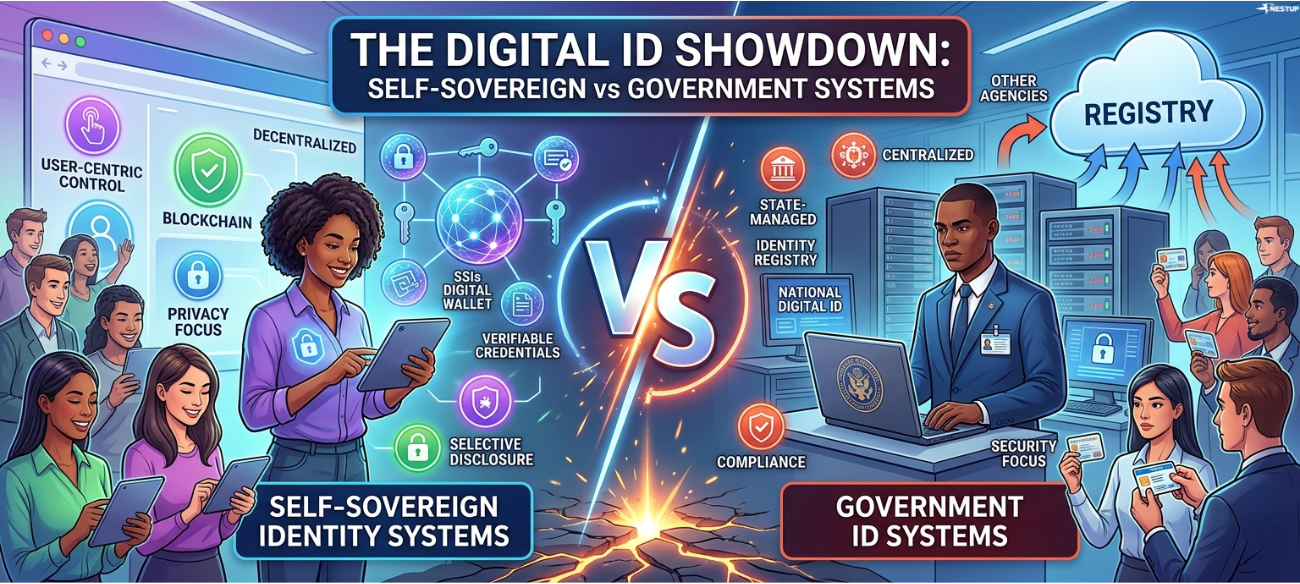
The era of the "digital scavenger" cobbling together a messy patchwork of passwords, platform logins, and fragile paper proofs is dead. 2026 marks the rise of the Unified ID, and with it, a war for the architecture of human autonomy. As governments and tech titans race to build the core infrastructure of the next decade, our digital existence is being migrated into unified systems designed to prove who we are with a single, cryptographic click.
This is the "Digital ID Showdown," a global struggle to determine whether our identities will serve as tools for state control, resources for corporate profit, or foundations for individual sovereignty. The transition is no longer optional; it is a forced evolution of the internet's bedrock. We are moving away from the convenience of a "Log in with" button toward a high-stakes reality where the central question is one of power: who truly owns your digital self?
Takeaway 1: AI is Forcing the Hand of Identity Infrastructure
The rise of generative AI has transformed digital identity from a Silicon Valley experiment into a global defense mechanism. We have entered a post-truth digital environment where deepfakes, sophisticated bots, and synthetic media can mimic human behavior with terrifying precision. This explosion of automated fraud has shattered the traditional trust models of the web.
There is a profound, strategic irony in our current trajectory: as technology makes it easier than ever to fake being human, we are forced to adopt even more intrusive technology to prove we are not. For the digital sovereignty strategist, this isn't just about security it’s about survival. Without trusted identity infrastructure, the digital commons will be reclaimed by automated agents, leaving human autonomy in the dust.
"The rise of deepfakes and AI bots is increasing demand for trusted identity verification."
Takeaway 2: The "Selective Disclosure" Revolution
Current identity systems are "liability magnets" and "honeypots." When you show a physical ID to enter a bar, you reveal your home address and exact birthdate just to prove you are over 21. In the digital realm, this over-sharing creates massive databases that act as primary targets for hackers and state surveillance. The Self-Sovereign Identity (SSI) movement seeks to flip this script through "selective disclosure."
By utilizing Verifiable Credentials (VCs) and Decentralized Identifiers (DIDs), SSI transforms identity into a "zero-knowledge asset." You can cryptographically prove you have a valid driver’s license or a specific age without handing over the underlying data. This is the "holy grail" for privacy advocates: a system that minimizes centralized data collection and ensures that users not platforms hold the keys to their own attributes.
Takeaway 3: Scale vs. Regulation (India’s DigiLocker vs. Europe’s EUDI)
The battle for the future is being fought through two distinct government models. India has seized a massive "practicality and scale" advantage with DigiLocker. By integrating with the Aadhaar system and existing financial infrastructure, India achieved massive-scale digital onboarding, allowing hundreds of millions of citizens to instantly verify credentials and bypass the friction of physical paperwork.
Meanwhile, the European Union is attempting a more philosophically complex feat with the EUDI (European Digital Identity) Wallet. While India prioritizes rapid adoption and integration, Europe is focused on "interoperability and privacy regulation," mandating user consent and technical standards that work across dozens of member states.
The EUDI Wallet aims to be a standardized tool for a variety of critical use cases:
- Digital passports
- Banking verification
- University credentials
- Medical prescriptions
- Tax services
- Age verification
Takeaway 4: The Biometric Controversy and "Proof of Personhood"
The most provocative front in the identity wars is the "proof of personhood" movement, exemplified by projects like Worldcoin. By using specialized hardware to perform iris scans, Worldcoin attempts to create a global biometric standard to solve the "bot problem." Proponents argue that in an AI-dominated world, proving human uniqueness is essential economic infrastructure.
However, from a sovereignty perspective, the risks are astronomical. You can reset a leaked password, but you cannot "reset" your iris. Critics warn that such systems, regardless of their cryptographic shields, carry an inherent risk of becoming permanent surveillance infrastructure. If these biometric databases are compromised or co-opted, the potential for social control is unprecedented.
"Critics worry digital IDs could evolve into centralized tracking systems or social control mechanisms."
Takeaway 5: The Future is a Hybrid, Not a Winner-Take-All
While purists argue for a totally decentralized utopia, the most pragmatic outcome is the rise of Programmable Identity Systems. This hybrid model acknowledges a hard reality: pure SSI has failed to gain mainstream traction because the user experience is too complicated and key management is too difficult for the average person. Furthermore, the "Standardization Problem" remains; without global standards, we risk trading one fragmented system for another.
In the likely hybrid future, governments will remain the "issuers of truth" for foundational credentials like citizenship leveraging their existing legal authority—but the management of those credentials will shift to the user. You will carry state-verified proofs in a private, cryptographic wallet. This model provides the legal recognition required for a functioning society while utilizing the privacy-preserving architecture of decentralization.
Conclusion: The Choice Ahead
The digital identity landscape has matured beyond technical specs into a fundamental struggle for privacy, power, and trust. We are at a crossroads that will define the next century of human interaction.
In the best-case scenario, we move toward a world of cryptographic ownership where governments verify legality and paperwork vanishes, but privacy is preserved through advanced mathematics. In the worst-case scenario, these same systems become behavioral monitoring infrastructure where anonymity is a relic and every action is linked to a central authority. The architecture we choose today will determine who owns your digital self tomorrow. Which future are you prepared to live in?