The Invisible Threads of Civilization
Imagine waking up to a world where the "smart" systems you rely on have suddenly gone mute. Your navigation app is a frozen map to nowhere; your stock ticker has flatlined mid-trade; your cloud-synced files are trapped behind an unreachable server. This isn't a cyberattack or a software glitch. It is the beginning of a planetary-scale infrastructure failure, triggered by a star 93 million miles away.
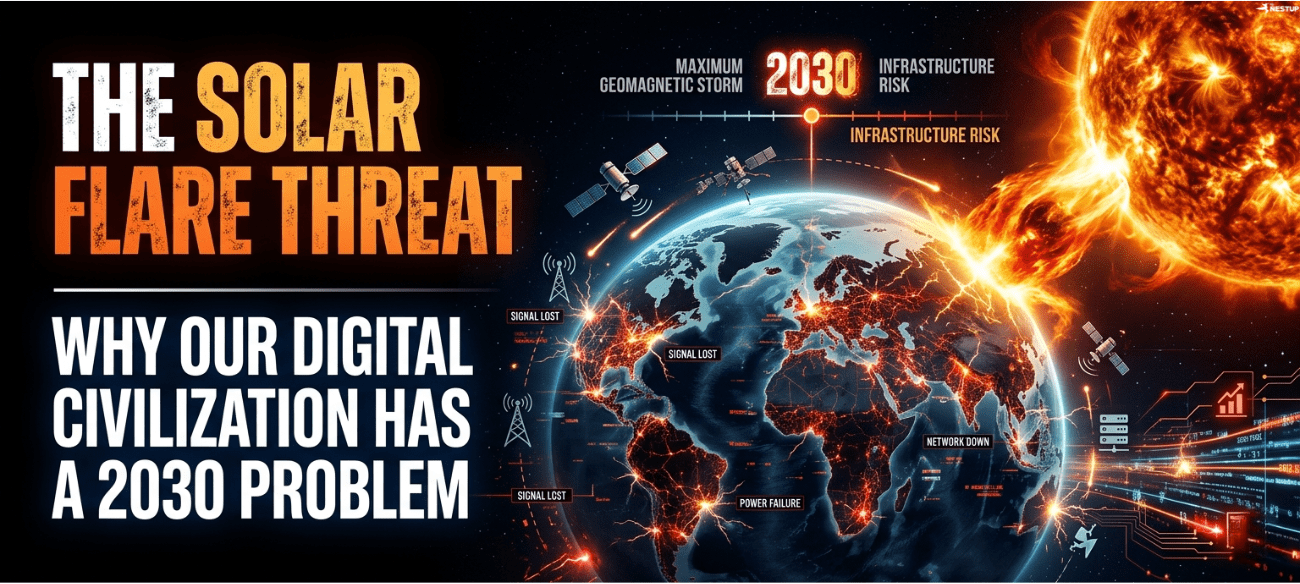
Modern life is suspended on a web of invisible threads. We take for granted the seamless streams of electricity and data that power everything from GPS to real-time financial settlement. As a strategic foresight consultant, I look at these systems and see a dangerous paradox: our technological advancement hasn't made us more resilient; it has made us a larger, more unshielded target. By 2030, we will have reached a point of peak vulnerability—a moment where our total dependence on digital synchronization meets a volatile solar peak.
The 1859 Ghost: A Warning from the Telegraph Era
To understand the stakes, we must look back to the "Carrington Event" of September 1859. When an enormous solar flare launched a coronal mass ejection (CME) directly at Earth, the most advanced technology of the day—the telegraph—literally caught fire. Operators were shocked by their equipment; telegraph paper ignited; and some systems continued to hiss signals through the wires even after being disconnected from their batteries.
The only reason the Carrington Event didn't end Victorian civilization was that society wasn't yet electrified. There were no microchips to fry, no satellites to de-orbit, and no high-voltage transformers to melt.
"At the time, human technology was relatively primitive. Telegraph systems represented the world’s most advanced electrical infrastructure... In 1859, society survived largely because civilization was not yet electrified."
The Strategic Take: We are no longer so lucky. We have spent the last century weaving electricity into the very fabric of our survival. Replaying 1859 in 2030 wouldn't just be a localized disaster; it would be a "hard reset" for the global economy.
The 2030 Perfect Storm: Solar Maximum Meets Total Connectivity
The Sun breathes on an 11-year cycle. We are currently climbing toward a "solar maximum"—a period of intense magnetic activity, sunspots, and CMEs—expected to peak in the second half of the 2020s and into 2030.
But the 2030 window is unique because it represents a "multi-hazard" convergence. Our national electrical grids are already aging and fragile, strained by the massive energy demands of AI data center expansion and the rapid adoption of electric vehicles. Into this high-stress environment, we are adding:
- AI-Driven Infrastructure: Systems that require "perfect" real-time sync to function.
- Hyper-Connected Logistics: Autonomous shipping and trucking that rely entirely on GPS and satellite links.
- Digital-Only Finance: Banking networks with no manual "paper" fallback for transactions or liquidity.
The risk isn't just "more solar activity"; it is our own growing dependency on a grid that is being pushed to its limit even on a sunny day.
The Transformer Bottleneck: A Physical Achilles' Heel
If the Sun is the storm, our large electrical transformers are the glass houses. These massive units are the heart of the power grid, and they are uniquely sensitive to geomagnetically induced currents. A severe solar storm can saturate their magnetic cores, causing them to overheat and fail permanently.
This is where the crisis becomes a long-term catastrophe. Transformers are the ultimate logistical nightmare:
- Custom-Made: They are not "off-the-shelf" parts; they are bespoke engineering projects.
- Supply Chain Fragility: Manufacturing a single unit can take months or years.
- Massive Scale: Their size and weight make them nearly impossible to transport quickly, especially if the logistics networks needed to move them are also without power.
The Strategic Take: A major solar event could damage hundreds of these units simultaneously. We aren't looking at a weekend blackout; we are looking at a scenario where vast regions remain dark for a year or more while waiting for a global supply chain—itself crippled—to produce replacements.
The Satellite Mega-Constellation Trap
We are currently engaged in a frantic race to move the internet into low-Earth orbit. While "global Wi-Fi" sounds like the ultimate resilience tool, it is actually a massive strategic vulnerability. Satellites sit in the "firing line," outside the protective shield of much of Earth’s atmosphere.
In 2022, a moderate geomagnetic storm—a mere fraction of a Carrington-class event—destroyed dozens of newly launched satellites by increasing atmospheric drag and causing them to burn up. By 2030, with tens of thousands of satellites in orbit, a major storm could trigger a cascade of collisions and orbital instability. We are putting our entire communication eggs in a basket that sits in the most exposed environment imaginable.
The Paradox of Sophistication: Why AI Makes Us Less Resilient
We often equate "smart" with "strong," but in infrastructure, the opposite is true. Older, offline systems had a "human buffer"—manual overrides and analog backups that could function when the lights went out. AI and cloud-dependent automation have stripped away that buffer in the name of efficiency.
Consider the cascading failure:
- Power Grid: Solar currents overload transformers, causing regional blackouts.
- Connectivity: Undersea communication cables, the nervous system of the global internet, experience induced currents that disrupt data flow.
- Finance & Logistics: Without data or power, AI-driven banking systems face liquidity failures, and autonomous logistics systems freeze.
Our pursuit of a "frictionless" digital existence has accidentally created a system where a single failure in the electromagnetic environment can paralyze the entire global machine.
Conclusion: Resilience Over Advancement
The 2012 near-miss, where a massive CME missed Earth’s orbit by only a week, was a "warning shot." We have been given a decade of grace to harden our infrastructure, shield our satellites, and build redundancy into our networks.
A Carrington-class event is a matter of probability, not possibility. The question is no longer whether the Sun will strike, but whether we are willing to pay the expensive price of hardening our civilization before it does. Are we so addicted to the convenience of our digital age that we are willing to risk its total collapse?
The real danger is not the Sun itself, but our decision to build a world that is too "smart" to survive a bad day of space weather.