
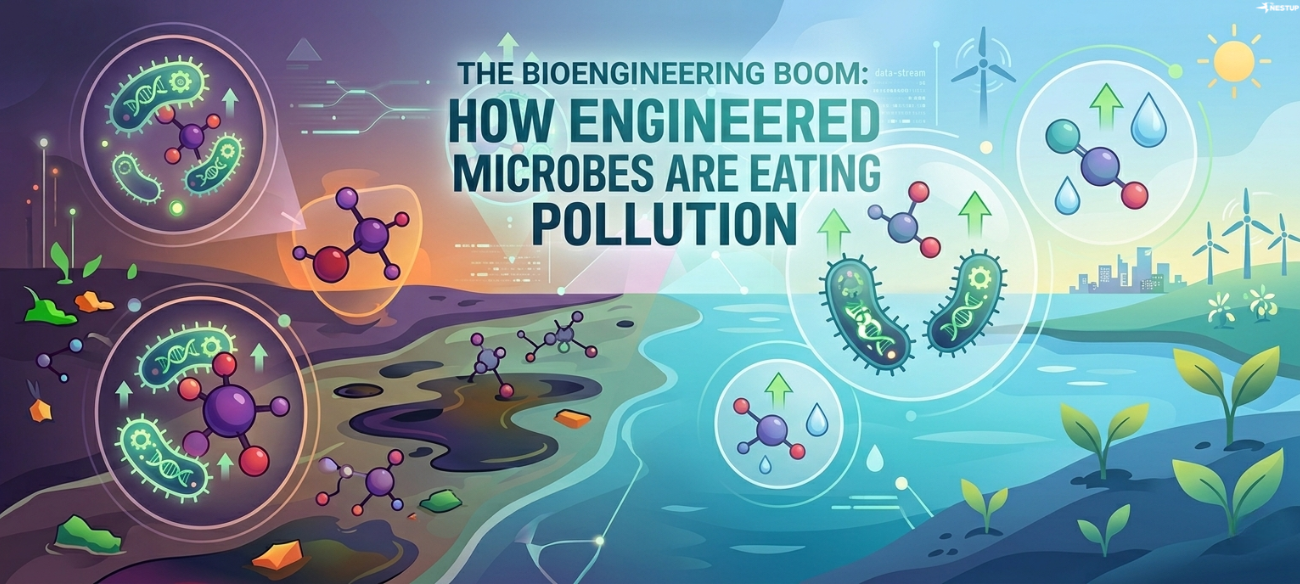
For the vast majority of the industrial era, our strategy for dealing with pollution has been remarkably primitive. When we contaminate a site, we essentially have four options: we dig it up, burn it, bury it, or filter it and move the residue somewhere else. These methods are energy-intensive, astronomically expensive, and ultimately incomplete—they often simply relocate the problem rather than solving it.
However, we are approaching a profound shift in the "signal" of environmental tech. Instead of using mechanical force to move waste, we are beginning to leverage biology to digest it. This field, known as bioremediation, involves using living organisms to break down or neutralize hazardous substances. While the concept has simmered in academic circles for decades, 2026 marks a decisive turning point as engineered microbes move from the laboratory into large-scale, real-world deployment.
The End of "Dig, Burn, and Bury"
The move from mechanical infrastructure to biological systems represents a fundamental change in our industrial philosophy. Traditional methods struggle with modern pollutants because many synthetic compounds are chemically stable and extremely persistent. Biology offers an elegant alternative by using metabolism to transform toxins into harmless matter.
- Old Industrial Cleanup (Mechanical/Physical):
- Methodology: Excavation, incineration, and landfilling.
- Targets: Mostly limited to moving bulk contaminated soil or debris.
- Outcome: Waste is typically concentrated or relocated; high energy and carbon footprint.
- New Bio-Cleanup (Metabolic/Biological):
- Methodology: Engineered enzymes and synthetic microbes.
- Targets: Petroleum contamination, industrial solvents, heavy metals, and complex synthetics.
- Outcome: Contaminants are broken down at a molecular level into harmless compounds or reusable building blocks.
This shift is profound because it marks the transition from "moving dirt" to "engineering chemistry." We are no longer just hiding our mistakes; we are using programmable biology to erase them.
Breaking the "Forever" in PFAS
The most urgent test for this technology is the PFAS crisis. Per- and polyfluoroalkyl substances (PFAS) are synthetic chemicals used in everything from nonstick coatings to firefighting foams. They are notorious for their chemical stability, which prevents them from breaking down naturally in the environment. The economic gravity of this problem is immense: PFAS remediation is projected to cost governments and corporations hundreds of billions of dollars in the coming decades.
“Forever chemicals” because they persist in the environment for extremely long periods.
Current filtration methods are merely a delay tactic; they trap PFAS molecules but do not destroy them, effectively concentrating the contamination for a future generation to handle. The breakthrough offered by engineered biological systems is the actual destruction of the molecules. By designing microbes that can survive in contaminated groundwater and metabolize these persistent bonds, we are moving toward a permanent solution for the water cycle.
The Circular Plastic Revolution
The concept of a "plastic-eating enzyme" has long been a staple of science fiction, but it is now entering the industrial mainstream. This transition began when scientists discovered naturally occurring enzymes capable of breaking down PET plastics, the primary material in bottles and textiles. Researchers have since engineered improved versions of these enzymes that work faster, at lower temperatures, and with the efficiency required for industrial-scale operations.
This technology enables true circular plastic recycling. Traditional mechanical recycling is often actually "downcycling," where the material’s quality degrades until it inevitably ends up in a landfill. Enzyme-based systems, conversely, break plastic down into its original molecular building blocks. This allows for the creation of "virgin-quality" plastic repeatedly, potentially decoupling plastic production from petroleum extraction.
The Secret Engine: The AI and SynBio Convergence
Environmental technology has survived many hype cycles that ultimately failed to deliver. Why is 2026 different? The credibility of modern bioremediation is driven by the convergence of three factors that have finally closed the "commercialization gap":
- Collapsed Sequencing Costs: The cost of DNA sequencing and gene editing has plummeted, making it economically viable to engineer specific microbial traits for niche pollutants.
- AI-Driven Protein Engineering: This is the real "engine" of the revolution. AI systems now predict protein structures and design enzymes with high precision, allowing researchers to optimize metabolic pathways in a fraction of the time required by traditional trial-and-error.
- Regulatory and ESG Pressure: As governments intensify pressure on water pollution and industrial waste, the cost of "doing nothing" has finally surpassed the cost of biological innovation.
This convergence is the solution to the historical stagnation of green tech; we now have the computational power to match the complexity of nature’s own chemistry.
The Commercial Reality Check
The field is rapidly maturing from academic curiosity into a viable commercial sector. Companies like Allonnia are leading this transition, moving beyond the laboratory to secure commercial contracts for mining waste treatment, heavy metal recovery, and municipal water cleanup. As the costs of traditional cleanup explode globally, these biological solutions are becoming the most economically attractive options on the table.
Once biology becomes programmable at industrial scale, pollution itself starts looking less like permanent waste — and more like a chemical problem evolution simply hasn’t optimized for yet.
Safety Protocol for the Bio-Digital Age: Controlled Environments
Deploying engineered life into the open environment is the hardest part of the equation. Real-world environments are messy, characterized by shifting temperatures and competing organisms. To manage risk and meet strict environmental standards, the industry is focusing first on "contained" industrial environments:
- Mining operations where runoff can be treated in-situ.
- Wastewater treatment plants with controlled flow.
- Industrial waste streams at the point of origin.
To prevent ecological disruption, these microbes are equipped with "kill switches" and nutrient dependencies—biological containment mechanisms that ensure the organisms cannot survive outside of the specific contaminated environment they were designed to clean.
Conclusion: A Biological Future
We are witnessing a historic transition in how humanity relates to its own waste. We are moving away from an environmental strategy based on steel, chemicals, and combustion toward one defined by cells, enzymes, and living systems. This is more than a technological upgrade; it is a fundamental shift in industrial civilization.
By treating pollution as a solvable chemical challenge—one that evolution simply hasn't had the time to address—we are beginning to close the loop on the industrial age. The question is no longer whether we can clean up our past, but how quickly we can scale the biological systems now ready to do the work.