
The End of the "NASA-Only" Era
For the better part of the 20th century, the orbital domain was a restricted theater of institutional hegemony. Reaching the stars required the immense gravitational pull of national budgets, multi-decade government planning cycles, and vast, sluggish armies of cost-plus contractors. In this legacy era, space was a instrument of national prestige, not a maturing industrial sector.
That era of centralized control has decisively ended. Today’s space sector is defined by aggressive commercialization, a massive influx of private capital, and a fundamental collapse in the price-per-kilogram to orbit. As we pivot toward 2030, the strategic focus has shifted from whether a commercial space economy can exist to a much more pressing question of market capture: Who is actually winning the race to own the orbital infrastructure? This analysis distills the most impactful structural shifts occurring as space matures from an exploratory frontier into a critical industrial utility.
SpaceX’s Secret Weapon Isn’t Just Rockets—It’s Vertical Integration
While the public remains captivated by the spectacle of landing boosters, the true competitive moat for SpaceX is its unprecedented level of vertical integration. Unlike traditional aerospace incumbents that manage a fragmented web of external vendors, SpaceX designs and manufactures nearly every critical component in-house—from Merlin and Raptor engines to the phased-array antennas of Starlink user terminals.
This strategy offers more than just logistical simplicity; it provides a profound economic advantage. By internalizing the supply chain, SpaceX bypasses the margin-stacking and "cost-plus" delays inherent in traditional contracting. This enables a cycle of rapid iteration where hardware changes can be implemented in days rather than months, preserving margins and accelerating the development of the next generation of lift.
"Few competitors can match that scale. The result is a feedback loop where more launches generate more revenue, which funds more development, which enables even more launches."
Starship: A Bet on the Economics of "Order of Magnitude"
The Starship program is not merely a play for size; it is a calculated bet on the economics of "order of magnitude" cost reduction. By aiming for total and rapid reusability, Starship seeks to move launch costs from thousands of dollars per kilogram to hundreds or less. If achieved, this won't just improve existing markets—it will unlock entirely new orbital business models that were previously non-viable.
Potential applications for this massive lift capacity include:
- Lunar cargo logistics and the first sustained transportation architecture to Mars.
- High-density satellite deployment to enable next-generation global communications networks.
- Commercial orbital habitats and the realization of large-scale in-orbit manufacturing.
- Deep-space scientific exploration utilizing payloads that are no longer mass-constrained.
The primary hurdle for Starship remains its transition from experimental flight to operational reliability. For the industry at large, the true test is whether SpaceX can demonstrate the high-frequency reusability required to make the platform economically sustainable.
The "Satellite Prize": Why Rockets are the Distraction and Data is the Goal
In the maturing space economy, rockets are essentially delivery trucks—a vital but increasingly commoditized service. The real value is being captured in the "cargo": the satellites and the data they generate. While launch vehicles dominate the headlines, the satellite economy is the engine of recurring revenue that provides the sector's financial gravity.
Megaconstellations like Starlink are the most prominent examples of this shift. They serve as a proof-of-concept for how orbital assets can generate a steady stream of capital that can potentially fund long-term exploration goals. We are seeing a pivot from "one-and-done" launches to a focus on sustained orbital infrastructure, including:
- Orbital servicing: Robotic repair, refueling, and life-extension of high-value assets.
- Space Traffic Management (STM): Maintaining safety and coordination in increasingly crowded orbital planes.
- Integrated Data Analytics: Synthesizing Earth observation and communication feeds into actionable intelligence for global markets.
Rocket Lab: The "Disciplined" Dark Horse to Watch
While SpaceX and Blue Origin command the heavy-lift narrative, Rocket Lab has emerged as a formidable strategist by exercising extreme operational discipline. After consolidating its position as the leader in the small-launch market with the Electron rocket, the company is now moving upmarket with its Neutron vehicle.
Rocket Lab’s methodology is notably more measured than the public "trial-and-error" of its larger rivals. By targeting the medium-lift market, Neutron is designed to fill the critical gap between niche small-sat launchers and super-heavy giants. Their focus on "responsive space"—the ability to launch on short notice to replace or augment constellations—positions them as an essential partner for both commercial and government clients who prioritize mission flexibility over raw payload mass.
The Geopolitical Pivot: National Security as the Primary Engine
A common misconception among observers is that the new space race is driven by a romantic desire for exploration. In reality, intensified geopolitical competition is the primary engine of industry growth. Space is now viewed as a contested domain, and governments are aggressively pivoting defense spending toward:
- Persistent Intelligence and Surveillance (ISR).
- Resilient Communications that can withstand electronic warfare.
- Advanced Missile Warning and Tracking systems.
Because national security requirements are inelastic, defense contracts provide the most stable revenue stream in the industry. For these customers, the primary metrics are no longer just cost, but operational reliability and schedule certainty. The ability to guarantee a launch window is becoming as valuable as the rocket itself.
The Moon is Transitioning from a Symbol to a Logistics Hub
The Moon is currently undergoing a conceptual shift: it is moving from a destination for symbolic flag-planting to a strategic logistics hub. The next decade will focus on "lunar industrialization"—building the foundational infrastructure required for a permanent presence.
Emerging lunar industries that are maturing beyond the conceptual phase include:
- Lunar Communications and GPS Networks: Essential for surface coordination.
- Surface Mobility and Power Generation: Providing the "utilities" for scientific and commercial outposts.
- Resource Extraction and Habitat Construction: Leveraging local materials to reduce the "mass tax" of launching from Earth.
By treating the Moon as a testing ground for broader industrial applications, the space economy is establishing the supply-chain templates that will eventually be applied to the rest of the solar system.
The 2030s Will Be About Building "Roads and Utilities"
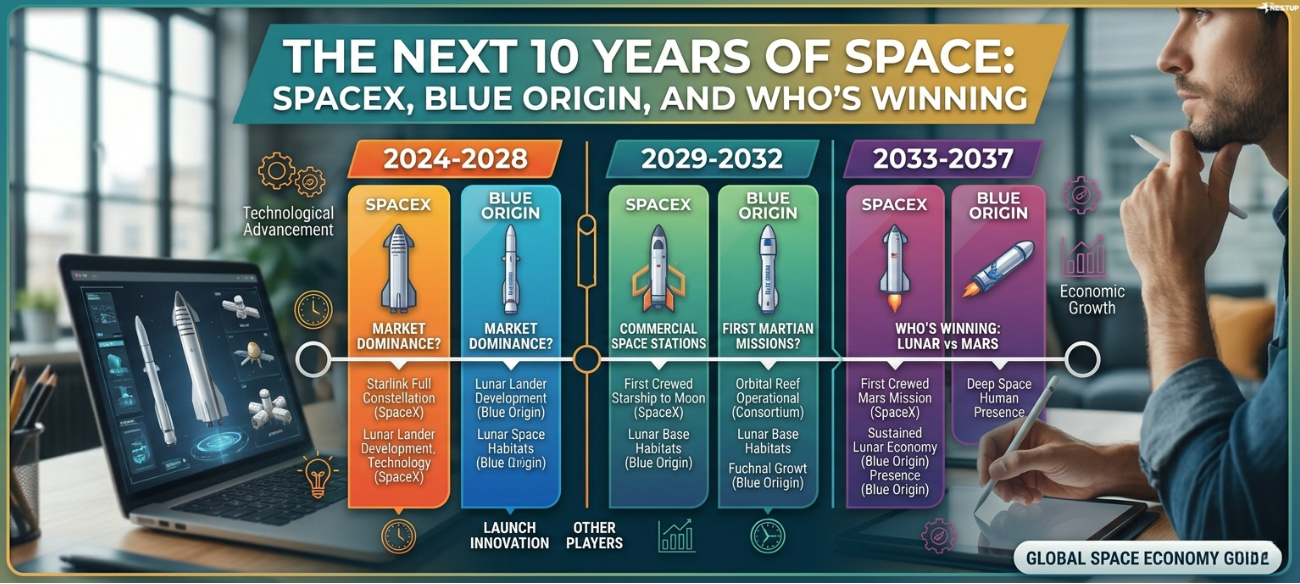
As we approach the mid-2030s, the space industry will likely evolve away from a concentrated, winner-take-all model toward a diversified map of functional specialists. The ultimate victors will not merely be those who sell "tickets" to orbit, but the companies that provide the "roads, ports, and utilities" of the new frontier.
The 2036 industry landscape is expected to consolidate around several key pillars:
- SpaceX: The dominant provider for heavy launch, human spaceflight, and deep-space logistics.
- Blue Origin: A primary specialist in heavy-lift government contracts and lunar infrastructure, centered on the operational maturity of the New Glenn rocket.
- Rocket Lab: The go-to provider for responsive launch, medium-class missions, and specialized space systems.
- Emerging Specialists: A secondary tier of firms focused on high-margin niches like orbital debris removal, in-space manufacturing, and resource utilization.
This shift from concentration to a multi-polar map is driven by the fact that while the barriers to entry—massive capital intensity and technical expertise—remain high, the maturation of the market allows for profitable specialization. Once the "roads" (launch) and "utilities" (power and comms) are established, the barrier for niche service providers begins to lower.
Conclusion: A New Economic Frontier
We are living through the most significant decade in the history of commercial spaceflight. We are witnessing the metamorphosis of space from a government-funded laboratory into a functional industrial utility. The winners of this era will be those who recognize that the orbital domain is no longer a place to visit, but a place to work.
As we look toward the 2030s, we must confront a fundamental shift in our economic reality: Are we prepared for the transition of space from a distant, romantic frontier into a foundational component of global industrial infrastructure? The "Space Age" is over; the "Space Economy" has arrived.