
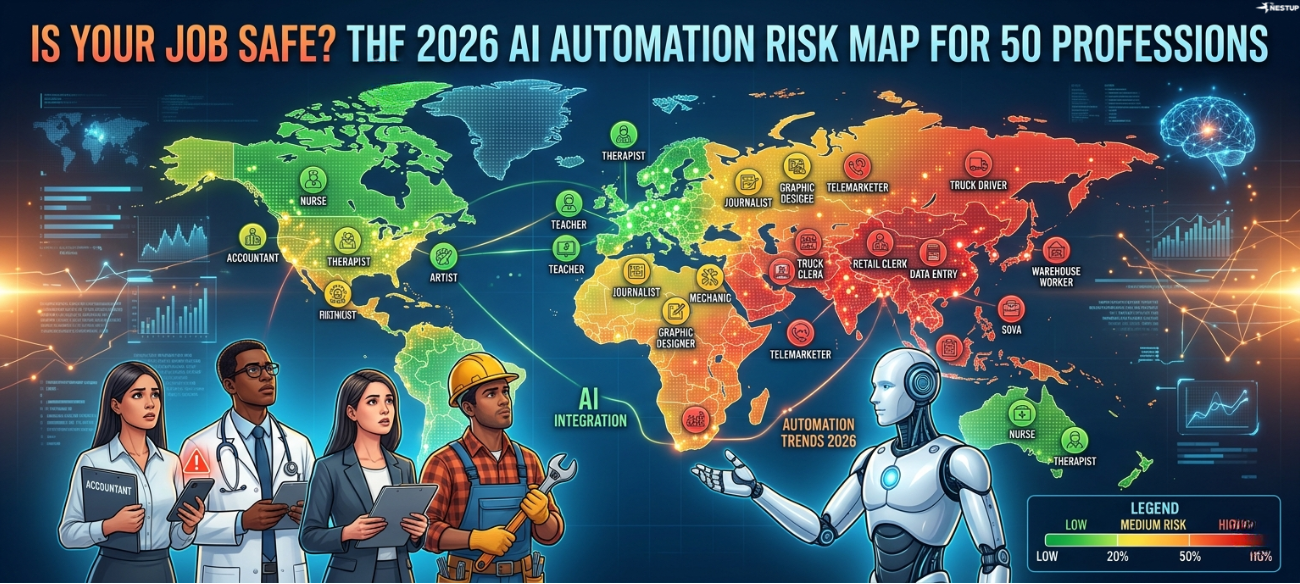
By 2026, the breathless panic of "Will AI take my job?" has finally matured into a more surgical reality. We have entered the era of task-based displacement. As the latest "2026 AI Automation Risk Map" makes clear, the workforce isn't being erased; it is being unbundled. We are no longer debating if automation will arrive—we are mapping exactly which parts of our workday are being handed over to the machines.
“The real question is: Which parts of this profession can AI automate — and which parts still require humans?”
For the white-collar professional who spent the last decade believing a degree was a suit of armor, the data is a wake-up call. The 2026 landscape reveals that the more "digital and structured" your work is, the more precarious your position. Meanwhile, the "messy" trades are enjoying a renaissance of job security.
The Physicality Paradox: Why the Real World is the Ultimate Moat
There is a profound irony in the 2026 labor market: the "cleaner" your workspace, the higher your risk. Software-based AI thrives on the predictable logic of code and spreadsheets, but it remains humbled by a 50-year-old copper pipe behind a crumbling basement wall.
This is the Physicality Paradox. Electricians, plumbers, and mechanics remain in the Lower Risk (10–30%) category because the physical world is gloriously, stubbornly unpredictable. Unlike a data repository, no two building environments are identical. Every job requires manual troubleshooting and a level of physical adaptability that robotics has yet to cost-effectively replicate. Compare this to Very High Risk (70–95%) roles like basic SEO writing or data entry—professions where the environment is purely digital, structured, and ripe for total algorithmic capture.
The “Accountability Moat” and the Tiering of High-Stakes Roles
Technical capability is no longer the only metric for automation; the new metric is liability. In 2026, we see a clear divide in how "prestige" roles are being disrupted based on who carries the weight of a mistake.
- The Lower Risk Tier (10–30%): Pilots and Surgeons remain resilient. While AI-assisted diagnostics and autopilot systems are more advanced than ever, the regulatory and ethical framework of 2026 demands a "human to blame." Society is not yet ready to let a black-box algorithm hold ultimate responsibility for a life-or-death crisis.
- The Moderate Risk Tier (30–50%): Lawyers have shifted into a higher risk bracket than their counterparts in the OR. While "courtroom strategy" remains a human-led endeavor, the "commodity" side of law—contract analysis and legal research—has been aggressively automated. The lawyer of 2026 is less a researcher and more a high-stakes negotiator.
Organizations still want a human neck in the literal or metaphorical noose when things go wrong. That accountability is a moat that code cannot cross.
The Rise of the "Solo Professional"
Perhaps the most transformative insight from the 2026 Risk Map is how AI is shrinking the operational size required to compete. We are witnessing the death of the "middle-management layer" and the birth of the Solo Professional.
AI is no longer just a tool; it is a force multiplier that allows a single individual to act as an entire department. This has birthed new, lean business models:
- Solo Media Businesses: Where one creator produces high-end video, audio, and text via AI orchestration.
- Micro-SaaS Startups: Where a single developer manages an entire software product.
- One-Person Agencies: Delivering elite consulting and research without the overhead of junior associates.
The "Junior Coder" is at risk precisely because the Solo Professional no longer needs a team to write boilerplate code or handle routine implementation.
The End of "Commodity Content" and the Shift to Orchestration
For those in High Risk (50–70%) roles—Junior Software Developers, Basic SEO Writers, and Graphic Designers—the "doing" of the task has become a commodity. If your value is based on producing a standard deliverable (a piece of code, a blog post, a logo), you are competing with a marginal cost of zero.
The exit ramp for these professionals is a shift in identity from Implementation to Architecture and Orchestration. The market no longer pays for the "writing"; it pays for the "vision." To survive, the Junior Coder must become a System Architect, and the writer must move toward original reporting, personality-driven insights, and community-building—areas where AI’s lack of lived experience makes it a poor substitute.
The Human-Centric Moats: EQ as the New Currency
The Very Low Risk (0–10%) professions are those anchored in the "Hard-to-Automate" human strengths. In 2026, Emotional Intelligence (EQ) isn't a "soft skill"—it’s the hardest currency in the economy.
- Empathy & Connection: Therapists and Childcare Providers remain essential because the "service" is the human relationship itself.
- Crisis Management & Ethical Judgment: Emergency Physicians and CEOs are shielded by the need for nuanced decision-making under extreme uncertainty.
- Persuasion: Elite Negotiators thrive because they can navigate the irrational, emotional, and cultural nuances of human ego—territory where algorithms still stumble.
Future-Proofing Checklist: Becoming “AI-Augmented”
Survival in the 2026 economy requires moving from a "human vs. machine" mindset to an "augmented" one.
- Adopt "Architecture and Orchestration": Stop focusing on how to do the task; focus on how to direct the AI to execute your high-level vision.
- Move Toward Strategy: Execution is being automated. Strategic decision-making and stakeholder management are where the value has migrated.
- Build a Personal Brand: In an ocean of AI-generated content, trust is the only scarce resource. Your "personality" is your most durable economic moat.
- Lean Into "Human-Heavy" Tasks: Double down on negotiation, ethical judgment, and complex relationship-building.
- Pursue Hybrid Skills: Combine the physical and digital. The most resilient workers are those who can bridge the gap—like the Smart-Home Electrician or the AI-Assisted Healthcare Worker who blends manual dexterity with digital literacy.
Conclusion: The 2026 Hybrid Reality
The 2026 labor market has taught us that the future doesn't belong to the smartest machine or the most hardworking human. It belongs to the Augmented Worker—those who have mastered the art of using AI leverage to amplify human judgment.
As you look at your own career path, ignore the job title and look at the tasks. Ask yourself: Are you spending your day on repetitive patterns that a machine can learn, or are you providing the "messy" judgment, accountability, and trust that only a human can offer? The answer to that question will determine if you are the one being replaced, or the one doing the replacing.