
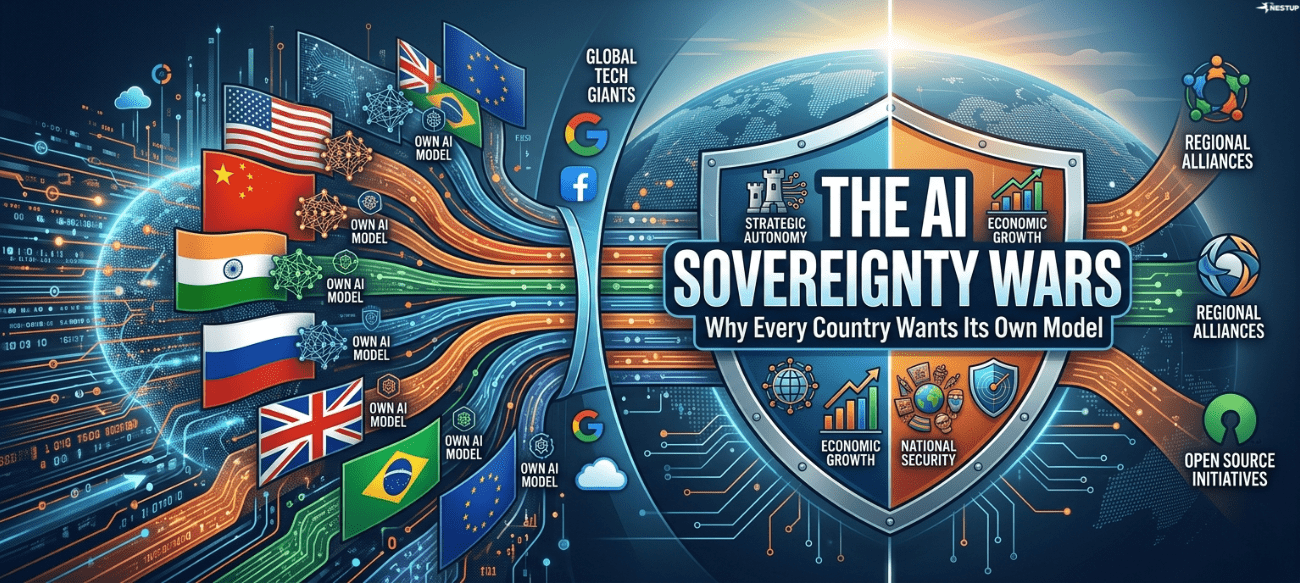
The early days of the generative AI boom were defined by a sense of universal utility. Tools like ChatGPT were perceived as global commons—digital conveniences accessible to anyone with an internet connection. However, that era of innocent globalism is ending. As we move deeper into the mid-2020s, a more unsettling reality has taken hold: what began as a commercial novelty has rapidly graduated into the most critical layer of national infrastructure.
For the modern nation-state, relying on foreign-controlled "digital intelligence" is no longer just a matter of convenience; it is a profound strategic vulnerability. This realization has birthed the era of Sovereign AI: a high-stakes geopolitical race to build, own, and govern domestic AI ecosystems. The goal is no longer just "innovation"—it is the pursuit of technological autonomy in an age where "informational sovereignty" determines a nation's place in the global order.
AI is the New Nuclear Energy
By 2026, the global perspective on artificial intelligence has fundamentally shifted. Policymakers no longer view AI through the lens of the commercial technology sector. Instead, it is now categorized alongside power grids, semiconductor fabrication, telecommunications, and nuclear technology.
This shift has elevated the stakes from corporate market share to national survival. Because AI now serves as a power multiplier for defense, intelligence analysis, and industrial productivity, a lack of domestic AI capacity is increasingly viewed as a form of strategic disarmament. For a state to lack its own "digital brain" is to yield the fundamental levers of modern power to external actors.
"Governments around the world are realizing that advanced AI systems may become as strategically important as energy infrastructure, semiconductor manufacturing, telecommunications, or nuclear technology."
The Fear of "Digital Colonialism"
There is a deepening anxiety among middle and emerging powers regarding their strategic dependence on a handful of "U.S. hyperscalers." When frontier models originate exclusively within a small circle of American firms—OpenAI, Google, Anthropic, and Meta—it concentrates immense influence within a single jurisdiction. This gives those private entities, and the government that regulates them, unprecedented control over the rest of the world’s economic productivity.
The fear is the emergence of a new "digital colonialism." In this paradigm, nations are reduced to mere "providers of raw data," while the "value creation"—the intelligence and the profits—is harvested and concentrated elsewhere. To resist this, countries are pivoting toward Digital Public Infrastructure, investing in sovereign compute capacity and domestic cloud systems. They recognize that if you do not own the "brain" of your digital economy, you are merely a tenant in someone else’s empire.
Language is the Ultimate Sovereign Border
A primary driver for Sovereign AI is the realization that language is not merely a medium for communication; it is a vessel for cultural assumptions, historical context, and social norms. Models trained predominantly on Western datasets carry inherent political framings that can marginalize local identities, leading to a "narrative distortion" that threatens a nation's cultural integrity.
- India: Through the BharatGPT initiative, India is addressing the challenge of linguistic scale. In a nation of immense linguistic diversity, AI is seen as a tool for digital inclusion. By building models that support local languages, India is ensuring that its Digital Public Infrastructure remains accessible and culturally resonant.
- Japan: The Japanese strategy is explicitly linked to its existential demographic crisis. Facing an aging population and severe labor shortages, Japan is optimizing domestic models for its unique language complexity and business workflows. For Tokyo, AI is the essential "human-assistive" technology required to maintain industrial productivity as the workforce shrinks.
The "Open-Weight" Loophole for Middle Powers
Achieving AI sovereignty is constrained by the "Compute Problem." Building frontier models from scratch requires a rare trifecta: advanced semiconductors, massive electricity supplies, and specialized engineering talent. This high barrier to entry means that while many nations want sovereignty, only a few can realistically compete at the frontier.
However, "open-weight" models have created a strategic loophole. By leveraging models like France’s Mistral or the UAE’s Falcon, nations can achieve technological autonomy without starting from zero.
- The UAE: Utilizing its massive capital and centralized planning, the UAE has positioned itself as a major player in AI infrastructure, viewing it as a pillar for post-oil strategic positioning.
- France: Through Mistral, France is championing a European model of "regulatory legitimacy," aligning AI development with EU privacy standards to reduce dependence on American hyperscalers. This democratization of weights allows nations with capital to bypass the talent shortage, fine-tuning existing models to meet specific national needs.
The Splintering of the Global AI Stack
The push for sovereignty is inevitably leading to the fragmentation of the technology world into distinct "AI Blocs." We are witnessing the emergence of a U.S.-aligned infrastructure, European systems focused on governance, and regional specialized models in the Gulf and Southeast Asia.
Most significantly, China remains the largest state-scale competitor to the U.S. By combining state coordination with vast domestic platform ecosystems and aggressive semiconductor investment, China is building a self-sufficient AI stack. This urgency has only been accelerated by U.S. export restrictions on advanced chips, forcing Beijing to double down on domestic hardware. This "AI Nationalism" mirrors historical patterns in telecommunications and internet governance; while it provides local control and security, it risks a global slowdown in progress as protectionism and restricted collaboration become the new standard.
Conclusion: The Future of Cognitive Infrastructure
The transition from AI-as-an-app to AI-as-infrastructure is complete. We have moved beyond the era of the chatbot and into the era of "cognitive infrastructure." Governments are no longer willing to let foreign corporations hold the keys to their economic, military, and cultural futures.
As this fragmentation accelerates, every nation must face a difficult trade-off: Is the efficiency and raw power of a globalized, frontier AI system worth the loss of national control? Can a nation truly claim to be sovereign if its most critical cognitive functions are outsourced to a foreign "digital brain" it neither owns nor understands?
"Countries are not fighting merely over chatbots. They are competing over the future cognitive infrastructure of civilization itself."