
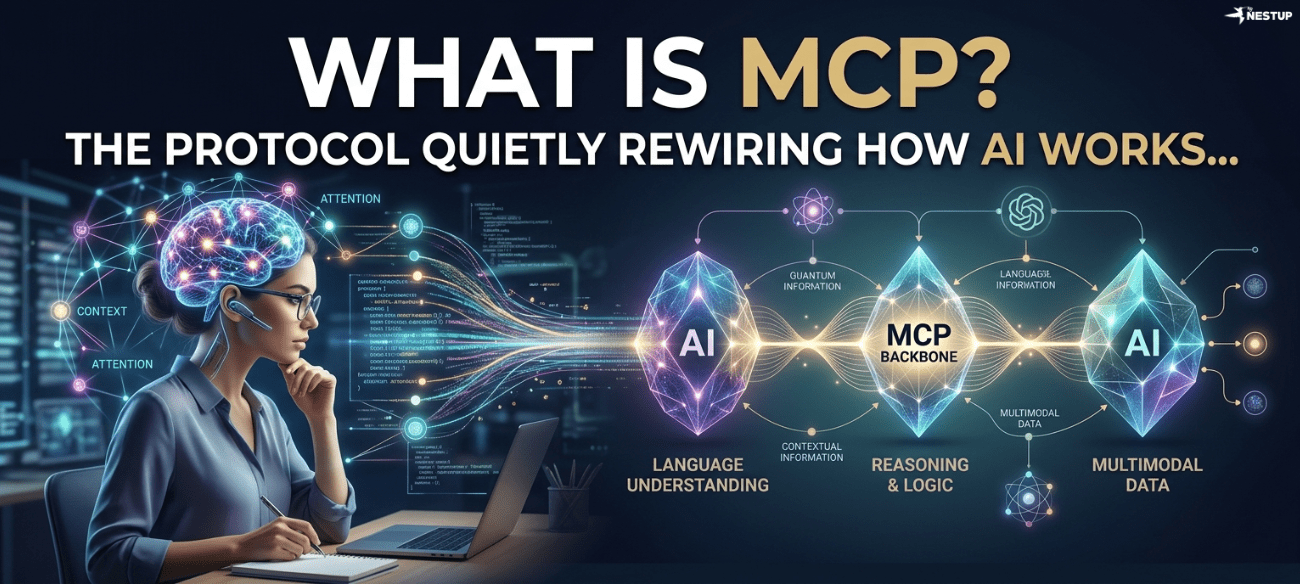
For years, the industry has been obsessed with the size of the "brain." We herald each new billion-parameter milestone as if we are nearing the finish line of intelligence. But we have hit an architectural wall: we are building geniuses trapped in soundproof rooms. These models possess staggering reasoning capabilities, yet they remain isolated organs in a jar, fundamentally disconnected from the very data and tools they are meant to master. The Model Context Protocol (MCP) is the architectural reckoning the industry has been waiting for. It is the "quietly rewiring" solution that finally installs the microphone and the keyboard into that room. By shifting the focus from model scale to model connectivity, MCP moves us away from solitary processing toward a unified nervous system for the AI-native era.
AI is Finally Getting Its Own Operating System
The fundamental innovation of MCP is its role as a universal interface for structured context exchange. Historically, LLMs have been hindered by a lack of standardization, requiring brittle, hardcoded integrations for every unique API or database they encountered. MCP replaces this fragmentation with a unified abstraction layer that treats context as a first-class citizen.
"Think of it less like a chatbot and more like an operating system layer for AI context."
As an architect, I see this as the moment AI becomes truly operational. By providing a standardized port for files, user data, and system states, MCP transforms the AI from a simple text generator into a dynamic system capable of "understanding" and reacting to its environment. This isn't just a new feature; it is the foundational layer that allows digital intelligence to plug into the world.
Curing the "Context Fragmentation" Headache
Current AI development is plagued by "context fragmentation," a technical debt that slows innovation. MCP addresses these bottlenecks by pairing specific developer struggles with architectural solutions:
- From a Tangled Web of APIs to Real-Time Data Access: Instead of building bespoke, fragile integrations for every data source, MCP provides a single, unified language for models to fetch information on demand.
- From Context Overload to Persistent Memory: Rather than stuffing thousands of tokens into a single prompt—praying the model identifies the signal in the noise—MCP enables models to maintain state and recall information across sessions with structured precision.
- From Inconsistent Tools to Agentic Behavior: By standardizing how models discover and execute actions, we move from "static responders" that wait for human input to "agentic systems" that can plan, act, and adapt across complex, multi-step workflows.
This transition is the key to the next generation of applications. When a system can plan and adapt autonomously, it ceases to be a tool and starts to be a partner.
From Prompt Engineering to System Design
The introduction of MCP signals a profound architectural shift. We are moving toward a clean separation of concerns, decoupling the AI stack into three distinct layers: the Model Layer (reasoning), the Context Layer (the MCP-driven knowledge), and the Tooling Layer (external capabilities).
This decoupling is a breakthrough for maintenance and scalability. It allows for "hot-swapping" models or external tools without needing to re-engineer the entire integration stack. If a superior model is released tomorrow, you swap the "brain" without needing to rewire the entire nervous system. This shifts the developer's focus from linguistic gymnastics toward robust system engineering.
The Shift in Developer Responsibilities:
- Defining structured schemas rather than crafting increasingly complex, unpredictable prompts.
- Building reusable tool interfaces that align with modern microservices and composable architectures.
- Designing stateful workflows where the AI functions as a central coordinator within a broader digital ecosystem.
The "HTTP" of the AI Era
MCP’s ambition is the standardization of the AI-native internet. In the same way that HTTP provided the universal standard that allowed the web to scale and innovate, MCP aims to be the open ecosystem standard for context.
While other protocols exist, they serve different philosophies. Google’s Agent-to-Agent (A2A) focuses on multi-agent orchestration—how agents talk to each other. IBM’s Agent Communication Protocol (ACP) is built for the enterprise, emphasizing governance and legacy integration within closed silos. MCP, however, is an open standard designed to drive exponential innovation. While closed tools solve internal problems, an open context layer creates a shared foundation that allows any developer to plug into a global network of information.
Security Through "Controlled Exposure"
As AI transitions from a passive assistant to an active decision-maker, the security stakes rise exponentially. A model that can act on the world must be managed with extreme precision. MCP addresses this through "controlled exposure," ensuring that models only access the specific data and tools they need at a given time.
This focus on authentication, authorization, and auditability is essential. Security is not just a secondary feature; it is the bridge that allows AI to move from experimental playgrounds into mission-critical infrastructure. By standardizing these security protocols, MCP ensures that "active" AI can be deployed without sacrificing system integrity.
"Just as the web unlocked new industries, MCP could unlock entirely new categories of AI applications—from autonomous business processes to deeply personalized digital assistants."
The Final Thought: A World of Better Connections
The future of the AI revolution will not be won solely by the smartest model. Intelligence is only as effective as the system it inhabits. By solving the foundational bottleneck of context—how AI systems access, share, and act on information—MCP is building the infrastructure for a more integrated digital future. We are moving toward a world where AI doesn't just generate text about our lives but interacts seamlessly with the systems that power them.
As we standardize how AI "sees" the world, how much faster will the world change around us?