
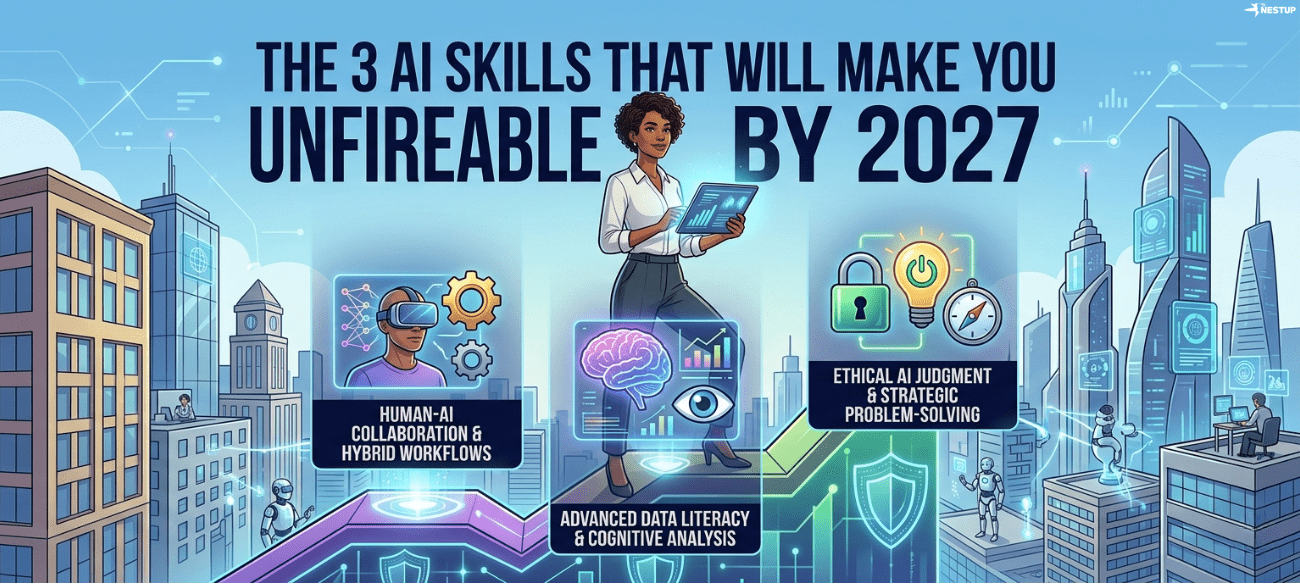
The digital economy is undergoing a fundamental restructuring of how human capital creates value. While automation anxiety is at an all-time high, the prevailing fear of total job replacement misses a critical nuance: AI rarely replaces entire roles; instead, it aggressively automates specific tasks within those roles.
By 2027, the primary driver of professional market differentiation will not be the avoidance of AI, but the ability to direct it. Career safety now belongs to those who view AI as a professional multiplier rather than a competitor. To secure your position, you must pivot from a manual contributor to a strategic orchestrator who raises the ceiling of what these systems can achieve.
Become the Conductor: The Power of Agent Orchestration
The era of "one prompt, one answer" is rapidly concluding. The next phase of productivity is defined by agent orchestration, the ability to manage complex networks of specialized AI tools working in tandem toward a single objective.
Instead of manual execution, the orchestrator directs a team of digital agents—including research agents, writing agents, spreadsheet agents, and automation agents—coordinated by a human review layer. This skill is already the secret weapon of founders running lean companies and marketing teams managing high-volume content pipelines with minimal overhead.
Mastering this allows you to reduce operational friction and multiply your total output far beyond traditional human limits. In this new hierarchy, the ability to architect a system is significantly more valuable than the ability to execute a single task.
"The orchestrator becomes more valuable than any single contributor."
Essential Tools for Orchestration:
- Workflow Platforms: Zapier, Make, n8n.
- Development Frameworks: OpenAI Platform, LangChain.
The Quality Moat: Cultivating Judgment and Taste
As AI lowers the barrier to creation, the volume of content will explode, leading to a surplus of work that is "plausible but average." To build a competitive moat, professionals must cultivate the two things AI lacks: the judgment to determine strategic correctness and the taste to ensure cultural resonance.
Judgment involves the ability to prioritize correctly, make difficult tradeoffs, and recognize the nuance of a specific context. AI often produces outputs that are technically correct but strategically wrong; the human filter is what ensures the work actually solves a business problem.
Taste is the recognition of high quality and an understanding of aesthetics and emotional resonance. As AI raises the floor for average output, exceptional human judgment becomes the ultimate differentiator in fields like product strategy, brand campaigns, and leadership.
"Exceptional judgment becomes the differentiator."
Recommended Resources for Building Judgment:
- The Design of Everyday Things (Don Norman)
- Thinking, Fast and Slow (Daniel Kahneman)
- Poor Charlie’s Almanack (Charles T. Munger)
Human-AI Interface Design: Solving the Usability Crisis
Most AI implementations fail not because the models are weak, but because the workflows are poorly designed and human trust breaks down. Human-AI Interface Design is the ability to translate human intent into functional systems through prompt architecture and AI onboarding experiences.
The winners in the 2027 labor market will be those who simplify AI complexity for others by designing intuitive AI copilots, dashboards, and conversational workflows. This requires deep UX thinking to ensure that automated assistants include the necessary layers for human oversight and reliability.
By building better bridges between humans and machines, you solve the "usability crisis" that prevents most organizations from realizing AI's full potential. You become the indispensable translator who makes technology actually work for real people.
Essential Tools and Guides:
- Design Tools: Figma.
- Prompting Standards: Anthropic Prompting Guide.
- User Experience Research: Nielsen Norman Group.
The 90-Day Mastery Roadmap
To build these competencies, you must move through a structured progression that balances technical understanding with strategic application.
Days 1–30: Fundamentals
- Learn: Prompting fundamentals, workflow automation basics, API concepts, UX basics, prompt structure, and AI limitations.
- Build: Simple automations and AI-assisted email workflows.
- Practice: Critiquing AI-generated outputs and consuming high-quality writing and design daily.
Days 31–60: Advanced Workflows
- Learn: Multi-step workflows, tool chaining, and data routing.
- Study: Decision-making frameworks and great product or company case studies.
- Build: An automated research assistant, an AI content pipeline, and internal tools or dashboards.
- Practice: Rewriting mediocre AI work into strong, strategically correct work.
Days 61–90: Systems & Reliability
- Learn: Agent frameworks, AI reliability management, and human oversight systems.
- Develop: Personal editorial standards, clear professional opinions, and a portfolio of refined work.
- Build: An end-to-end AI workflow tailored to your specific profession.
- Test: Real user interactions, identify friction points, and implement clarity improvements.
Conclusion: The New Leverage
The AI era does not eliminate the need for human talent; it shifts where that talent creates the most value. We are moving away from rewarding repetitive manual effort and toward rewarding systems thinking and AI coordination.
To remain unfireable, you must recognize which skills are becoming increasingly vulnerable:
- Basic content production and routine coding.
- Generic analysis and repetitive administrative work.
Conversely, you must double down on skills that are increasingly valuable:
- Strategic judgment and communication.
- Systems thinking and AI orchestration.
The future belongs to those who do not compete against the machine, but who become exceptionally good at directing, refining, and integrating it into human workflows.
As AI raises the floor for average work, what are you doing today to raise your ceiling of exceptional judgment?