
 N
N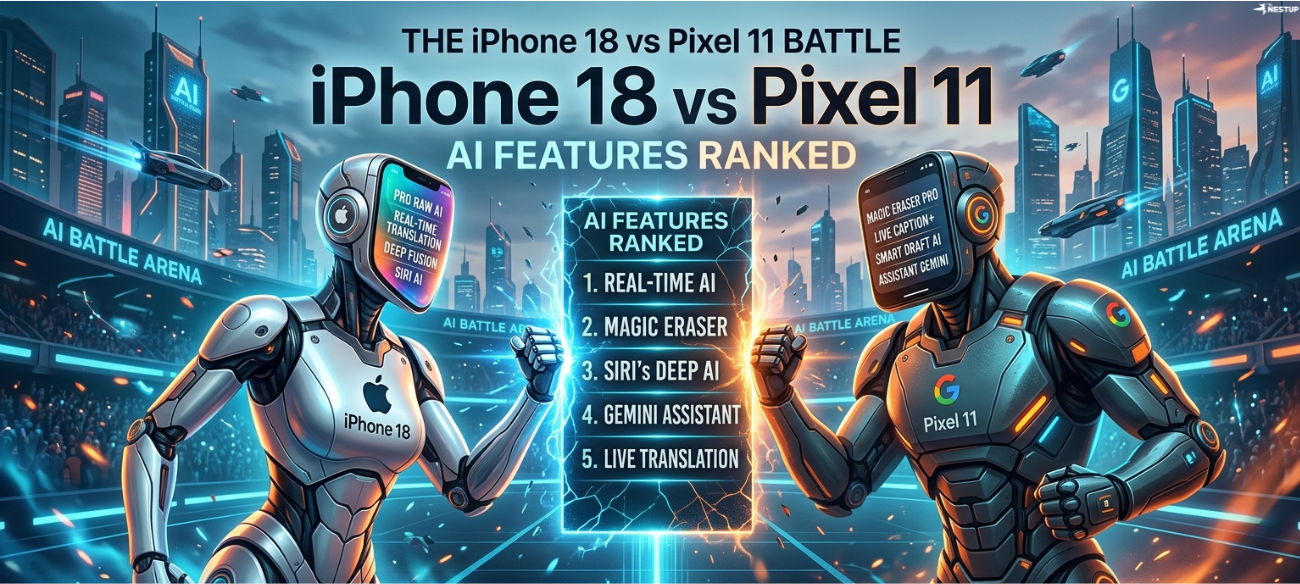
The Hook: The Death of the Megapixel Era
For decades, the smartphone industry measured progress through the cold prism of hardware benchmarks: the count of megapixels, the raw speed of a processor, and the physical capacity of a battery. By 2026, those metrics have largely become secondary as the battleground shifts to the AI operating system layer. We are witnessing a transition from a world of static tools to one of fluid intelligence.
The fundamental question has evolved. We are no longer asking how fast a phone can launch an app, but rather: Is your phone a tool you use, or an assistant that works for you? This comparison between the iPhone 18 and Pixel 11 isn't a race for speed; it is an investigation into which device understands context and masters the "Digital Mind" better than the other.
Two Irreconcilable Philosophies (Proactive vs. Polished)
Google and Apple have approached mobile AI from opposite ends of the spectrum. The Pixel 11 is a unapologetically AI-native device designed for constant, proactive intervention. Conversely, the iPhone 18 represents a more restrained philosophy, treating AI as a refined layer that enhances the user experience without hijacking it.
"The Pixel 11 often feels smarter immediately, while the iPhone 18 feels more polished and less intrusive over time."
This choice forces users to weigh the cognitive load of an "active collaborator" against the reliability of a "calm assistant." Choosing a Pixel means opting for maximum automation, where the phone anticipates needs before they are voiced. Choosing an iPhone means maintaining user agency, where the AI acts as a quiet support system that respects the boundaries of the digital experience.
The End of One-Off Commands (Contextual Continuity)
The Pixel 11, powered by Gemini Live, introduces a level of contextual continuity that makes Siri look like a legacy utility. Google’s system allows for complex, multi-step reasoning that bridges the gap between disparate apps. For instance, you can find a restaurant mentioned in a message, book it via a browser, and text the group the reservation details in one fluid conversation.
- Gemini’s Ambitious Multi-App Logic: Seamlessly bridges Search, Gmail, Maps, and YouTube to execute real-world requests without user hand-holding or repetitive prompts.
- Apple’s Controlled Refinement: Apple Intelligence focuses on on-device semantic search and writing tools, prioritizing the accuracy of Siri’s improved memory over broad app orchestration.
This gap is most visible in Live Translation. For international professionals, the Pixel 11 offers a "Travel AI" suite—including AI call translation and real-time conversation support—that feels woven into the OS. Apple’s translation is competent and private, but it lacks the speed and "always-on" adaptability found in the Google ecosystem.
Semantic Photography and the Death of Manual Edits
The camera war has moved beyond glass and sensors into the era of semantic editing. The Pixel 11 utilizes AI Zoom reconstruction and features like Best Take to create the "perfect" shot, even if that shot never strictly happened in reality. Users can issue natural language commands like "Make this look like golden hour" or "Remove the crowd," and the AI reconstructs the scene with startling accuracy.
Apple maintains a more conservative stance, prioritizing natural skin textures and realistic HDR balance. While this might seem less "innovative" in a side-by-side spec sheet, it represents a strategic bet on the ethical and aesthetic value of the unedited moment. In an era of deepfakes and generative manipulation, Apple’s restraint serves as a safeguard for visual truth, ensuring that a photograph remains a memory rather than a construction.
The Productivity Paradox (Automation vs. Assistance)
In the workplace, these devices operate with fundamentally different logic. Google’s Pixel 11 acts as an active collaborator, utilizing Gemini to resolve calendar conflicts, summarize meetings, and generate email replies automatically. It is a high-reward system for power users who want to offload the "busy work" of their day to an algorithm.
Winner: Depends on Personality If you want a phone that automates your decisions, the Pixel 11 is the clear victor. However, many users find constant AI intervention overwhelming or untrustworthy. For them, the iPhone 18 is the better fit; it acts as a calm assistant, focusing on adjustments to writing tone, notification prioritization, and proofreading while leaving the final executive decision in the user's hands.
The Hidden Trade-off (Privacy vs. Power)
The most significant hurdle for mobile AI is battery efficiency. Continuous background inference and semantic indexing are power-hungry processes. The Pixel 11, despite its Tensor-powered local AI processing, occasionally struggles with heat and battery drain during sustained tasks like live translation or continuous video summarization.
The iPhone 18 holds a distinct advantage here through its tight hardware-software integration and Private Cloud Compute. By performing a massive portion of AI tasks through on-device inference, Apple achieves a "calmer" power profile and superior battery longevity. For the privacy-conscious, Apple’s emphasis on minimal data retention and local semantic indexing remains the gold standard in the industry.
The Verdict: A Snapshot Comparison
| Category | Winner |
| AI Assistant (Gemini Live) | Pixel 11 |
| Camera AI (Best Take/Zoom) | Pixel 11 |
| Translation AI | Pixel 11 |
| Privacy (On-Device) | iPhone 18 |
| Battery Efficiency | iPhone 18 |
| Ecosystem Polish | iPhone 18 |
| AI Ambition | Pixel 11 |
Closing: The Decade of the Digital Mind
The rivalry between the iPhone 18 and the Pixel 11 marks the end of the hardware era and the beginning of the Decade of the Digital Mind. We are no longer choosing between glass and aluminum; we are choosing a personal philosophy of how we interact with information and the world around us.
Google is aggressively pushing the boundaries of what an automated assistant can do, while Apple is defining the limits of how AI should responsibly enhance a human-centric experience. As you look toward your next upgrade, the question is no longer about the camera or the screen. You must decide: Do you want a phone that automates your decisions, or one that merely assists your decisions?