
 N
N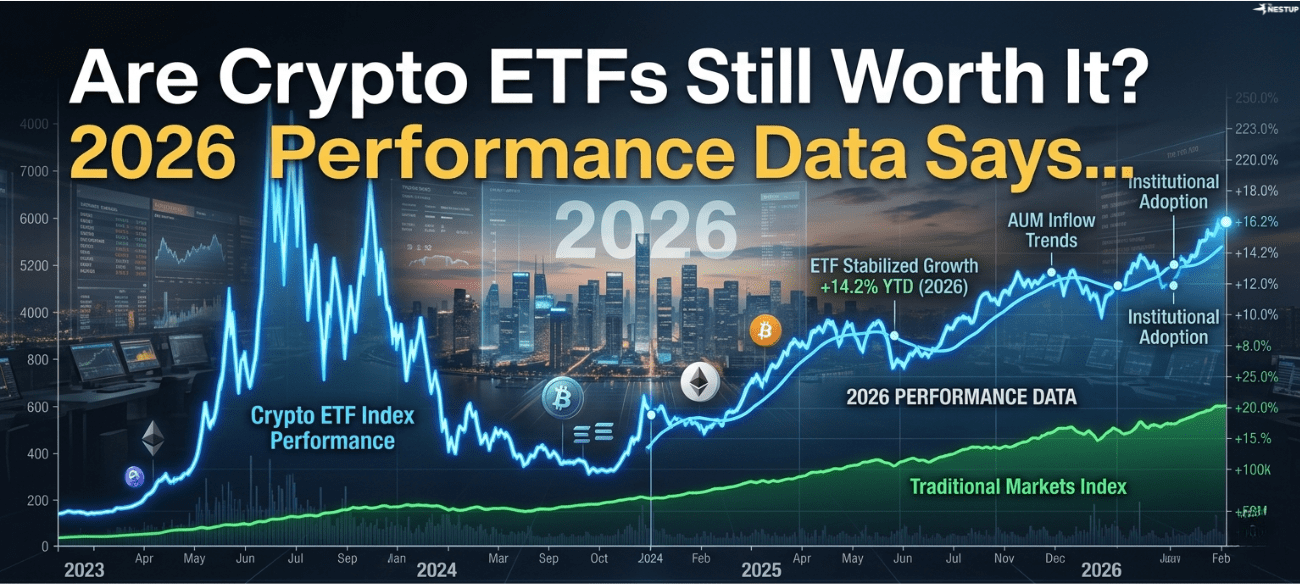
Introduction: The Great Crypto Rebrand
The "wild west" era of digital assets—once defined by the high-stakes management of private keys, 12-word seed phrases, and the constant anxiety of losing a hardware drive—has been replaced by the buttoned-up world of the brokerage account. In 2026, gaining exposure to the crypto market is often as simple as clicking "buy" on a standard trading platform alongside your index funds.
This shift has created a profound central tension. While many celebrate spot ETFs as a historic breakthrough that has finally brought trillions in institutional capital to the table, critics argue these products fundamentally defeat the original purpose of decentralized finance. We are now living in an era where digital assets are no longer just a counter-culture movement; they are a structured, "wrapped," and highly regulated financial product.
Bitcoin is Officially a "Macro Asset" (Not Just a Coin)
By the first quarter of 2026, Bitcoin ETFs have solidified their position as the dominant vehicle for digital asset investment. These funds attracted a staggering $18.7 billion in net inflows during Q1 alone, pushing total Bitcoin ETF assets to a historic milestone of over $128 billion.
Large institutions overwhelmingly prefer the ETF structure over direct ownership for five primary reasons:
- Regulatory clarity: A defined legal framework for asset holding.
- Liquidity: High trading volumes allow for efficient institutional entry and exit.
- Simpler compliance: Funds align with existing corporate and fiduciary mandates.
- Familiar infrastructure: Assets are held within existing brokerage and custodial ecosystems.
- Easier allocation: Bitcoin can be seamlessly integrated into traditional portfolio models.
This institutional gravity has fundamentally altered the market’s DNA. Instead of being driven purely by retail sentiment on social media, price action is now materially influenced by massive, regulated fund flows.
"In many ways, Bitcoin increasingly trades like an institutional commodity asset instead of a purely retail-driven cryptocurrency."
The Ethereum Paradox: Superior Tech vs. Sluggish Demand
While Bitcoin has flourished as "digital gold," Ethereum ETFs have faced a more uneven path in 2026. Despite Ethereum’s sophisticated technological foundation—including smart contracts and Layer-2 scaling—it suffers from a "Complexity Gap." Institutional investors often struggle to digest the multifaceted nature of the network compared to the simple narrative of Bitcoin.
The challenge is that Ethereum’s investment thesis is harder to pitch in a traditional allocation meeting. While Bitcoin is an easy sell as a store of value, Ethereum requires an understanding of tokenization, stablecoins, and decentralized finance. Consequently, these ETFs have seen inconsistent demand and periods of sustained outflows even when Bitcoin remained resilient.
However, a shift is occurring. Sophisticated allocators are increasingly viewing Ethereum not as a coin, but as "infrastructure exposure." For those betting on the future of tokenized assets and Web3 infrastructure, Ethereum is viewed as the foundational platform layer—a long-term play that values utility over mere speculation.
The Solana Surprise: The "Sticky" Money No One Expected
One of the most counter-intuitive trends of 2026 is the resilience of Solana ETFs. Despite severe price weakness in the underlying asset, Solana ETFs managed to attract $1.45 billion in inflows. This is a notable anomaly, as institutional adoption usually collapses during steep drawdowns.
Instead, Solana appears to be attracting a "sticky" investor base composed of high-risk institutional allocators and crypto-native hedge funds looking for venture-style speculative growth. This suggests that institutions now want exposure beyond just the two largest assets, even during periods of volatility.
Subheading: Critical Risks of the Solana ETF Path
- Lower liquidity compared to the Bitcoin and Ethereum markets.
- Heightened regulatory uncertainty regarding specific network features.
- Significant volatility and ecosystem concentration risk.
The "Tax Wrapper" Advantage vs. The Sovereignty Cost
The primary draw of crypto ETFs in 2026 is their ability to sit within tax-advantaged accounts like IRAs and Roth IRAs. For many investors, the long-term tax savings offered by these "wrappers" far outweigh the annual management fees, which have stabilized between 0.15% and 0.25%.
Furthermore, the pricing concerns of the past have largely vanished. The SEC’s 2025 approval of in-kind redemptions significantly improved pricing efficiency, ensuring that major Bitcoin ETFs now track spot pricing closely even during market stress. However, this convenience comes at the cost of blockchain sovereignty.
| The ETF Path (Simplicity) | The Direct Path (Sovereignty) |
| Accessible via IRAs/Roth IRAs for significant tax efficiency. | Direct ownership allows for on-chain staking and DeFi yield. |
| Institutional custody eliminates the risk of losing seed phrases. | Total control over assets with the ability to transfer 24/7. |
| Standardized brokerage reporting and simplified tax filing. | Complex tax reporting involving wallets and cross-chain swaps. |
| Pricing efficiency improved by 2025 in-kind redemption rules. | Full flexibility to interact with decentralized applications. |
The Rise of the Hybrid Investor
A new trend has emerged among "serious investors" who no longer see the choice between ETFs and direct ownership as binary. Instead, they utilize a hybrid strategy to balance convenience with active participation.
Common 2026 Structure:
- ETFs: Held in retirement accounts for maximum tax efficiency and passive long-term holding.
- Direct Ownership: Used for active crypto participation, such as DeFi, staking, and global transfers.
- Self-Custody: Reserved for "sovereign" holdings kept outside the traditional financial system.
The final verdict for 2026 is clear: ETFs have become the tool of choice for retirement investors and institutional allocators, while direct ownership remains the gold standard for active users and privacy-focused investors. ETFs are for those who value simplicity over sovereignty.
7. Conclusion: A New Era of Intermediaries
The success of crypto ETFs has permanently altered the market by reintroducing the very intermediaries—brokers, custodians, and regulators—that digital assets were originally designed to bypass. While this has brought unprecedented capital, it has also replaced the "raw" utility of the blockchain with the "paper gains" of the traditional financial system.
As we look toward the future of digital finance, every investor must answer a fundamental question: Is the convenience of a regulated, tax-advantaged account worth the price of giving up direct control over your digital assets?