
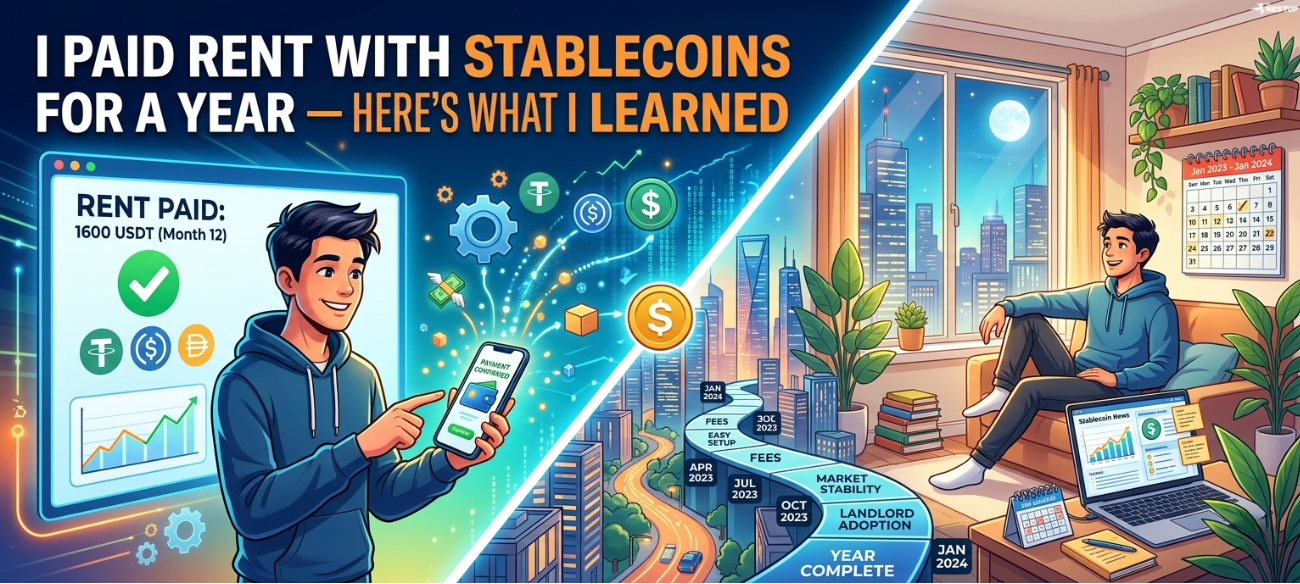
Introduction: The 12-Month Digital Dollar Experiment
For the past year, I embarked on a rigorous stress test of decentralized finance: an attempt to settle every primary real-world obligation—rent, utilities, and recurring subscriptions—using USD Coin (USDC). This wasn’t an exercise in ideological purity or a search for "edge"; it was a practical investigation into the current state of the digital economy. I wanted to determine if stablecoins have transitioned from speculative trading tools into a legitimate medium of exchange for everyday life.
Over twelve months, I lived on the frontier of the "Internet of Value." The experiment revealed that while the underlying blockchain protocols are mature, the surrounding social and regulatory infrastructure remains a significant bottleneck. It was a journey through the friction of the old world and the efficiency of the new, providing a glimpse into the future of financial plumbing.
Takeaway 1: The "Fiat Bridge" is Where the Money (and Friction) Lives
The first realization of the experiment was that the primary cost of using stablecoins is unrelated to the efficiency of the blockchain itself. Instead, the "cost center" is located at the points of interoperability between legacy rails and blockchain protocols. Unless one’s income is natively paid in crypto, navigating the "fiat bridge" introduces unavoidable slippage and fees.
During the year-long trial, the typical costs for these transitions remained consistent:
- On-ramps (Converting fiat to USDC): 0.5%–1.5%
- Off-ramps (Withdrawing to traditional bank accounts): 0.5%–2%
While network fees on Layer 2 solutions were negligible, these percentage-based bank fees represent the institutional friction of a system protecting its borders. The "tax" of crypto isn't the technology; it's the gatekeepers.
"Most of the ‘cost’ of using stablecoins came from touching the traditional financial system."
Takeaway 2: Technology is Faster Than Human Behavior
The experiment highlighted a persistent "Social Layer Problem." While a transaction can settle in seconds, the onboarding friction for non-crypto users—landlords and utility providers—is immense. This is not a software limitation; it is a significant UX barrier.
Even when I successfully negotiated with landlords to accept USDC, they almost universally opted for an immediate conversion back to fiat. This underscored a vital analyst's truth: we are currently dealing with a massive "behavior shift" that lags years behind the code. The infrastructure for a digital dollar exists, but the cognitive models for managing it have not yet updated.
"Stablecoins aren’t just a tech shift—they’re a behavior shift. And behavior changes slower than software."
Takeaway 3: The "Boring" Advantage of Volatility Immunity
In the world of digital assets, stability is often viewed as unexciting. However, for an analyst looking at "Budgetary Sanity," USDC’s dollar-denominated nature is its most critical feature. High-volatility assets like Bitcoin or Ethereum are functionally unusable for non-negotiable liabilities like rent.
The "peace of mind" provided by stablecoins for basic budgeting is non-negotiable for three reasons:
- No sudden drops: Rent money does not lose 10% of its purchasing power overnight due to market liquidations.
- No market timing: There is no need to delay a utility payment while waiting for a "dip" to recover.
- Predictable budgeting: A $2,000 obligation remains $2,000 in your wallet, ensuring the ledger always balances.
Takeaway 4: Banking Hours Are a Relic of the Past
The most objective technical win of the year was the eradication of "intermediary friction." Stablecoins operate on the 24/7/365 schedule of the internet, making traditional banking hours feel like a quaint, industrial-age relic.
Beyond the lack of weekend delays or banking holidays, stablecoins offer a level of programmability that traditional wire transfers simply cannot match. For freelance income and cross-border transactions, the ability to settle payments instantly and globally without a middleman asking for permission is a profound upgrade. In this arena, stablecoins are not just an alternative; they are a technologically superior rail for the digital economy.
Takeaway 5: The Hidden Tax and Paperwork Tax
The most significant "surprising lesson" was the sheer scale of the regulatory friction. Even though the price of USDC remained pegged to the dollar, most jurisdictions treat spending stablecoins with the same asymmetric reporting requirements as high-risk investments.
In the eyes of the law, every rent payment and utility bill was not a "cash transfer" but a "disposal" of a crypto asset. This creates an ironic burden: an asset designed to be as stable as cash requires the accounting rigor of a hedge fund. The resulting paperwork tax included:
- Granular Transaction Tracking: Every single micro-payment had to be logged as a reportable event.
- Specialized Software Requirements: Manually managing hundreds of entries was impossible, necessitating the use of specialized crypto tax platforms.
- Asymmetric Burdens: Despite zero price volatility, the reporting requirements remained as complex as if I were trading volatile altcoins.
Conclusion: The Future of "Internet Plumbing"
Financially, the year was a break-even event. The capital lost to on-ramp and off-ramp fees was balanced by the non-monetary value of total fund control, settlement speed, and independence from legacy banking hurdles.
The experiment proved that stablecoins are currently acting as a "parallel layer"—the nascent financial plumbing of the internet. They are most effective when you remain within the digital ecosystem, and most cumbersome when you attempt to force them into the legacy world. The real transformation will occur not when the technology improves, but when this plumbing natively reaches employers and governments.
As we move toward a hybrid financial future, we must ask: If the "Internet of Value" is already faster and more available than our local bank, how much longer can the legacy system justify its 9-to-5 gates?