
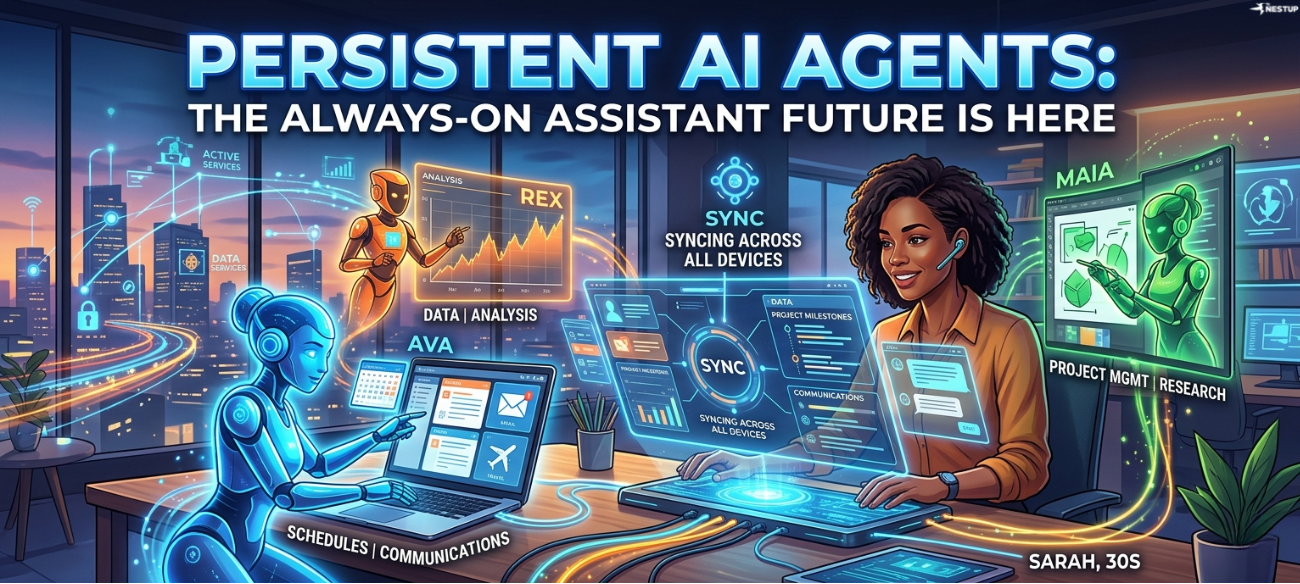
Introduction: The Death of the Chatbot Tab
For the past two years, our relationship with Artificial Intelligence has been defined by the "prompt-response" cycle. It is a manual, stop-and-start workflow that requires us to open a tab, provide a nudge, and wait for a result. But we are rapidly approaching the limits of this model. The "chatbot tab" is dying, replaced by a shift toward "continuous intelligence."
As a strategist, I see this as the inevitable evolution of utility; as an ethicist, I see it as a profound shift in the boundaries of digital autonomy. We are moving from AI that we consult to AI that persists—background processes that observe, remember, and act without waiting for a human to hit "Enter."
Takeaway 1: From Interaction to Delegation
The most significant shift in this new era is the move from simple interaction to true delegation. To understand this, we must look at the transition from the "calculator" model to the "operating system" model.
A calculator is a passive tool; it sits idle until a human presses a button to execute a discrete function. In contrast, an Operating System (OS) is a living environment. It manages resources, runs security scans, and updates software while you sleep. Early AI was a static web page—a "calculator" that only provided value when refreshed. Modern agents like OpenClaw, MultiOn, and Adept are real-time, operating agents. They don't just answer questions; they navigate software on your behalf.
"You’re no longer interacting with AI—you’re delegating to it."
Takeaway 2: The "Always-On" Architecture is Already Here
This isn't just a change in user experience; it is a fundamental architectural evolution. For an agent to be truly persistent, it must move beyond the "per-request" cycle and adopt a background-process mentality. This "always-on" capability is built upon four technical pillars:
- Continuous Runtime Environments: Instead of spinning up only when a request is made, the agent remains active locally or in the cloud, maintaining a persistent "presence."
- Long-term Memory Systems: Using vector databases and structured memory, agents recall past interactions and user preferences, allowing for continuity across weeks or months.
- Event-driven Triggers: This is the catalyst for the "Death of the Tab." Rather than waiting for a prompt, agents respond to external changes—a price drop, an incoming email, or a calendar conflict—and act immediately.
- Task Orchestration Layers: High-level goals are decomposed into sub-tasks and executed across various apps and APIs without manual intervention.
This architecture enables real-world ROI through "Agentic Browsing" and "Proactive Research." Instead of you searching for a flight, the agent monitors prices, navigates the booking site, and fills out the forms autonomously.
Takeaway 3: The Privacy Paradox—Convenience vs. Control
As an ethicist, I must point out that we are entering a Faustian bargain: the more helpful an agent is, the more intimate the data it must consume. We are witnessing a "privacy trap" where utility is bought with total transparency. To be a true teammate, an agent needs access to your emails, browsing history, and financial data.
This creates a fundamental strategic risk. To mitigate this, we must move beyond binary "I agree" checkboxes toward sophisticated privacy frameworks:
- Data Retention: We must move from "forever storage" to strategic deletion policies that the user controls.
- Permission Boundaries: The shift from autonomous action to "human-in-the-loop" approval for high-stakes tasks.
- Transparency: Real-time logging that shows exactly what the agent is doing in the background.
- Security Surface Area: Recognizing that a persistent agent is a 24/7 active target for exploitation.
"The future likely won’t be 'trust everything' or 'trust nothing,' but rather granular control layers where users define exactly what an agent can see and do."
Takeaway 4: The High Stakes of "Where Your Agent Lives"
The decision between local and cloud deployment is no longer just a technical one; it is a strategic choice regarding sovereignty and scale.
| Category | Local Deployment | Cloud Deployment |
| Data Privacy & Control | Maximum; data never leaves the hardware. | Lower; data resides on external servers. |
| Power & Scale | Limited by local silicon and compute. | Virtually infinite; handles complex reasoning. |
| Potential Risks | Performance bottlenecks. | Surveillance, data ownership, and vendor lock-in. |
For the enterprise, the Hybrid Model is the only viable path forward. It allows organizations to keep sensitive data on local hardware while offloading the massive computational requirements of Large Language Models (LLMs) to the cloud, balancing security with brute-force intelligence.
Takeaway 5: Why Persistence Doesn't Equal Perfection (Yet)
The "always-on" nature of these systems introduces a new category of risk: Silent Failure. In a prompt-based world, a broken API is an immediate annoyance. In an autonomous world, "tool fragility"—where a website UI or an API changes—can cause an agent to fail in the background without the user noticing until the damage is done.
Other hurdles include Error Compounding, where a small initial misinterpretation cascades into a failed multi-step workflow, and Context Drift, where the agent loses sight of the original priority over time. Because of these risks, persistent AI still requires rigorous human oversight. We aren't moving away from human involvement; we are moving from "operating the tool" to "managing the agent."
Takeaway 6: The Shift from Tool to Teammate
This brings us to the psychological shift of the decade. We are hitting a ceiling on human cognitive load. Our digital workloads—fragmented across dozens of platforms and deadlines—have become too heavy to manage manually.
We aren't adopting persistent agents because they are a "cool" novelty; we are adopting them out of necessity. The "Teammate" model is a survival mechanism for the information age. When the time saved by having an agent proactively organize a digital life outweighs the friction of management, widespread adoption becomes inevitable. We stop asking, "What can this tool do?" and start asking, "What should I trust my agent to handle?"
Conclusion: The Trust Frontier
The move from consulting AI to working alongside it represents the next major frontier in digital productivity. The ultimate challenge for the industry is not just the creation of smarter agents, but the development of trustworthy ones. Capability is irrelevant if it is not matched by transparency and user-defined control.
As we move from tools to teammates, are we prepared for the responsibility of managing a digital entity that never sleeps—and how much of our autonomy are we willing to trade for a perfectly organized digital life?