
The Death of the 10,000-Hour Barrier
For decades, the moat protecting the software industry wasn't just capital—it was syntax. The "technical privilege" of being able to code meant that the path from an idea to a working product was gated by a massive barrier to entry. You either spent years mastering the 10,000-hour climb of programming or you spent a fortune hiring a development team to translate your vision into logic.
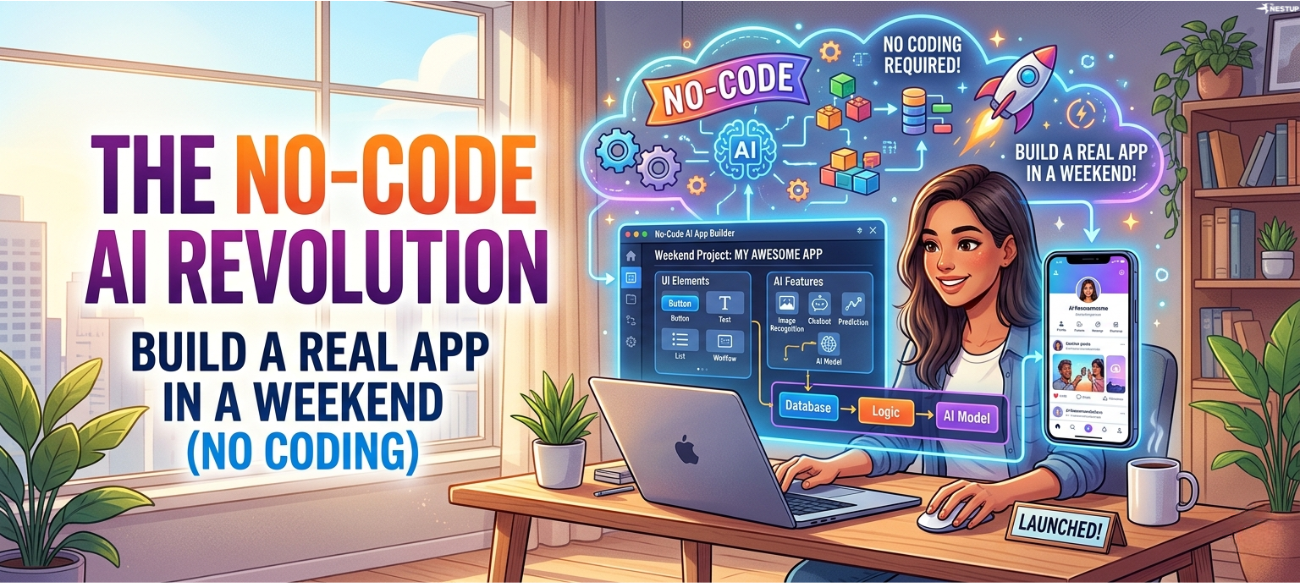
Today, the moat of syntax has dried up. We have entered the No-Code AI Revolution, a structural shift where software development has been decentralized and democratized. The ability to build is no longer a niche technical skill; it has been transformed into a creative superpower. With the right prompt and a 48-hour window, the distance between "I have an idea" and "I have a live URL" has effectively vanished.
Your Blueprint is More Important Than Your Syntax
In this new landscape, the power has shifted decisively from the coder to the prompter. However, this doesn't mean building is effortless. Because AI builds exactly what you ask for, the primary skill required is no longer writing lines of code, but meticulous scoping and architectural planning.
This is the Garbage In, Garbage Out (GIGO) principle of the AI era: if your prompt is vague, your application's architecture will fail. To build a functional product in a weekend, you must master the Minimum Viable Product (MVP)—the leanest version of your idea that solves a core problem. Before touching a single tool, you must define these four components in plain English:
- The Core Problem: The single objective (e.g., "A personal habit tracker that gamifies daily goals").
- User Persona: Who is the user and what is their ideal "happy path" through the app?
- Key Features: Limit yourself to 2 or 3 non-negotiables (e.g., user login, a daily checklist, and a streak counter).
- Data Structure: What specific information must be persisted? (e.g., usernames, habit names, and completion timestamps).
The "Big Four" AI Tech Stack
A new ecosystem of tools has emerged to handle the heavy lifting. As a product strategist, choosing your stack depends on whether you prioritize visual polish, full-stack automation, or local control.
- v0 by Vercel: The ultimate frontend wizard. Built by the creators of Next.js, it generates production-ready interfaces using Tailwind CSS and shadcn/ui components. It is the gold standard for crafting the visual "shell" of an app.
- Bolt.new: A revolutionary full-stack sandbox that runs entirely in the browser. It doesn't just write code; it spins up a live environment, installs dependencies, and configures relational databases automatically.
- Lovable.dev: Positioned as a "software engineer for everyone," Lovable excels at complex, multi-step chat interactions. It is particularly adept at building out backend logic and database schemas through simple conversation.
- Cursor: The power-user’s choice. As a fork of VS Code, Cursor is an AI-first code editor that lives on your machine. It can read your entire codebase and predict edits, making it the essential bridge for move from a prototype to a production-grade application.
The Browser is Now a Full-Stack Sandbox
The most radical shift in modern development is the move to "text-to-app" workflows within a browser tab. Tools like Bolt.new and Lovable have eliminated the "it works on my machine" headache by handling all environment configurations, database setups, and server logic behind the scenes.
The browser is no longer just a place to view the web; it is a full-stack laboratory. As the technology matures, platforms like Lovable act as "dedicated software engineers, handling everything from frontend aesthetics to backend logic based entirely on chat interactions." This allows a single creator to iterate at the speed of thought, seeing their changes reflected in a live environment instantly.
The 4-Phase Workflow for a 48-Hour Build
To move from a blank screen to a live product over a weekend, follow this streamlined, active pipeline:
Phase 1: Designing the UI Shell (v0)
Start by generating your visual identity.
- The Prompt: "Create a clean, modern dashboard for a gamified habit tracker. Include a sidebar for navigation, a central daily checklist with satisfying completion animations, and a prominent 'streak count' card at the top. Use a dark mode theme with neon green accents." Refine by clicking elements and prompting specific changes like, "Make the checklist items draggable."
Phase 2: Building Full-Stack Logic (Bolt.new or Lovable)
Transition your visual concept into a functional application with a database.
- The Prompt: "Build a full-stack React app for a gamified habit tracker: Users can sign up, create habits, check them off daily, and earn experience points (XP) to level up. Use a local storage or a simple database to persist user data."
Phase 3: Fine-Tuning and Integrations (Cursor)
When you hit the limits of browser tools—such as needing a specific payment gateway—download the repository and open it in Cursor. Use the Cmd+K interface to handle high-level logic: "Integrate this page with the Stripe API to handle premium subscriptions." This is where you harden the code for real-world use.
Phase 4: The One-Click Launch (Netlify/Vercel)
The weekend ends with deployment. Both Bolt.new and Lovable offer a "Deploy" button that pushes your code to Netlify or Vercel. Within seconds, you have a live, production-ready URL to share with the world.
Respecting the "Glass Ceiling" of AI Development
While these tools feel magical, a strategist must understand their boundaries. AI development thrives on CRUD (Create, Read, Update, Delete) patterns—the bread and butter of most SaaS apps—but it is not a total replacement for human engineering.
- The Context Window Limit: As apps grow, the AI may "forget" earlier code, accidentally breaking existing features while trying to add new ones.
- Highly Custom Logic: AI lacks training data for proprietary algorithms or niche technologies. If you are building something truly novel, expect the AI to hallucinate.
- Complex Security Infrastructure: While AI can handle standard logins, enterprise-grade security and data protocols still require a human "pilot" to ensure safety.
Think of AI as a springboard. It gets you to a functional prototype at 10x speed, but human oversight remains the final filter for quality and security.
Conclusion: From Coder to Creator
The No-Code AI Revolution hasn't killed software engineering; it has simply invited everyone to the table. By stripping away the requirement for manual syntax, we have unlocked a new era of meritocracy where the quality of your idea and the clarity of your communication are the only metrics that matter.
The gatekeepers are gone. The tools are live. If the technical barriers were removed today, what would you build? You have forty-eight hours. Start prompting.