
 N
N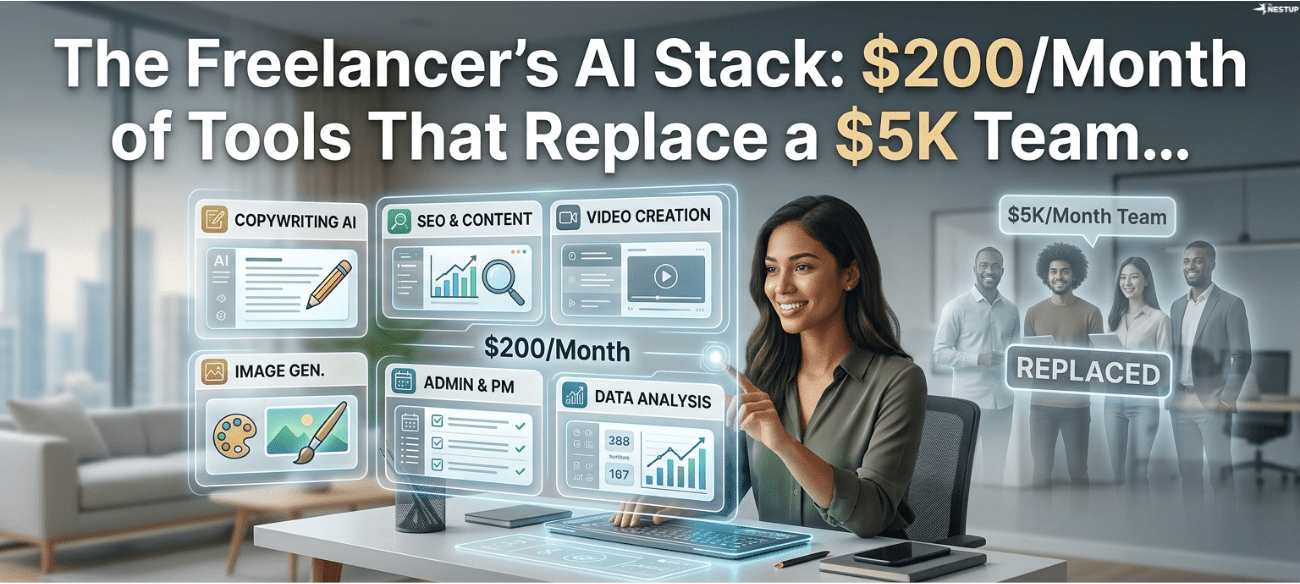
Introduction: The Ceiling of One
In the traditional freelance economy, every successful solo operator eventually hits the "ceiling of one." This is the point where your capacity to generate revenue is hard-capped by the hours in your day. Historically, breaking through this wall required a transition from "freelancer" to "agency owner," a shift that brought the immediate burden of a $5,000/month overhead for a baseline team: a virtual assistant for admin, a designer for visuals, an editor for content, and a researcher for market analysis.
By 2026, the technological landscape has fundamentally rewritten the economics of scale. The strategic objective is no longer "hiring up" to increase capacity, but "tooling up" to achieve asymmetric upside. The "AI-powered micro-agency" is the new paradigm, allowing a single professional to wield the leverage of a full staff for an investment of roughly $200 a month. We are moving toward a world where the marginal cost of execution is trending toward zero, leaving only the value of your strategy and taste.
The Death of "Switching Costs"
The most profound value of AI isn’t the total automation of work; it is the radical compression of "operational drag." For the modern strategist, time is less of a constraint than "cognitive load." Freelancers traditionally lose 30–40% of their billable potential to the friction of moving between tasks and managing the "work about work."
Specifically, the micro-agency stack targets these "drag" factors:
- Context switching: Moving between deep work and reactive tasks.
- Formatting and file organization: The non-billable hours spent cleaning up deliverables and structures.
- Repetitive administrative tasks: Invoicing, lead routing, and manual data entry.
- Revisions and draft iterations: The slow cycle of feedback and minor adjustments.
- Primary research and sourcing: Sifting through noise to find credible data points.
- Client communication and scheduling: The endless "back-and-forth" of the inbox.
When these frictions are compressed, the freelancer shifts from being a manual laborer of digital tasks to a high-level executor. This is the ultimate form of leverage: doing more by doing less of the "boring" work.
The result is leverage. A solo creator who previously handled 3 clients can now realistically manage 8–12 without dramatically increasing working hours.
The Multi-AI Brain (Why One Tool Isn’t Enough)
The sophisticated solopreneur understands that there is no "god-model." Instead, the winner’s edge lies in tool layering—treating different AI models as specialized thinking partners. We are seeing a move toward voice-first workflows, using tools like Superwhisper to dictate drafts and process emails at the speed of speech, which is 3x faster than typing.
By layering specialized tools, you create a "synthetic board of directors."
| Tool Category | The "Winner" Tool & Role |
| Research | Perplexity Pro: Synthesizes live web research with citations and market scans. |
| Writing | Claude Pro: Handles long-form articles with a superior natural tone and brand consistency. |
| Design | Midjourney / Canva: Handles visual ideation and lightweight asset production. |
| Operations | Notion AI: Serves as the central "memory" for CRMs, SOPs, and project tracking. |
Design Without the Designer
The democratization of high-fidelity visuals through Canva and Midjourney has effectively eliminated the need for "lightweight design outsourcing." Previously, a freelancer would outsource pitch decks or social graphics to a junior designer. Now, the "blank-canvas problem" has been solved.
By using Midjourney for visual ideation and Figma AI for rapid wireframing and UI generation, the freelancer’s role has evolved from a "pixel-pusher" to a Creative Director. You are no longer building every element from scratch; you are selecting, iterating, and refining AI-generated mockups. This compresses the creative cycle from days to minutes, allowing for rapid client iteration and significantly faster delivery.
The Automated Executive Assistant Layer
The operational backbone of the micro-agency is the "Executive Assistant" layer. Tools like Motion, Zapier, and Otter handle the logistical "drag" that typically kills freelance momentum.
This is about more than just "saving time"—it is about preserving decision capital.
- Motion uses AI for dynamic scheduling, automatically restructuring your calendar when a deadline shifts so you don't have to "think" about what to do next.
- Zapier automates the transition from "lead" to "onboarded client," routing invoices and syncing CRM data without human intervention.
- Otter.ai handles the "memory" of the business, extracting action items from meetings and reducing the cognitive load of note-taking.
The $200 Budget vs. The $5,000 Capacity
The transition from a capped freelancer to a high-throughput micro-agency is remarkably cost-efficient. A 2026 "Power Stack" includes:
- ChatGPT Plus: $20 (Strategic ideation/Operating system)
- Perplexity Pro: $20 (Deep research/Sourcing)
- Claude Pro: $20 (Long-form writing/Polishing)
- Notion AI: $15 (CRM/Knowledge base)
- Canva Pro: $15 (Presentations/Graphics)
- Superwhisper: $10 (Voice-to-text productivity)
- Motion: $19 (AI-driven scheduling)
- Zapier AI: $20 (Automation backbone)
- Otter.ai: $10 (Meeting transcription)
- QuickBooks/Wise: $20 (Accounting and global currency friction reduction)
- Midjourney: $10 (Visual generation)
- Figma AI: $15 (UI/Prototyping)
- Total: ~$194/month
--------------------------------------------------------------------------------
The Revenue Impact: Throughput at Scale
The Freelance Writer
- Before: 4 articles/week (Manual research and editing) → $3K/month
- After: 12 articles/week (Voice dictation, AI outlining, Claude-assisted polishing) → $8K/month capacity
The Marketing Consultant By using Perplexity for instant competitor research and Canva for automated deck generation, consultants can now handle 2x–3x more clients simultaneously while maintaining high-quality strategic output.
The Indie Designer With Figma AI wireframing and Midjourney ideation, designers eliminate the "blank-canvas" phase, leading to faster delivery cycles and higher client retention through more included revision rounds.
The "Overload" Trap and the Human Edge
As a tech ethicist, I must warn against the "Overload Trap." Productivity is not measured by the number of subscriptions, but by workflow clarity. The risk in 2026 is spending more time "tinkering" with automations than actually solving client problems. A lean stack is a fast stack.
Furthermore, as execution becomes a commodity, the human element becomes the "premium" tier. AI cannot replace:
- Judgment: Deciding what to build, not just how.
- Taste: The aesthetic and ethical "soul" of a project.
- Empathy: The trust-based relationship that manages a client's anxiety.
The freelancers thriving most in 2026 are not necessarily the best prompt engineers. They are the people who combine strong domain expertise and human taste with fast AI-assisted execution.
Conclusion: From Freelancer to Architect
The evolution of the $200 micro-agency represents the death of "manual labor" in the digital world. By eliminating operational drag, you are no longer selling your hours; you are selling your unique synthesis of information and your judgment.
In an era where execution is nearly free, the value of the "architect" is skyrocketing. The tools have removed the ceiling. The only remaining question is: are you using AI to build yourself a more efficient job, or are you constructing an automated empire?