
We've all become accustomed to AI chatbots. We ask a question, and they provide a text-based response. They can write an email, summarize an article, or even generate code snippets. But their work largely ends when the text generation stops. This model has defined our interaction with AI—a conversational back-and-forth.
But what if an AI could go beyond conversation and become a true autonomous agent? An agent that doesn't just tell you how to do something but actually does it for you—researching online, writing code, creating documents, and managing files, all from a single instruction. After a deep dive into the Manus AI platform, I found it does just that, and in ways that are surprisingly different from the mainstream AI experience. I discovered a platform that redefines the user experience through three core principles: radical transparency into its work, profound simplicity in its commands, and the freedom of true 'delegate and forget' autonomy. Here are my key takeaways.
Takeaway 1: You Get to Watch It 'Think'—Literally
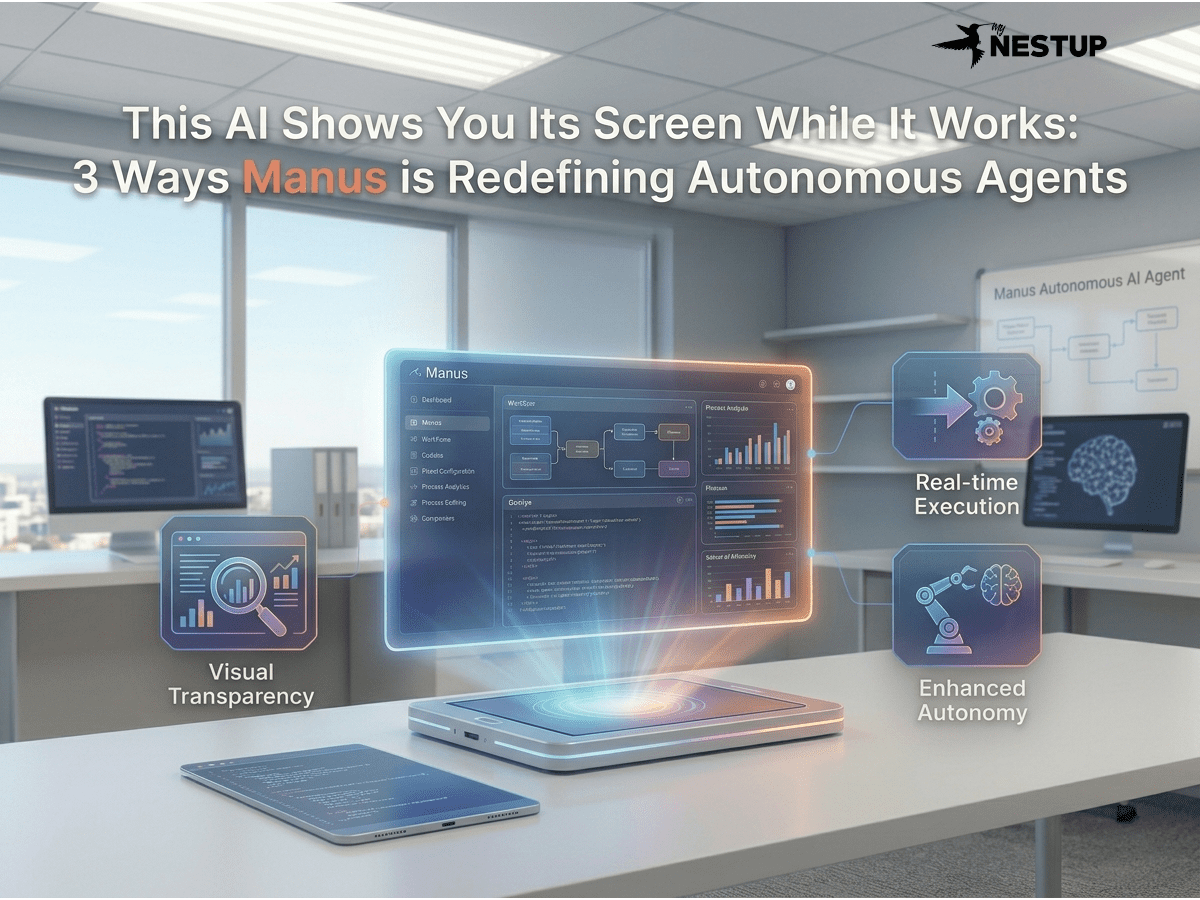
My first surprise was the radical transparency of the platform. Once you give Manus a task, you’re taken to the Task Execution View. On one side, you have a chat interface with progress updates. But on the other side is a unique feature called "Manus's Computer," and it’s a game-changer.
This panel is essentially a live "screen share" of the AI's virtual environment. You can literally watch as it opens browser tabs for searching, clicks links, and fills out forms. You see it open a terminal to write and debug code, or watch as files and folders pop into existence in its file system. But the transparency goes even deeper. Below the screen share is an "Event log" that shows the AI's step-by-step reasoning: "Searching for flights...", "Analyzing results...", "Generating report."
In a world of "black-box AIs" where the inner workings are a complete mystery, this combination provides an unprecedented, real-time window into the AI's autonomous process. You're not just getting a final result; you're seeing the complete methodology. This transparency is what builds the trust needed for the next surprising feature: initiating these complex tasks with almost no effort.
Takeaway 2: Starting a Complex Task is as Easy as Sending a Text
Given the complexity of what Manus can do, I expected an elaborate setup process. Many advanced AI platforms require users to manually build agents, configure tools, and design complex workflows. Manus is the opposite.
Starting a new task is as simple as opening a chat window and typing your goal in natural language, often taking less than 30 seconds. For example, a prompt like "Create a 7-day Japan itinerary with costs, flights from NYC, and a PDF summary" is all it takes to kick off a multi-step project. You can even attach files, like a spreadsheet of dietary restrictions or a document of preferred activities, to guide its research. While the input is simple, you can still select higher-performance models like "Manus Max" for more demanding jobs, showing there’s sophisticated configuration hidden beneath the surface.
From a product design perspective, this is a masterful decision. It lowers the barrier to entry to near-zero, ensuring that the platform's power is accessible to everyone, not just engineers who can configure complex workflows.
Takeaway 3: You Can Close the App and It Keeps Working for You
Perhaps the most significant shift in workflow comes from the platform's asynchronous architecture. Once you submit a task, it begins running in the cloud. You don't have to keep the tab open and watch it work. You can close your browser or mobile app, and Manus will continue executing the job independently.
When the task is finished—whether it takes minutes or hours—the platform sends you a notification. The final deliverables appear in your session, ready for use: links to deployed dashboards, downloadable PDFs and Excel files, or even entire code repositories. This capability lets you act like a manager overseeing a team of autonomous agents; you can assign multiple complex tasks from your dashboard and get back to your own work. This isn't just a feature; it's a fundamental shift in the user interaction model. It moves the product from the category of a 'tool' you actively wield to an 'agent' you manage.
This "delegate and forget" model is only possible because of the trust built by the radical transparency mentioned earlier. You can step away precisely because you know you can always check in and see the AI's exact methodology.
Conclusion: A New Way to Work
My time with Manus AI revealed a platform where profound simplicity at the start is made trustworthy by radical transparency during execution, ultimately enabling a powerful new model of asynchronous work. Together, these features point toward a new paradigm for productivity.
It leaves us with a compelling question to consider: As tools like this become more common, how will our definition of delegation, productivity, and even the nature of work itself begin to change?