
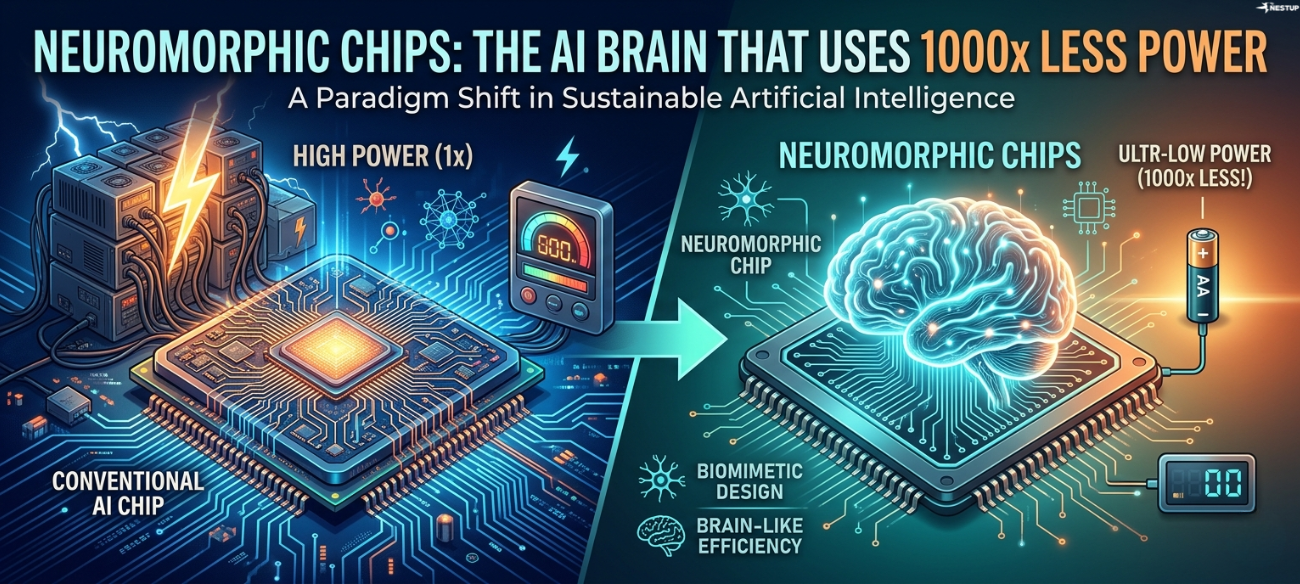
Artificial intelligence is facing a looming energy crisis that no amount of venture capital can subsidize away. As we push the boundaries of frontier models, the infrastructure required to support them has reached a staggering, almost gluttonous scale. Today’s largest systems demand massive GPU clusters and specialized cooling systems that consume as much electricity as a small town. We are effectively using a sledgehammer to crack a nut, relying on "brute force" computation to simulate intelligence while the planet pays the utility bill.
In stark contrast to these energy-hungry giants sits the humble human brain. Capable of adaptive learning, complex sensory integration, and the kind of general intelligence that still leaves Silicon Valley in the dust, the brain operates on a mere 20 watts of power. To put that in perspective, the most sophisticated known intelligence in the universe runs on less energy than the dim household lightbulb in your hallway.
We are hitting a "silicon ceiling." While modern GPUs are undeniably powerful, they are fundamentally inefficient compared to biological systems. This 1,000x efficiency gap has led researchers to a radical conclusion: to build the next generation of AI, we must stop trying to make faster calculators and start building digital brains.
The 1,000x Efficiency Gap: Why We’re Doing It Wrong
The primary reason current hardware struggles is a fundamental architectural flaw known as the Von Neumann bottleneck. In a traditional computer, the place where data is stored (memory) is physically separated from where it is processed (the CPU or GPU).
Every time a calculation is made, data must be shuttled back and forth across a "bus." This creates a massive, invisible "energy tax" paid in heat and time. Imagine if, every time you wanted to form a thought, your brain had to move its memories from a warehouse in another city into your forehead. It is a logistics nightmare that makes "more power" an unsustainable path forward.
How Traditional Hardware Differs from the Brain:
- Sequential vs. Asynchronous: Traditional chips process instructions in rigid, sequential batches; the brain’s neurons communicate asynchronously, firing only when they have something to say.
- Memory Separation vs. Integration: CPUs/GPUs pay the "energy tax" of data movement; brains integrate memory and computation in the same physical space.
- Continuous vs. Selective Activation: AI hardware is effectively "always on," consuming energy even when idling; biological neurons are "event-driven," activating only when a signal is received.
- Dense Matrix Operations vs. Massive Parallelism: Modern AI relies on heavy, continuous mathematical crunching; the brain uses sparse, massively parallel networks that prioritize efficiency over raw throughput.
Takeaway 1: The "Spiking" Secret to Event-Driven Intelligence
At the heart of this neuromorphic shift is the Spiking Neural Network (SNN). Unlike traditional neural networks that use continuous streams of numbers to represent data, SNNs mimic the discrete "spikes" of electricity used by biological neurons.
This leads to the "aha!" moment of neuromorphic design: event-driven processing. In a standard system, the hardware processes every pixel of a video frame, even if nothing is moving. In a neuromorphic system, the hardware ignores the static background and only "fires" when a pixel changes.
"That event-driven structure dramatically improves efficiency," allowing the system to remain mostly dormant until a meaningful event occurs.
This makes neuromorphic chips the holy grail for "Edge AI"—intelligence that lives locally on your person rather than in the cloud. For a robot or a wearable medical device, the ability to process real-world sensory data without a backpack full of batteries is a game-changer.
Takeaway 2: The Silicon Pioneers (IBM, Intel, and Manchester)
While the field is still maturing, three major projects have proven that brain-inspired silicon isn't just a theory; it's a functioning reality:
- IBM TrueNorth: One of the first serious attempts to digitize biology, TrueNorth uses roughly one million programmable neurons to achieve extremely low-power pattern recognition. It proved that event-driven processing could handle complex tasks on a fraction of the energy used by conventional chips.
- Intel Loihi: Intel’s research powerhouse focuses on on-chip learning. Unlike most AI that is "trained" once in a data center and then frozen, Loihi can modify its behavior in real-time. This makes it a leader in autonomous navigation, allowing robots to adapt to new environments on the fly.
- University of Manchester SpiNNaker: This isn't just a computer; it's a massive research tool designed for large-scale brain simulation. By focusing on asynchronous messaging, SpiNNaker allows neuroscientists to test theories about how the brain actually functions, prioritizing biological accuracy over traditional computing benchmarks.
Takeaway 3: Why Your Smartphone Isn't a "Brain" Yet
If these chips are 1,000x more efficient, why aren't they in our pockets? The reality is that we are currently trying to run "brain software" on "calculator hardware," and the translation friction is immense.
- The Software Ecosystem Gap: Modern AI exploded because of tools like CUDA, PyTorch, and TensorFlow. Neuromorphic environments are currently fragmented and immature. It is significantly harder to program a spiking network than it is to train a standard model.
- GPU Momentum: NVIDIA’s architecture has decades of industrial momentum. When the tooling is already there and the performance is "good enough," most companies are hesitant to leap into a radical new architecture.
- The Biological Mystery: Perhaps the most humbling obstacle is that our engineering is limited by our ignorance. We still don't fully understand consciousness, memory formation, or general intelligence. We are trying to build a blueprint of a house we haven't finished exploring.
Takeaway 4: The Impending Shift to "Hybrid AI"
The future won't be a winner-take-all battle between GPUs and neuromorphic chips. Instead, we are entering an era of specialization that resembles the human body. Just as the brain has specialized regions for logic and others for sensory reflex, our devices will use a mix of architectures.
The Neuromorphic Adoption Timeline:
- Short-Term (2026–2030): Integration into industrial sensors and specialized robotics. These systems will handle "edge" tasks where power is at a premium.
- Medium-Term (2030s): Neuromorphic co-processors in consumer tech. Imagine AR glasses or hearing aids that offer "always-on" AI without needing a recharge every two hours.
- Long-Term Outlook: A total reshaping of autonomous agents. Robots that don't just follow instructions but learn and adapt to their surroundings in real-time.
In this hybrid future, GPUs will remain the heavy lifters in the data center, handling the massive training of models, while neuromorphic chips act as the "nervous system" at the edge—managing sensory processing and real-time interactions locally.
Conclusion: Hitting the Physics Limit
We are approaching a crossroads where the current trajectory of AI scaling—more data, more GPUs, more electricity—reaches its physical and economic breaking point. The explosion of infrastructure costs is forcing a radical rethink of hardware from first principles.
It is a humbling reality that despite our vast, town-sized data centers, biology still holds the master key to efficiency. We have achieved incredible feats of intelligence through the sheer force of silicon and heat, but the human brain reminds us that there is a more elegant way to think.
As the "silicon ceiling" draws closer, the defining question for the next generation of technology is no longer about scale, but about elegance. Will the next Einstein be born in a data center that consumes a river, or on a chip that consumes a sandwich?