 N
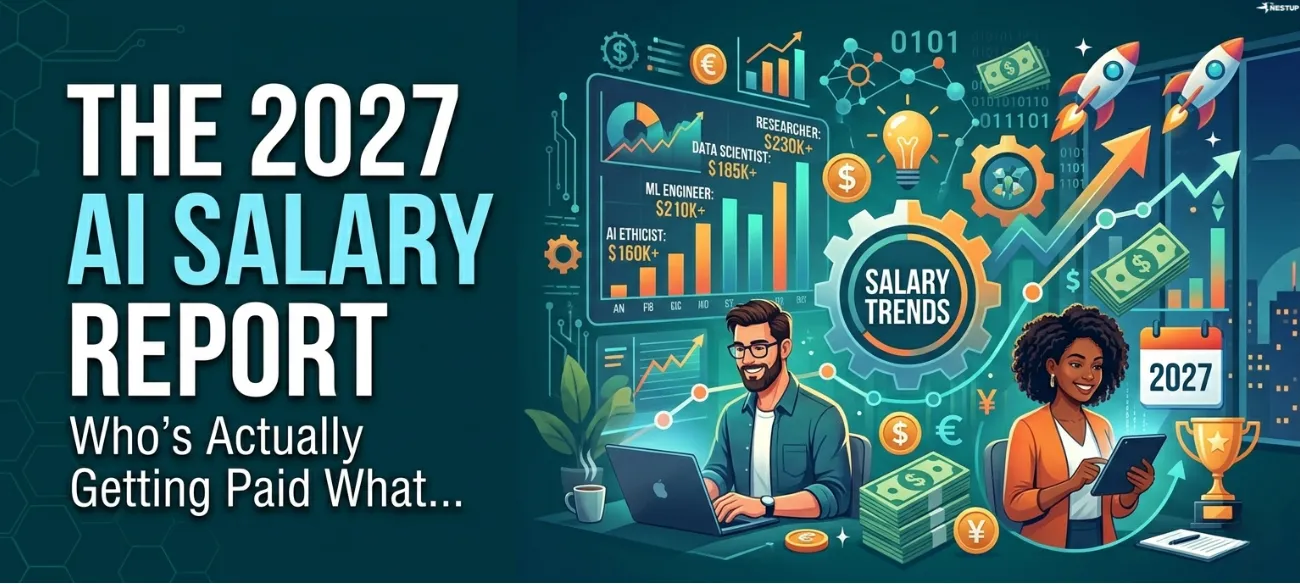
The initial hiring frenzy that followed the release of ChatGPT has officially cooled, replaced by a sophisticated and demanding market where the "wild west" of AI recruitment has been tamed. By 2027, the chaotic "land grab" for anyone with a passing familiarity with Large Language Models has evolved into a disciplined environment. Companies have transitioned from the novelty of generative AI to the rigorous, multi-year cycles of integration, optimization, and scaling.
This maturation signals the end of an era where curiosity alone justified a high-six-figure salary. Organizations have moved past the experimentation phase and are now focused on building sustainable, production-grade systems. For the modern tech professional, the "Gold Rush" isn't over, but it has certainly become more exclusive. The market now rewards deep technical impact and the ability to navigate complex, compute-constrained environments over mere proximity to the technology.
The central premise of the current landscape is clear: the era of "blank checks" has officially ended. In its place, we see a radical delta between a standard software developer and a production-grade AI specialist—a gap that is now worth as much as $300,000 annually. For tech leaders and career strategists, navigating this landscape requires a shift from chasing hype to mastering the specialized architectural and economic levers of the 2027 AI stack.
The "Blank Check" Era Has Officially Ended
The market has transitioned into a highly competitive, highly structured space. Companies are no longer willing to overpay for "AI tourists" who can only navigate a chat interface or generate basic creative content. Instead, the focus has shifted toward professionals who can demonstrate measurable technical impact within an MLOps lifecycle.
This shift reflects a move away from speculative hiring toward a focus on unit economics and production stability. As the industry matures, the distinction between "playing" with AI and "building" production systems has become the primary driver of total compensation.
"The days of handing out blank checks to anyone who can type a prompt are gone. Instead, the market has matured into a highly competitive, highly structured space where real technical impact and production experience dictate the numbers."
Hardware Efficiency is the New King of Compensation
While the software layer captures the headlines, the most significant financial rewards in 2027 are found at the intersection of code and silicon. Machine Learning (ML) Engineers who specialize in CUDA and GPU optimization are commanding the highest premiums in the industry.
Senior roles in this niche frequently clear $500,000 in total compensation. This is driven by the reality that hardware efficiency remains the biggest bottleneck in technology. Companies are desperate for engineers who can manage data pipelines, build infrastructure, and train models from scratch. Those who can write custom kernels to wring performance out of expensive chips are the indispensable architects of this era, as they directly reduce the massive capital expenditure associated with compute power.
The AI PM Split: Token Economics vs. Feature Padding
We are witnessing a radical polarization in the compensation for AI Product Managers (AI PMs). There is a sharp split between "bolt-on" PMs—who simply add basic AI features to existing products and earn standard wages—and "core" AI PMs.
At frontier labs like OpenAI, Anthropic, and Meta, the core AI PM functions as a "Mini-CTO." These individuals manage massive compute budgets and are responsible for high-stakes variables like token costs, custom evaluation suites, and model performance optimization. This level of responsibility justifies executive-level compensation packages that are heavily weighted in equity:
- Median Total Compensation: $228,000
- Top-Tier Labs: $460,000 – $860,000+
Prompt Engineering Has Become a Systematic Discipline
The role of the Prompt Engineer has been successfully professionalized. It is no longer viewed as a collection of "hacks," but rather as a systematic discipline rooted in evaluation design and natural language processing. The "hype" version of this job is dead; in its place is a stable career path focused on fine-tuning output consistency and rigorous testing.
The market has normalized, with top-tier compensation now found at established giants like Google and Meta:
- Median Total Pay: $126,000
- Top-Tier Ceiling: $234,000 – $245,000
The "Geographic Premium" Remains Unshakable
Despite the ubiquity of remote work, geography remains a dominant factor in determining compensation. For career strategists, this creates a landscape of "geo-arbitrage" and varying market characters:
- San Francisco / Bay Area ($400,000 – $750,000+): The epicenter of AI; driven by frontier labs and high-stakes equity packages.
- New York City ($340,000 – $550,000): A heavy overlap between financial institutions and enterprise software.
- United Kingdom / London (£110,000 – £170,000): A research-heavy market led by Google DeepMind and high-growth startups.
- Germany / Berlin & Munich (€100,000 – €155,000): Strongly focused on industrial automation and B2B SaaS.
- US Remote (Non-Hub): Benchmarked at 70–90% of Bay Area bands, typically landing between $180,000 – $270,000 in base salary.
While remote work offers flexibility, the "epicenter" premium in the Bay Area remains the gold standard for those seeking maximum equity upside.
The "Agentic" Premium for AI Engineers
A clear distinction has formed between ML Engineers—who focus on low-level infrastructure, training models from scratch, and MLOps—and AI Engineers, who focus on applied AI and integration. While ML Engineers handle the "how" of the model, AI Engineers handle the "what" of the application.
For Senior AI Engineers, total compensation now ranges from $340,000 to 550,000**. The "Agentic" premium is awarded to those who can move beyond simple API calls. Mastery of **AI Agent development**, **custom LLM fine-tuning**, and advanced **Retrieval-Augmented Generation (RAG)** is what pushes a professional toward that **550,000 ceiling.
Navigating the Production-First Era
The AI industry has moved from wide-eyed experimentation into a permanent fixture of everyday business operations. In this "production-first" era, technical depth—specifically in optimization and agent frameworks—is the only currency that matters.
To remain competitive, professionals must transition from being "AI-aware" to being "production-grade." This means moving deeper into the stack: if you are a developer, focus on kernel optimization; if you are an architect, master RAG and agentic workflows. The most significant rewards are no longer reserved for those who can talk about AI, but for those who can scale it within the constraints of real-world economics.
As you evaluate your trajectory, ask yourself: Is your current skill set aligned with the rigorous demands of production-grade AI, or are you still operating in the realm of experimental novelty? Your answer will define your value in the 2027 landscape.