
Introduction: The Physical Turn in Decentralization
For years, the crypto narrative was a hall of mirrors built on the abstract. We lived through the rise of Decentralized Finance (DeFi), an ecosystem of virtual exchanges and lending protocols that existed entirely within the Ethereum Virtual Machine. But by 2026, the industry has undergone a decisive "physical turn." The most significant players in the space are no longer just swapping tokens; they are building the tangible backbone of the modern world.
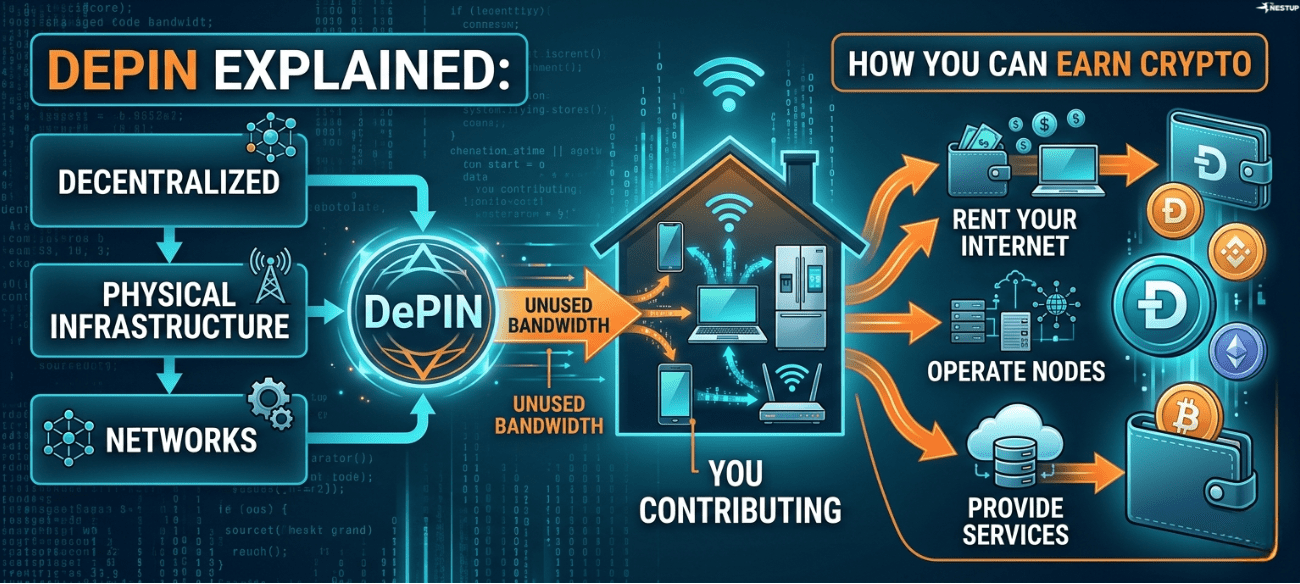
Decentralized Physical Infrastructure Networks (DePIN) represent the evolution of the internet's ownership model. Here, the hardware—be it a GPU cluster, a localized sensor, or even your unused home internet bandwidth—is owned by the people who use it, rather than centralized mega-corporations. We are officially past the exploratory era of asking "Is DePIN real?" The question for today’s market participant is more ruthless: "Which economic models actually scale, and which are just hardware-subsidized fantasies?"
Takeaway 1: It’s an Infrastructure Business, Not a "Set-and-Forget" Passive Income Stream
The most persistent myth in the early days of DePIN was the promise of "passive income." In 2026, that retail-facing marketing has been replaced by the reality of Operational Excellence. To succeed in this space, you aren't just a "user"; you are a pro-sumer running a tiny infrastructure business.
This shift means moving away from a "set-and-forget" mentality toward active management. Whether you are providing bandwidth or compute, your ROI is now driven primarily by uptime and maintenance. If your node goes offline or your hardware becomes outdated, your revenue vanishes.
"In many cases, profitability resembles running a tiny infrastructure business rather than earning effortless passive income."
Treating a dashcam or a wireless hotspot as a capital asset requires a professional mindset. Participants must calculate electricity costs, cooling requirements, and technical optimization to remain competitive in a landscape where "cheap" crypto is a relic of the past.
Takeaway 2: The AI Boom is DePIN’s Secret Rocket Fuel
The explosive growth of Artificial Intelligence has acted as DePIN’s primary accelerator. As AI models grew in complexity, centralized cloud providers (hyperscalers) began to struggle with the "Scale vs. Speed" dilemma—they simply cannot build data centers fast enough to meet the voracious demand for compute and storage.
This is where projects like Render (for compute) and Filecoin (for storage) have found their stride. By aggregating idle, globally distributed resources, DePIN offers a decentralized alternative that circumvents the bottlenecks of traditional supply chains. To the AI economy, DePIN provides three critical resources:
- Compute: Massive, distributed GPU power for rendering and model training.
- Storage: Decentralized, redundant space for the gargantuan datasets AI requires.
- Networking Capacity: Global bandwidth and edge networking to move data with minimal latency.
Takeaway 3: The "Helium Lesson" — Token Incentives Don't Guarantee Sustainability
Helium, the sector’s "Original Giant," remains the ultimate case study in the tension between technical feasibility and economic sustainability. While Helium successfully proved that a decentralized wireless network could be built at scale, the 2026 landscape shows the scars of its early volatility. The lesson is clear: a network can be a technical marvel while remaining economically fragile if it relies on speculation over utility.
| Feature | Initial Pitch | 2026 Reality |
| Network Goal | Community-built telecom infrastructure | Saturation in urban hubs; rewards diluted |
| Earnings Potential | High rewards for early adopters | Declining rewards below marketing hype |
| Hardware Value | High-utility capital asset | Hardware depreciation and rapid obsolescence |
| Economic Basis | Speculative token growth | Token volatility complicating ROI planning |
Takeaway 4: Your Commute is Now a Competitive Data Market
Mapping is a perfect DePIN use case because the physical world changes faster than a centralized fleet from Google or Apple can track. Hivemapper has capitalized on this by turning daily commutes into a data collection engine. It is a masterful example of "incentive alignment"—monetizing an action (driving) that participants were going to do regardless.
However, the "Digital Economy Strategist" must recognize the Law of Diminishing Geographic Returns. In DePIN mapping, redundancy is the enemy of profit. In a hyper-dense city like New York, the hundredth driver mapping the same street adds zero value to the network, resulting in saturated rewards. Conversely, the driver mapping a rural suburb or a new construction zone provides unique, high-value data. The market has become a sophisticated game of geographic arbitrage.
Takeaway 5: The High Cost of "Free" Crypto (Hardware & Depreciation)
The entry price for DePIN is often underestimated. While the "crypto" might feel like a free reward for your activity, the physical reality is one of Depreciation and Opportunity Cost. Basic setups—from dashcams to hotspots—typically range from $100 to over $500, but that is just the beginning.
Operational reality in 2026 demands accounting for:
- Wear-and-Tear: Physical hardware has a limited lifespan. Every hour your GPU runs or your dashcam records, you are trading hardware longevity for tokens.
- Energy and Cooling: In high-compute sectors like Render, the cost of electricity and specialized cooling can eat 40-60% of your gross earnings.
- Physical Obsolescence: In the race for AI compute, a GPU that was top-tier eighteen months ago may be uneconomical today.
Takeaway 6: Reversing the Centralization Trend
The philosophical driver of DePIN is a direct assault on the hegemony of AWS, Google, and Microsoft. For two decades, the digital age's backbone has been consolidated into the hands of a few "hyperscalers." This centralization has created single points of failure and monopolistic pricing.
DePIN offers a different path: Collective Ownership. This is more than a technical shift; it is a move toward the "sovereign infrastructure" of the digital age. By allowing individuals to own the hardware, the rewards of the digital economy are redistributed from the boardroom to the contributor.
Conclusion: A Selective Mainstream Future
As we look ahead, DePIN will not be a universal replacement for all infrastructure, but its success will be highly selective. The "winners" of the 2026 economy have emerged in sectors with clear, unquenchable demand: AI compute, edge networking, and sensor data collection.
The industry has matured from a hobbyist's playground into a serious economic sector. For the participant, the fundamental question remains: Would you rather pay a monthly fee to a trillion-dollar corporation for the rest of your life, or would you rather contribute your resources to own a piece of the global network you use every day?