
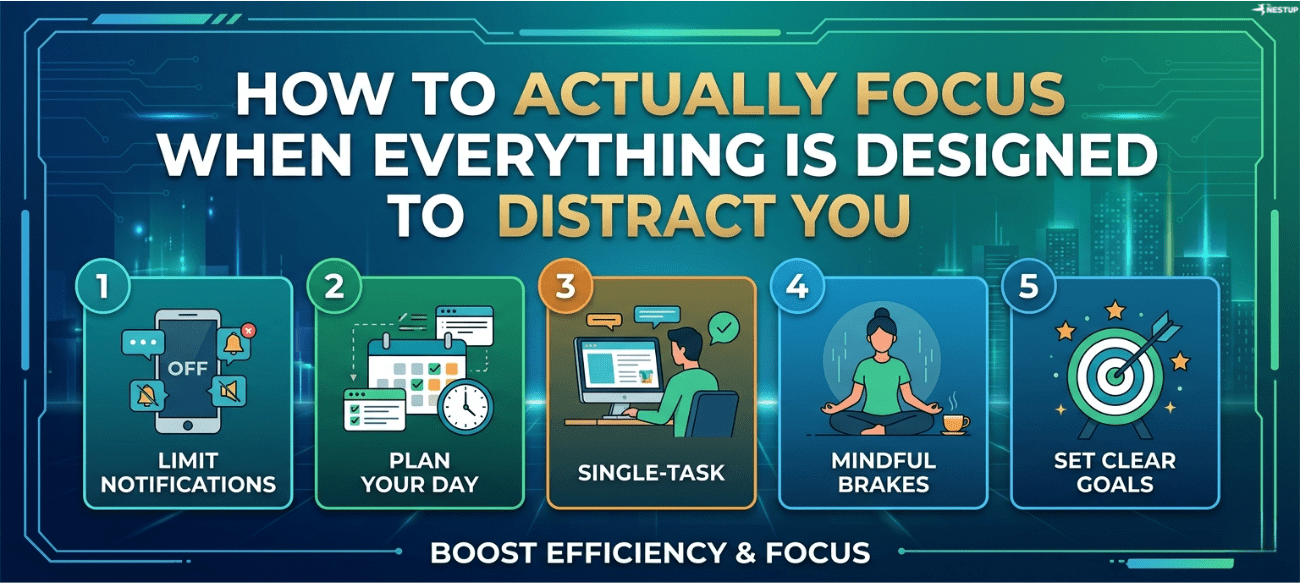
The Invisible War for Your Focus
Imagine the standard workflow of 2026. You initiate a high-priority strategic task, only to have a single notification trigger a cascade of digital diversions. Within seconds, your prefrontal cortex is bypassed; you drift from an email to a news feed to a short-form video loop. In the span of a heartbeat, thirty minutes of cognitive capital have been liquidated.
This state of "mental fragmentation" is not a character flaw. In our current era, the struggle to concentrate is rarely a symptom of laziness or a deficit of willpower. Instead, we are navigating a neurological siege—an environment defined by industrial-scale attention engineering. The core reality is stark: focus is no longer a default state; it is a resource being systematically mined. To reclaim it, we must transcend the myth of personal discipline and treat attention as a problem of high-level system design.
It’s Not a Willpower Problem; It’s a System Design Problem
A primary misconception in modern productivity is that high performers possess a "superhuman" capacity for discipline. In truth, the most effective individuals are not more resilient; they are superior environment designers.
Modern digital ecosystems are not merely distracting; they are engineered to weaponize novelty, social validation, and unpredictability to exploit ancient dopamine-driven reward pathways. When your prefrontal cortex—the region responsible for coordinating goal-directed behavior—is pitted against a multi-billion-dollar algorithm designed to trigger compulsive checking, the odds are mathematically stacked against you.
Reframing focus as a "system design" challenge rather than a "character" issue is a strategic necessity. It removes the paralyzing weight of guilt and replaces it with an actionable protocol. If the environment is engineered to fracture your attention, the only rational response is to re-engineer the environment to protect it.
"The people who consistently produce meaningful work are usually not superhumanly disciplined. They simply build environments that make distraction harder and concentration easier."
The Hidden Cost of "Fractured Cognition"
The myth of multitasking suggests that shifting between a task and a notification only costs the few seconds of the diversion. Cognitive science refutes this, revealing the phenomenon of "cognitive residue." Every time you switch contexts, a portion of your brain remains tethered to the previous stimulus, resulting in what can only be described as fractured cognition.
The "Neuroscience of Sustained Focus" demonstrates that task-switching degrades four critical cognitive pillars:
- Working Memory Efficiency: Your ability to hold and manipulate complex data points simultaneously.
- Problem-Solving Performance: The capacity to navigate through the "middle-space" of difficult solutions.
- Comprehension Depth: The ability to grasp nuances and synthesize high-level information.
- Creative Output: The generation of original connections between disparate ideas.
"Just checking a notification" is never a neutral act for the brain’s processing power. It is an active interruption of the prefrontal cortex’s ability to coordinate deep, goal-directed behavior. Each switch is a withdrawal from your total cognitive capacity, leaving you with diminished resources for the work that actually generates value.
Why the Best Productivity Tool is "Removal"
While the uninitiated attempt to manage distraction through scheduling, the Strategic Mindset Architect utilizes the power of removal. App minimization is far more effective than time management because it reduces the cognitive load of resistance.
A startling reality of our digital age is the "alert state" triggered by the mere presence of a smartphone. Even if the device is face down or powered off, a portion of the brain remains vigilant, anticipating potential notifications. This creates a constant "cognitive drag" on your focus.
To achieve peak concentration, your environmental strategy must be binary:
- Physical Environmental Adjustments: Physically relocate the smartphone to another room, eliminate visual clutter from the primary workspace, and employ noise-cancellation to signal a "monotasking" state to the nervous system.
- Digital Environmental Adjustments: Operate with minimal browser tabs, disable all non-human-generated notifications, and employ aggressive app-blockers to introduce friction between impulse and action.
By emphasizing "removal" over "management," you preserve cognitive energy. Resisting temptation is a depleting activity; removing temptation is a strategic preservation of force.
Boredom: The Unlikely Competitive Advantage
We have been conditioned to treat boredom as a defect to be cured by immediate stimulation. Every idle micro-moment is now filled with a screen, effectively training the brain to escape the very mental states required for original thought. This has led to a significant "Economic Paradox": the world is becoming more distracting at the exact moment that deep focus is becoming exponentially more valuable.
As AI continues to commoditize shallow, repetitive tasks, focus becomes a form of leverage. High-value human output—creativity, synthesis, and judgment—requires the ability to endure cognitive discomfort. The "pain" of boredom is actually the gatekeeper to deep insight. The ability to sit with a problem long enough to move beyond superficial thinking is now a rare and highly compensated economic skill.
"Creative insight often emerges only after the brain remains engaged with a problem long enough to move beyond superficial thinking."
The "Always Available" Trap and the Path to Autonomy
The modern "Always Available" culture is a trap that trains the brain into "perpetual partial attention." Constant responsiveness to reactive communication channels destroys the capacity for depth. True focus requires periods of intentional, temporary unavailability.
To outsmart future impulses, one must deploy "Pre-Commitment Devices"—systems that make distraction difficult in advance:
- Aggressive Software: Website blockers and internet-disabled writing apps that remove the option to wander.
- Environmental Friction: Leaving devices in separate locations during deep-work blocks.
- Public Accountability: Committing to specific outputs within high-stakes social groups.
Crucially, the goal is not "perfect focus." The defining characteristic of high performers is their recovery speed. They experience the same drifts and boredom as everyone else; the difference is they notice the drift earlier and return to the task intentionally rather than spiraling into fragmentation. This is the transition from being a passenger of your impulses to being the architect of your attention.
Conclusion: Beyond Productivity
Focus has evolved from a workplace skill into a foundational life skill—the bedrock of mental sovereignty. Reclaiming your attention is the ultimate act of autonomy in a world designed to keep you reactive.
As you move toward this recalibration, expect the "Dopamine Reset" to be uncomfortable. When a brain used to infinite novelty returns to high-effort, low-stimulation work, it will initially feel flat. This is not a sign of failure; it is the feeling of your reward system recalibrating. Improvement is progressive, and the discomfort is the price of entry for a recovered mind.
In an age of infinite algorithmic stimulation, the most critical question remains: If you don't choose where your attention goes today, whose algorithm is choosing for you?