
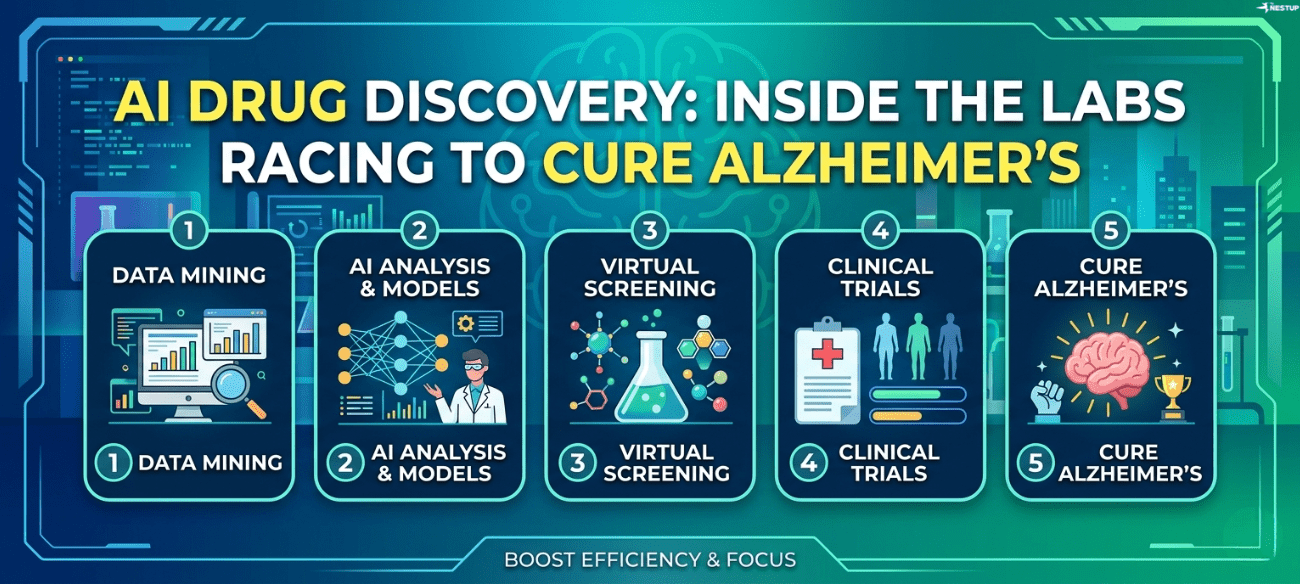
The Hook: A Decades-Old Deadlock
Alzheimer’s disease remains the graveyard of modern pharmacology. For decades, the search for a cure has been defined by a staggering, nearly absolute failure rate. Billions of dollars have been liquidated into research that led nowhere, with thousands of drug candidates collapsing in clinical trials. Even the industry’s "North Star"—the theory that clearing amyloid-beta plaques would solve the crisis—has been battered by years of disappointing results where drugs successfully cleared plaques but failed to stop cognitive decline.
In this landscape of stagnation, artificial intelligence is emerging not merely as a "spreadsheet analyzer" for faster data entry, but as a catalyst for a radically different approach. We are witnessing a transition from the old-school trial-and-error method to a period of predictive, AI-native drug discovery. This isn't just about doing things faster; it’s about rewiring our fundamental understanding of a disease that has outsmarted human intuition for over a century.
Speeding Through the "Impossible" Timeline
The traditional pharmaceutical pipeline is a grueling marathon, often taking five to ten years just to move from a biological hypothesis to a viable drug candidate. AI is beginning to collapse these timelines by simulating molecular interactions in silicon before a single petri dish is touched.
A primary example of this acceleration comes from Insilico Medicine. While the company is now applying its tech to the "brutal difficulty" of Alzheimer's, it recently proved the model’s viability by moving an AI-generated candidate for fibrosis from target discovery to preclinical nomination in just 18 months. This speed is a paradigm shift for the economics of medicine; it allows biotech firms to test more radical ideas and fail faster, ensuring only the most robust theories survive the jump to the lab.
"Because while AI may dramatically improve parts of the drug discovery pipeline, biology remains brutally difficult."
Finding the "Hidden Patterns" in Human Complexity
Traditional research often failed because it treated Alzheimer's as a monolithic enemy. However, human biology is too interconnected for a single-track mind to model. AI is now being used to "find the door" by mapping relationships between genes, proteins, and pathways that were previously invisible to the human eye.
Companies like BenevolentAI and Recursion Pharmaceuticals are leading this charge. BenevolentAI uses "knowledge graphs" to mine vast datasets—from medical records to scientific literature—to uncover non-obvious therapeutic opportunities. This tech stack gained critical validation during the COVID-19 pandemic when it rapidly identified existing drugs with antiviral potential. Meanwhile, Recursion Pharmaceuticals utilizes automated laboratories and machine vision to detect cellular patterns far too subtle for human observers. This shift allows us to move beyond the amyloid-only narrative, treating Alzheimer’s as it likely is: a complex interplay of "multiple overlapping diseases" involving inflammation, vascular dysfunction, and protein misfolding.
The Generative Shift: Designing Molecules, Not Just Screening Them
If target identification is "finding the door," generative AI is "printing the key." We are moving away from manual screening—where scientists tested millions of existing compounds to see what "stuck"—to an era of de novo molecular design.
AI-native pharmaceutical companies now use generative models to optimize for multiple high-stakes variables simultaneously:
- Binding Affinity: Ensuring the drug sticks to its biological target.
- Blood-Brain Barrier Penetration: Solving the "delivery problem" by ensuring molecules can actually reach the brain.
- Failure Prediction: This is perhaps the most critical economic driver. AI models now predict metabolic instability, toxicity, and off-target interactions early, identifying "clinical failure risks" before they consume billions in late-stage trials.
The Reality Check: Why Biology is "Noisy"
Despite the Silicon Valley narrative of "disruption," neuroscience remains uniquely resistant to digital shortcuts. There is a fundamental "Data Problem" that makes AI drug discovery far harder than building a chatbot or an image generator.
Unlike the relatively clean, massive datasets used to train Large Language Models (LLMs), biological data is "noisy." In Alzheimer's research, data is often fragmented, inconsistent, and difficult to standardize. While an LLM trains on the collective text of the internet, a neuro-AI must contend with limited brain tissue access and the fact that Alzheimer’s develops over decades, making high-quality longitudinal data nearly impossible to come by. If the underlying biological data is incomplete or the scientific model is flawed, even the most advanced algorithm cannot compute its way to a cure.
The Hybrid Future: Human Intuition Meets Machine Scale
The most effective model for the next decade of discovery is not a machine working in isolation, but a "hybrid intelligence" model. This partnership leverages the unique strengths of both parties to bridge the gap between digital prediction and physical reality.
AI excels at pattern detection, multi-variable optimization, and large-scale search through billions of possibilities. Human scientists, however, remain the masters of hypothesis generation, clinical reasoning, and the "experimental judgment" required when an algorithm hits a biological wall. This combination is the true future of the lab—an industrial-scale computational engine steered by human intuition.
"Biological breakthroughs still depend heavily on laboratory science, not just algorithms."
Conclusion: A Revolutionary Increment
As we look toward the future, we must reconcile AI’s light-speed discovery with the "FDA Reality." Even if AI designs a perfect molecule today, the U.S. Food and Drug Administration requires years of evidence for safety and efficacy. Because Alzheimer's is a slow-moving disease with endpoints that are difficult to measure, many therapies entering the pipeline now will not reach the public until the 2030s.
The breakthrough likely won't be a single, cinematic "cure" discovered in a flash of digital insight. Instead, progress will be a series of "revolutionary increments": earlier detection, better-selected targets, and lower R&D costs that allow for more shots on goal. We are finally moving from guessing to calculating.
If AI can turn the tide by making discovery more efficient and personalized, isn't that the breakthrough we’ve been waiting for?